Content last revised on September 17, 2026
Assembly Integrity and Layout Architecture for 5STP 04D5200 Heat Dissipation
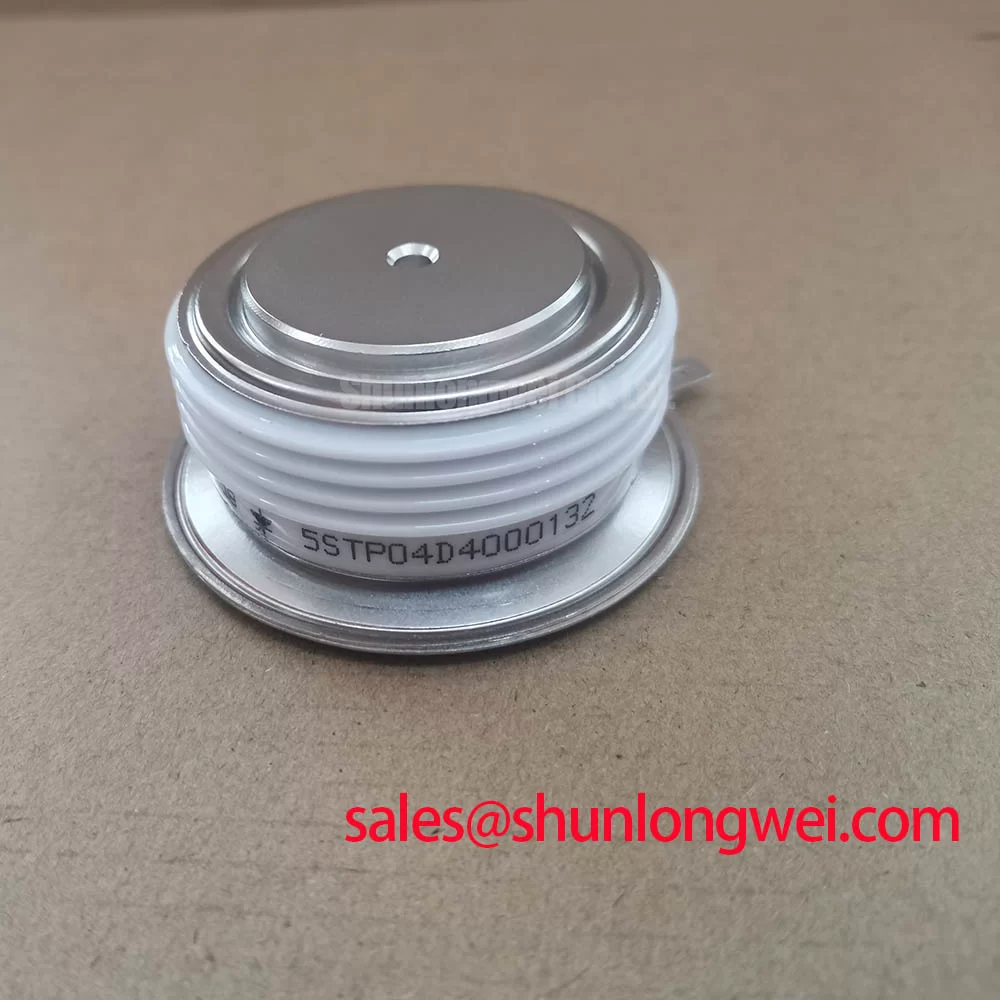
The 5STP 04D5200 is an ABB press-pack thyristor rated at VDRM = 5200 V and ITAV = 410 A at Th = 70 °C, according to the official specification. Its double-sided junction-to-case thermal resistance is specified as 32 K/kW. This value describes the device's thermal path only under the stated mounting condition; it does not define the thermal capability of a complete soft starter cabinet.
For a stopped high-voltage three-phase motor solid-state soft starter, begin by checking that both heatsink faces are flat, clean, and aligned with the press-pack axis. Uneven pressure can leave part of the thermal interface poorly coupled even when the thyristor itself is electrically functional. Apply the thermal interface material as a controlled, thin, continuous layer in accordance with the material supplier's instructions and the equipment manufacturer's service procedure. The purpose is to fill unavoidable surface irregularities, not to create a thick thermal barrier.
The official clamping-force range for this ABB unit is 8 to 12 kN. This is an official specification, and the installed force should be established through the original clamp geometry, spring stack, and tightening procedure. Bolt torque alone is not interchangeable with clamping force because screw size, lubrication, washers, thread condition, and the clamp mechanism all affect the result.
Field Alert: Do not energize a press-pack thyristor assembly after tightening by feel alone; verify that the installed clamping system produces force within the specified 8 to 12 kN range.
Design Consideration: maintain adequate creepage and clearance around energized buswork at the actual system voltage, contamination level, enclosure condition, and applicable installation standard. The 5200 V repetitive peak off-state rating is an official device boundary, while cabinet insulation distances, barriers, and bus support geometry remain system-level responsibilities. Guidance from the VDE Association for Electrical, Electronic & Information Technologies can help engineers identify applicable electrical safety and testing requirements for the finished equipment.
When reviewing a thermal issue, measure heatsink temperatures on both sides under comparable operating conditions and examine the clamp stack for tilt, displaced springs, or uneven contact marks. A difference between sides may indicate an assembly or cooling-path concern, but should be confirmed against the original machine layout and known-good operating measurements. For test-method context, the JEDEC JESD51 thermal test method describes established approaches for characterizing thermal behavior of electrical components.
Benchtop Waveform Tuning for Power Factor and Harmonic Control
In a phase-angle controlled soft starter, the firing angle changes the portion of each AC waveform applied to the motor. As firing is delayed from the early part of the waveform toward later conduction angles, the motor receives less effective voltage and the input current waveform becomes more distorted. This can reduce displacement power factor and increase reactive demand, so the commissioning engineer should capture voltage, current, and firing-reference waveforms together rather than judging behavior from current magnitude alone.
The ABB 5STP 04D5200 has an official critical off-state voltage rise capability of dv/dt = 1000 V/µs. This rating must be treated as a device specification, not as a substitute for waveform validation in the installed cabinet. Trigger timing, phase balance, busbar layout, source impedance, and motor cable conditions can influence the voltage transition seen by each thyristor.
Engineering Recommendation: during controlled bench commissioning, compare each phase pair at the same firing command and record whether the voltage recovery and current transfer are consistent. A delayed or irregular turn-on event may relate to gate-drive timing, control reference integrity, line conditions, or the connected load. Verification with isolated measurement equipment and the OEM schematic is required before assigning a single cause.
For systems using a rectified front end or related high-current conversion stage, the SSIL2890S46C can be evaluated as a separate complementary component. Its suitability depends on the actual topology, voltage class, current path, cooling arrangement, and original protection scheme; it is not an assumed replacement for the ABB thyristor.
Where optical isolators or digital isolators carry firing commands across control and power domains, Design Consideration requires checking their common-mode transient behavior against measured switching conditions. The control board, firing transformer or isolation stage, snubber path, and power layout must be assessed as one signal chain. A clean low-voltage command at the controller does not by itself prove correct gate behavior at the power device.
Mechanical Torque Shock Reduction in High-Voltage Motor Soft Starters
A high-voltage three-phase motor solid-state soft starter can use phase-angle control to moderate motor acceleration compared with direct line starting. During evaluation, engineers commonly assess whether the starter limits the locked-rotor demand that can otherwise reach several times rated motor current. The achievable current limit, acceleration profile, and resulting mechanical torque are determined by the motor, driven load, utility supply, bypass arrangement, and control strategy, not by the 5STP 04D5200 alone.
The official specified non-repetitive surge current is ITSM = 8.5 kA under the applicable datasheet test conditions. This value is valuable for reviewing fault and transient withstand boundaries, but it must not be interpreted as a permitted repetitive operating current. Protection coordination should be checked against the original fuse data, including the fuse I2t characteristics, prospective fault current, controller response, and the specific series connection of devices in each phase path.
Before returning a repaired starter to service, inspect phase bus joints, clamp hardware, gate-control wiring, cooling-air paths, and bypass-contactor sequencing. Thermal discoloration, loosened connections, or unequal phase measurements can point to more than one potential issue. Verify the results against the equipment schematic and measurements from a confirmed working phase where available.
For a comparison during an equipment-specific repair review, the SKT340/18E provides another thyristor-module reference point. Electrical rating, mounting method, terminal configuration, thermal interface, gate requirements, protection coordination, and system qualification must all be checked before any substitution decision.
Preventing Spurious Faults Through RC Snubber and Layout Review
RC snubber networks and series inductive elements are often used in controlled thyristor circuits to manage transient voltage rise, commutation behavior, and unwanted triggering risk. For the 5STP 04D5200, the official 1000 V/µs critical dv/dt rating establishes an important device boundary. The final snubber resistance, capacitance, reactor selection, and physical placement must be determined from measured system waveforms and validated against peak voltage margins during switching tests.
Design Consideration: keep the transient-current loop physically compact where the topology requires it, because distributed inductance in buswork and interconnects can add voltage overshoot during rapid current change. Confirm the result with appropriately rated differential voltage probes and current measurement methods. Probe grounding, bandwidth, and measurement location can materially alter what appears on an oscilloscope screen.
In a soft starter, a fault indication during commutation may be associated with several interacting conditions, including snubber degradation, unbalanced firing, supply disturbance, wiring errors, gate-path interference, or a changed load condition. Inspect capacitor condition, resistor connections, reactor continuity, and phase-to-phase waveform consistency before changing component values. The module's 5200 V VDRM rating should be checked against actual measured off-state stress, including expected line transients and cabinet operating conditions.
For broader maintenance and application context involving industrial power semiconductors, refer to Industrial Applications. The final acceptance decision should remain based on the original ABB documentation, the host equipment schematic, measured waveforms, and the verified protection and cooling configuration.