

Content last revised on February 27, 2026
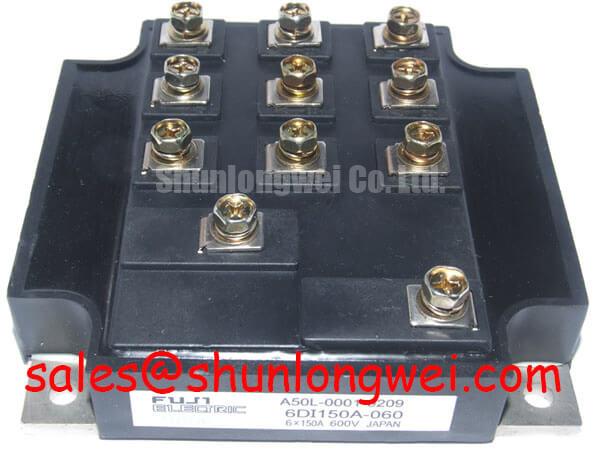
6DI150A-050 Fuji Electric 150A 500V Power Transistor Module Engineering Overview
The 6DI150A-050, a high-performance power transistor module from Fuji Electric’s 6DI series, provides a robust 500V and 150A switching solution specifically designed for industrial power conversion. By integrating six Darlington transistors into a single package, it serves as a critical bridge component for AC/DC motor drives and uninterruptible power supplies (UPS). This module is characterized by its low collector-emitter saturation voltage, which directly minimizes conduction losses during high-current operation. What is the primary benefit of its Darlington structure? It enables high current gain at significant power levels, simplifying the required base-drive circuitry compared to discrete configurations. For industrial systems requiring a balance of high current density and thermal stability, the 6DI150A-050 represents a time-tested architecture for medium-voltage applications.
Application Scenarios & Value
Optimizing Energy Efficiency in Industrial Motor Drives and UPS Systems
The 6DI150A-050 is frequently utilized in high-fidelity engineering scenarios such as the output stage of a Variable Frequency Drive (VFD). In these applications, the module must handle the significant inrush currents associated with inductive motor loads. With a continuous collector current rating of 150A, it provides the necessary overhead to manage motor starting surges without triggering desaturation or thermal runaway. Engineers often leverage the six-pack configuration to simplify the physical layout of three-phase inverters, reducing parasitic inductance and improving EMI performance.
In the context of Uninterruptible Power Supplies (UPS), the 6DI150A-050 ensures a reliable transition between grid power and battery backup. The 500V rating is particularly suitable for systems operating on 200-240V AC lines, providing an ample safety margin against transient voltage spikes. For designers who may require higher voltage handling for 400V or 480V systems, the related 6DI150AH-060 offers an increased Vces of 600V. By integrating this module into power stages, manufacturers can achieve significant system-level benefits, including reduced footprint and streamlined assembly. This alignment with industrial standards is further discussed in our technical guide on high-efficiency power systems.
Key Parameter Overview
Decoding the Specs for Enhanced Thermal Reliability
The engineering value of the 6DI150A-050 is best understood through its maximum ratings and thermal characteristics. The following table summarizes the essential specifications derived from the official Fuji Electric documentation.
| Parameter | Official Specification | Engineering Impact |
|---|---|---|
| Collector-Emitter Voltage (Vcex) | 500V | Ensures robust operation on standard industrial low-voltage grids. |
| Collector Current (Ic) | 150A | Supports heavy-duty switching for large inductive loads. |
| Collector Power Dissipation (Pc) | 800W (per element) | High power density requires precise thermal management. |
| Saturation Voltage (Vce sat) | Typical 2.0V to 2.5V | Low conduction losses contribute to overall system efficiency. |
| Thermal Resistance (Rth j-c) | Max 0.16 °C/W | Facilitates efficient heat transfer to the cooling assembly. |
| Operating Junction Temp (Tj) | Up to +150°C | Maintains performance under stressful environmental conditions. |
Technical Deep Dive
The Engineering Behind Low Collector-Emitter Saturation Voltage
The internal architecture of the 6DI150A-050 utilizes a Darlington pair configuration to achieve high current amplification. To explain the Vce(sat) of 2.0V using a practical analogy: imagine a large industrial water valve. If the valve is partially clogged, it takes more energy to push water through (loss). The 6DI150A-050 acts like a high-flow, precision-machined valve that opens wide with minimal resistance, ensuring that the "flow" of 150A current incurs very little energy loss as heat.
Furthermore, the Thermal Resistance (Rth j-c) of 0.16 °C/W is critical for long-term reliability. A low thermal resistance means the internal junction can effectively "shed" heat to the external heatsink. In a high-frequency switching environment, even a small increase in resistance can lead to localized hotspots. By maintaining a tight Rth(j-c), the 6DI150A-050 allows engineers to use more compact heatsinks while maintaining a safe operating temperature, which is a core principle in modern thermal management design.
Application Vignette
Managing High-Inrush Loads in Heavy Industrial Machinery
Consider an engineer designing a control system for a heavy industrial conveyor. During startup, the motors demand a massive amount of current to overcome static friction. If the power module cannot handle this surge current, the voltage drop across the transistor increases, leading to potential failure. The 6DI150A-050, with its 150A continuous rating and robust peak current capability, handles these transients with ease.
The integrated Fast Recovery Diodes (FRD) within the module provide a safe path for inductive "kickback" current when the transistors switch off. This protection prevents voltage spikes from exceeding the 500V limit. This specific combination of current handling and integrated protection makes the 6DI150A-050 a reliable choice for servo drives and robotic controllers. For more insights on choosing between different transistor technologies for these roles, see our analysis on IGBT vs. MOSFET vs. BJT.
FAQ
Addressing Technical Queries for Long-Term Operation
How does the Rth(j-c) of 0.16 °C/W directly impact heatsink selection and overall system power density?
A lower Rth(j-c) like 0.16 °C/W allows for faster heat dissipation from the silicon die to the baseplate. In practical terms, this means you can either drive the 6DI150A-050 at higher currents within the same thermal envelope or reduce the size and weight of your cooling system, thereby increasing the power density of the entire inverter cabinet.
Is the 500V Vcex rating sufficient for 380V three-phase industrial applications?
Generally, a 500V rating is considered tight for 380V/400V AC lines due to the rectified DC bus voltage reaching approximately 540V. For 380V-480V AC systems, engineers typically prefer 1200V modules. The 6DI150A-050 is best suited for 200V-240V AC input systems where the DC bus remains well below the 500V ceiling.
Does the 6-pack bridge configuration affect the base drive circuit design?
Yes, because the 6DI150A-050 integrates six Darlington pairs, the designer must ensure isolated base drives for the upper three transistors in the bridge. Since these are bipolar transistors, they require a constant base current to remain in saturation, unlike voltage-controlled IGBTs. This requires a drive circuit capable of delivering steady current rather than just a voltage pulse.
The 6DI150A-050 remains a foundational component for engineers maintaining or designing power stages where high current gain and electrical robustness are paramount. By providing a clear path for thermal energy and high current loads, it ensures the longevity of industrial automation systems.