
Content last revised on September 10, 2026
BSM100GB120DN2: A Deep Dive into the 1200V, 100A EconoPACK™ 2 IGBT Module
Introduction: Core Specifications and Engineering Value
Optimized for Efficiency and Thermal Stability in Demanding Drive Applications
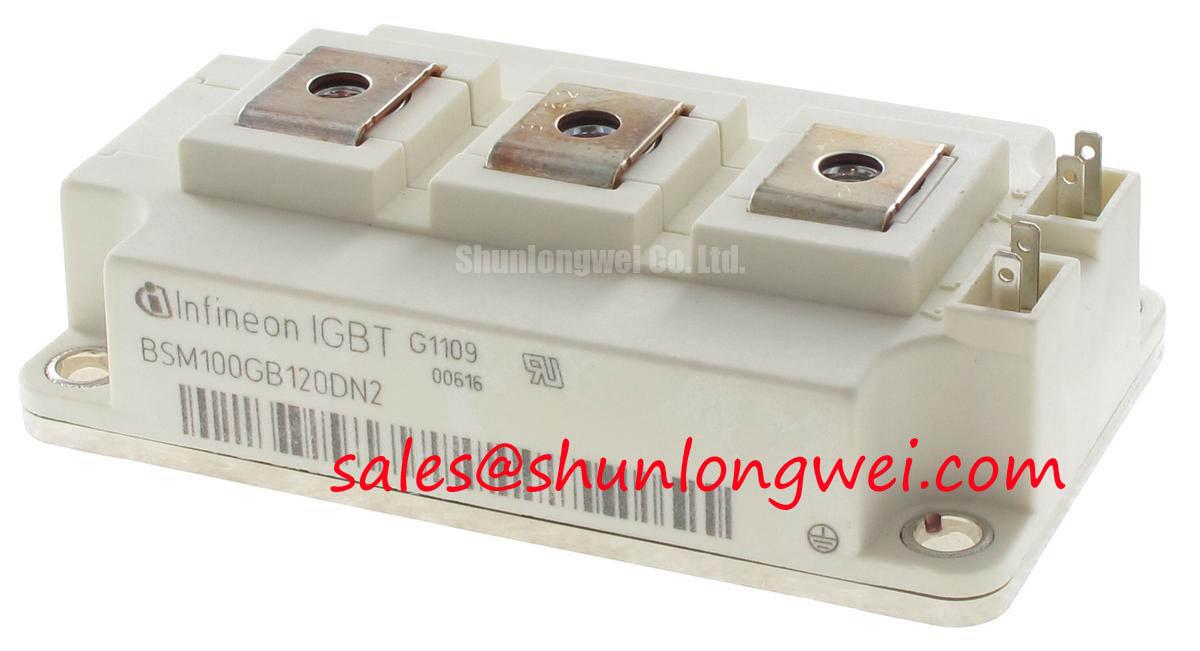
The BSM100GB120DN2 is a high-performance dual IGBT module engineered to deliver a precise balance of efficiency, thermal performance, and reliability. Featuring core specifications of 1200V and 100A nominal current, this module integrates Infineon's TrenchSTOP™ IGBT3 technology to achieve a low typical collector-emitter saturation voltage (VCE(sat)) of 1.70V at its nominal current. This key characteristic directly minimizes conduction losses, a critical factor in the overall efficiency of power conversion systems. Its design also incorporates a fast-switching Free-Wheeling Diode (FWD) and an integrated NTC thermistor for accurate, real-time temperature monitoring. For mid-power industrial motor drives and UPS systems where thermal margin and energy efficiency are primary design constraints, the BSM100GB120DN2 provides a robust and well-documented power switching solution.
Key Parameter Overview
Translating Datasheet Values into System-Level Performance
The technical specifications of the BSM100GB120DN2 are foundational to its performance in real-world applications. Each parameter has a direct implication for the design of the surrounding system, from the gate driver to the thermal management solution. Understanding these values is key to unlocking the module's full potential.
| Parameter | Value | Engineering Interpretation & Value |
|---|---|---|
| Collector-Emitter Voltage (Vces) | 1200V | Provides a substantial safety margin for applications operating on 400V to 575V AC lines, ensuring reliability against voltage transients common in industrial environments. |
| Nominal Collector Current (Ic nom) | 100A | Defines the module's primary current handling capability, making it suitable for motor drives in the 30 kW to 45 kW power range, depending on switching frequency and cooling. |
| Collector-Emitter Saturation Voltage (VCE(sat), typ. @ Ic nom) | 1.70V | A critical indicator of efficiency. This low value directly reduces conduction power loss (P = VCE(sat) * Ic), leading to less waste heat and potentially smaller heatsink requirements. |
| Total Switching Losses (Ets, typ. @ Ic nom) | 16.50 mJ | Represents the energy lost during turn-on and turn-off events. This value is crucial for calculating thermal load in high-frequency applications like modern Variable Frequency Drives (VFDs). |
| Thermal Resistance, Junction-to-Case (Rth(j-c)) per IGBT | 0.43 K/W | This parameter acts like the bottleneck on a heat-flow highway. A lower Rth(j-c) indicates a more efficient path for heat to travel from the active silicon chip to the module's baseplate, simplifying thermal design. |
| Short Circuit Withstand Time (tsc) | 10 µs | Defines the module's robustness against fault conditions. This 10 microsecond window provides critical time for protection circuits to detect a short circuit and safely shut down the system before catastrophic failure. |
Download the BSM100GB120DN2 datasheet for detailed specifications and performance curves.
Application Scenarios & Value
System-Level Benefits in Industrial Power Conversion
The BSM100GB120DN2 is engineered specifically for the demanding environments of industrial power electronics. Its primary value is realized in applications where operational uptime, energy efficiency, and compact design are not just goals, but necessities.
A prime engineering scenario is the development of a compact, high-efficiency Variable Frequency Drive (VFD) for conveyor or pumping systems. In such applications, control cabinets are often space-constrained, making thermal management a significant challenge. The BSM100GB120DN2's low VCE(sat) of 1.70V directly reduces the thermal load on the heatsink. This allows engineers to either design a smaller, more cost-effective cooling system or increase the power density within the existing enclosure. Furthermore, the integrated NTC thermistor simplifies the control board design by eliminating the need for an external temperature sensor, providing a more accurate and reliable signal for thermal protection algorithms. This direct feedback mechanism is crucial for preventing overheating under sustained load conditions, thereby enhancing the long-term reliability of the entire drive system. For systems demanding higher power output, the BSM200GB120DN2 offers a similar feature set with double the nominal current handling capability.
- Industrial Motor Drives: The module's balance of switching and conduction performance is ideal for AC induction and permanent magnet motor control.
- Uninterruptible Power Supplies (UPS): Its high reliability and 1200V blocking voltage ensure robust performance in inverter stages for critical power backup systems.
- Solar and Wind Inverters: Delivers efficient DC/AC power conversion necessary for renewable energy grid integration.
- Welding Equipment: The module's ability to handle high pulse currents makes it suitable for advanced welding power supplies.
Frequently Asked Questions (FAQ)
How does the typical VCE(sat) of 1.70V directly impact the thermal design of a power inverter?
A lower VCE(sat) directly reduces conduction losses, which are a major source of waste heat. For a given current, the BSM100GB120DN2 generates less heat than modules with higher saturation voltages. This allows engineers to specify smaller, lighter, and lower-cost heatsinks, or alternatively, to run the module at higher output power with the same cooling solution, increasing power density.
What is the primary benefit of the integrated NTC thermistor in the BSM100GB120DN2?
The integrated NTC thermistor provides a direct, real-time measurement of the module's internal temperature close to the IGBT chips. This enables more precise and rapid thermal protection, preventing the device from exceeding its maximum junction temperature. It simplifies system design by removing the need for external sensors and provides a more reliable foundation for implementing over-temperature shutdown and thermal rollback features in the control logic.
Is the BSM100GB120DN2 suitable for high-frequency switching applications above 10 kHz?
Yes, but with careful design considerations. The module utilizes TrenchSTOP™ IGBT3 and a fast recovery freewheeling diode, which are optimized for a balance between low conduction losses and moderate switching speeds. While suitable for typical motor drive frequencies (4-16 kHz), operating at higher frequencies will increase switching losses (Ets). This requires a robust gate drive design and a thorough thermal analysis to ensure the junction temperature remains within the specified Safe Operating Area (SOA).
What are the key considerations for paralleling these modules for higher current capacity?
While possible, paralleling IGBT modules requires careful engineering. Key considerations include ensuring symmetrical layout to balance stray inductances, using gate resistors with tight tolerances to ensure matched switching times, and implementing a thermal design that keeps all paralleled modules at a similar temperature. The positive temperature coefficient of the VCE(sat) in IGBTs provides some inherent self-balancing, but layout and gate drive symmetry are paramount for reliable long-term operation.
How does the EconoPACK™ 2 housing contribute to system reliability?
The EconoPACK™ 2 package is an industry-standard housing known for its robust construction and low thermal resistance. It features a flat copper baseplate for excellent thermal contact with a heatsink and provides industry-standard terminal layouts that simplify bus bar and PCB design. This standardization and proven design contribute to simplified assembly and predictable, reliable thermal performance in industrial environments.
Technical Deep Dive
An Inside Look at TrenchSTOP™ IGBT3 Technology
The performance of the BSM100GB120DN2 is largely defined by its core silicon: the Infineon TrenchSTOP™ IGBT3. This technology represents a significant evolution in power switching devices. Unlike older planar IGBTs, the TrenchSTOP design creates a vertical trench gate structure. This increases the density of cells on the chip, leading to a much lower VCE(sat) for a given current. It's like redesigning a city grid from wide, inefficient streets to a dense network of multi-lane highways; the same area can now handle significantly more traffic with less congestion. This "traffic" is the flow of current, and "congestion" is the electrical resistance that generates heat. The "Field-Stop" layer, an additional feature, allows for a thinner silicon wafer, which reduces switching losses, particularly the turn-off energy (Eoff), enabling efficient operation in the mid-range frequency band typical for motor drives.
Application Vignette
Enhancing Reliability in a 30kW Servo Drive System
Consider a high-precision Servo Drive used in a CNC milling machine, a core component in modern industrial automation. This application demands rapid acceleration and deceleration, leading to high current peaks and significant thermal cycling. The primary engineering challenge is to manage these thermal stresses to ensure a 10+ year operational lifespan. The BSM100GB120DN2 is exceptionally well-suited for this challenge. Its low thermal resistance (Rth(j-c)) of 0.43 K/W ensures that the heat generated during peak loads is efficiently transferred away from the silicon. When combined with the accurate feedback from the integrated NTC, the drive's control system can implement a sophisticated thermal rollback strategy. Instead of a hard shutdown upon reaching a temperature limit, the controller can slightly reduce the peak current to maintain operation within the Safe Operating Area, preventing unnecessary downtime while protecting the power stage. This intelligent thermal management, enabled by the module's inherent characteristics, is a cornerstone of building highly reliable and precise motion control systems.
From a design perspective, the robust architecture of this module provides the necessary foundation. Engineers can focus on refining control algorithms rather than compensating for thermal limitations, confident in the power stage's ability to handle the rigorous demands of high-performance servo applications.