
Content last revised on February 8, 2026
CM1000HA-25H: Mastering High-Current Power Conversion
An In-Depth Engineering Review of the 1200V Single IGBT Module
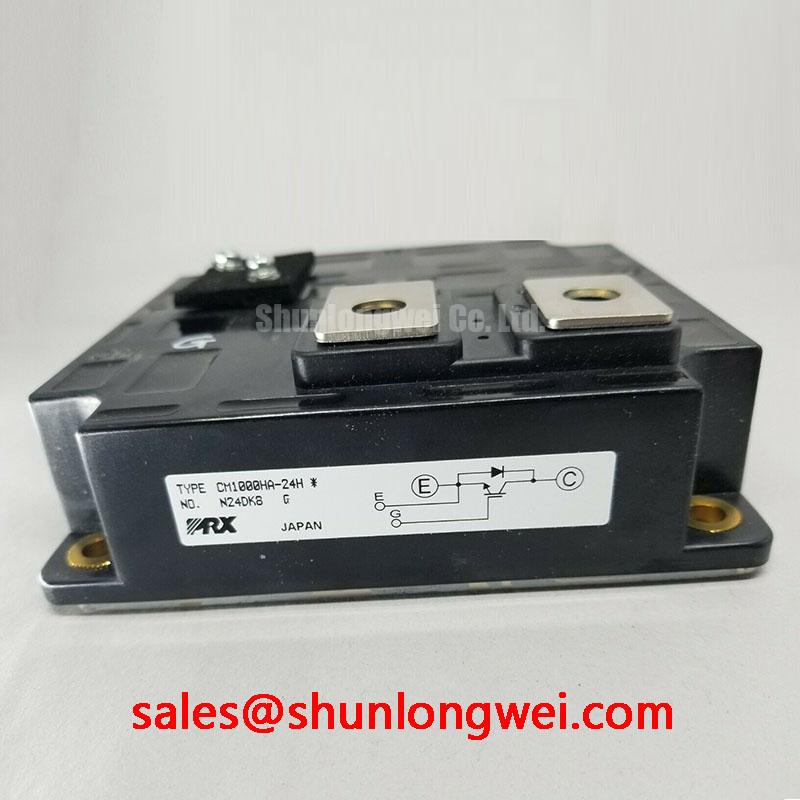
The CM1000HA-25H is a high-power H-Series IGBT Module from Mitsubishi, engineered to deliver robust performance in demanding, high-current switching applications. This module provides a formidable combination of 1200V collector-emitter voltage and a continuous collector current of 1000A, with a low typical VCE(sat) of 2.2V. Its primary engineering benefits include minimized conduction losses and simplified thermal design, crucial for enhancing system-level efficiency and reliability. For systems requiring robust switching in the megawatt class, this single IGBT configuration offers a streamlined alternative to complex paralleled arrays. What is the best application for this module? For high-power Variable Frequency Drives (VFDs) where minimizing component count and maximizing efficiency are paramount, the CM1000HA-25H is an optimal design choice.
Key Parameter Overview
Decoding the Specs for Enhanced Switching Performance
The technical specifications of the CM1000HA-25H are foundational to its performance in high-power systems. The values presented below are extracted from the official datasheet and are critical for accurate system modeling, thermal analysis, and performance prediction.
| Parameter | Value |
| Collector-Emitter Voltage (Vces) | 1200V |
| Continuous Collector Current (Ic) | 1000A |
| Collector-Emitter Saturation Voltage (Vce(sat)) | 2.2V (Typ) at Ic=1000A |
| Gate-Emitter Voltage (Vges) | ±20V |
| Total Power Dissipation (Pc) | 4800W at Tc=25°C |
| Maximum Junction Temperature (Tj max) | 150°C |
Download the CM1000HA-25H datasheet for detailed specifications and performance curves.
Application Scenarios & Value
Achieving System-Level Benefits in High-Power Motor Control
The CM1000HA-25H is engineered for applications where high current handling and efficiency are non-negotiable. Its specifications make it a cornerstone component in a variety of high-power conversion systems.
- High-Power Variable Frequency Drives (VFDs): In multi-megawatt industrial drives for applications like mining conveyors, large-scale pumps, or steel rolling mills, the challenge is to reliably control massive induction motors. The CM1000HA-25H's 1000A current rating allows it to manage the immense power demands of a single inverter phase, often eliminating the need for complex and potentially unreliable paralleling of smaller modules. This simplifies the busbar layout, gate drive circuitry, and enhances overall system reliability.
- Renewable Energy Inverters: For utility-scale solar and wind power converters, maximizing energy conversion efficiency is paramount. The low VCE(sat) of this module directly translates to reduced conduction losses, meaning more generated power is delivered to the grid. Its robust thermal design ensures long-term reliability in harsh outdoor environments.
- Uninterruptible Power Supplies (UPS): In large data centers or critical industrial facilities, the module's capacity to handle high surge currents ensures the UPS can seamlessly take over the load during a power outage, protecting sensitive equipment.
By integrating a single, high-capacity module like the CM1000HA-25H, engineers can design more compact, efficient, and reliable high-power inverters. For applications with reduced current demands but requiring the same voltage class, the related CM600HA-24H offers a 600A alternative within the same product family.
Technical Deep Dive
Analyzing Conduction and Switching Losses for System Efficiency Optimization
In high-power inverter design, mastering the trade-offs between conduction and switching losses is crucial for achieving target efficiency and managing thermal loads. The CM1000HA-25H provides key specifications that empower engineers to precisely model and mitigate these losses.
The Collector-Emitter Saturation Voltage, VCE(sat), is a primary determinant of conduction loss. At a typical value of 2.2V at 1000A, this module exhibits efficient current conduction. Think of VCE(sat) as the "pressure drop" across the switch when it's fully open; a lower value is like a wider pipe, allowing current to flow with less resistance and generating less heat. This low VCE(sat) is critical for applications with high duty cycles, where the IGBT spends most of its time in the on-state.
Conversely, Switching Loss occurs during the transition between the on and off states. The datasheet specifies the turn-on (Eon) and turn-off (Eoff) energies, which are essential for calculating these losses. This can be compared to the energy required to open and close a heavy industrial door; the faster and more efficiently you can do it, the less energy is wasted in the process. By providing these values, Mitsubishi enables designers to accurately predict losses at different operating frequencies and optimize their Gate Drive design to balance switching speed against voltage overshoots and EMI generation.
Frequently Asked Questions (FAQ)
How does the 1000A rating of the CM1000HA-25H impact inverter design compared to using paralleled lower-current modules?
Using a single 1000A module simplifies the overall inverter design significantly. It eliminates the need for complex current-sharing mechanisms, matched gate driver channels, and intricate busbar layouts that are required when paralleling smaller modules. This leads to a more compact, reliable system with fewer points of failure.
What is the practical significance of the specified switching energy (Eon/Eoff) values in the datasheet?
The specified Eon (220mJ) and Eoff (300mJ) values allow engineers to precisely calculate switching losses (Power Loss = (Eon + Eoff) x Switching Frequency). This is critical for predicting the total thermal load on the module, designing an appropriate cooling system, and optimizing the inverter's operating frequency for the best balance between efficiency and performance.
With a power dissipation (Pc) of 4800W, what does this imply for the module's thermal design and reliability?
A high power dissipation capability of 4800W indicates a robust thermal interface between the IGBT die and the module's baseplate. It gives designers significant headroom for managing the heat generated from both conduction and switching losses, allowing for reliable operation at high currents or in challenging ambient conditions. This robust thermal performance is key to achieving a long operational lifespan.
For high-power system designs, the selection of a core switching component like the CM1000HA-25H is a strategic decision that influences efficiency, reliability, and total cost of ownership. This module provides the foundational current handling and thermal performance necessary to build next-generation inverters and motor drives that meet the increasing demands for power density and energy conservation in industrial and renewable energy sectors.