

Content last revised on September 10, 2026
Mitsubishi CM300DXD-24A: Technical Analysis of a 1200V Dual IGBT Module
CM300DXD-24A Datasheet, Specs & Analysis | 1200V 300A Dual IGBT Module
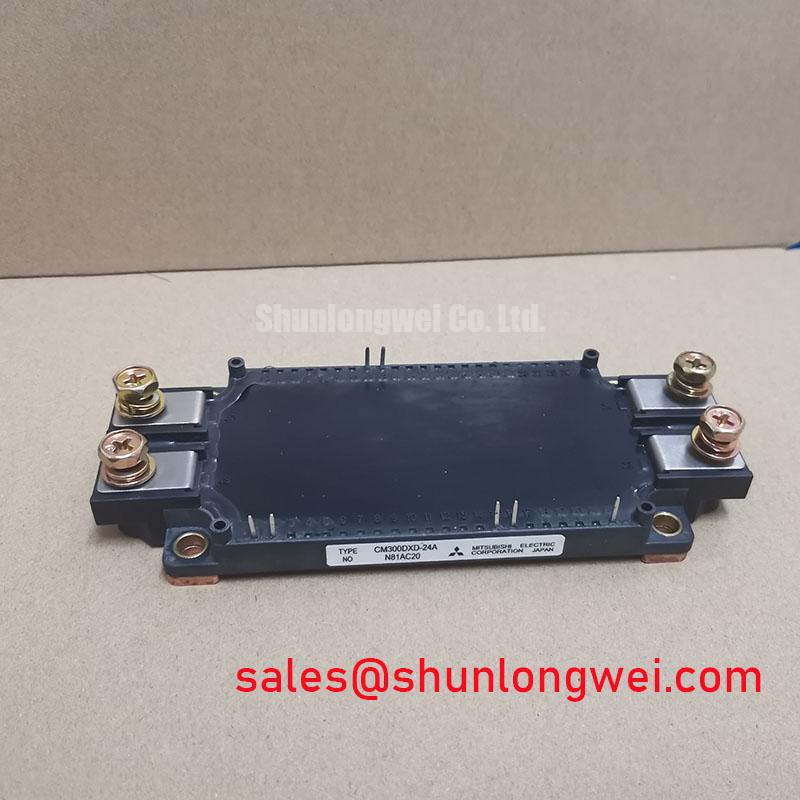
Engineered for high-power switching, the Mitsubishi CM300DXD-24A is a dual IGBT module designed to balance robust performance with high efficiency in demanding industrial applications. With its core specifications of 1200V | 300A | VCE(sat) 2.4V (Max), this module delivers a dependable foundation for power conversion systems. Its key benefits include effective thermal transfer and a durable insulated package. A primary concern for engineers designing motor drives or power supplies is achieving reliable operation without excessive thermal management costs. The CM300DXD-24A addresses this by combining a low thermal resistance with a high-current handling capability. For industrial drive systems in the 75-150 kW class, the module's robust thermal performance and dual configuration offer an excellent balance of power density and reliability.
Key Parameter Overview
Decoding the Specs for Enhanced Thermal Reliability
The technical specifications of the CM300DXD-24A underscore its suitability for high-stress power conversion topologies. The module's design prioritizes thermal efficiency and electrical stability. Below is a summary of key parameters sourced directly from the official manufacturer's datasheet, structured to highlight its performance characteristics under operational loads.
| Parameter | Value | Conditions |
|---|---|---|
| Absolute Maximum Ratings (Tj = 25°C) | ||
| Collector-Emitter Voltage (VCES) | 1200 V | - |
| Collector Current (DC) (IC) | 300 A | Tc = 87°C |
| Collector Power Dissipation (PC) | 1385 W | Per IGBT element |
| Electrical Characteristics | ||
| Collector-Emitter Saturation Voltage (VCE(sat)) | 1.90 V (Typ) / 2.40 V (Max) | IC = 300 A, VGE = 15 V, Tj = 125°C |
| Emitter-Collector Voltage (VEC) (FWDi) | 2.16 V (Typ) | IE = 300 A, Tj = 125°C |
| Short-Circuit Withstand Time (tsc) | ≥ 10 µs | VCC = 600 V, VGE = 15 V, Tj = 125°C |
| Thermal Characteristics | ||
| Thermal Resistance (Rth(j-c)) | 0.09 K/W (Max) | IGBT Part, Junction to Case |
| Thermal Resistance (Rth(j-c)) | 0.17 K/W (Max) | FWDi Part, Junction to Case |
Application Scenarios & Value
Achieving System-Level Benefits in Industrial Power Conversion
The Mitsubishi CM300DXD-24A is engineered for high-performance power control systems where efficiency and reliability are critical. Its dual-IGBT configuration makes it an ideal building block for half-bridge topologies, which are foundational to many power conversion systems, including Variable Frequency Drives (VFDs), servo amplifiers, and uninterruptible power supplies (UPS).
A high-fidelity engineering scenario for this module is the design of a VFD for a 110 kW AC induction motor. In this application, the inverter stage must handle continuous high currents, making thermal management a primary design challenge. The CM300DXD-24A's low thermal resistance (Rth(j-c)) of 0.09 K/W is a decisive factor. This parameter is analogous to the thermal conductivity of an insulator; a lower value signifies more efficient heat transfer from the active silicon chip to the module's baseplate. For a system designer, this directly translates into a more manageable thermal solution, enabling the use of a smaller, more cost-effective heatsink and improving the overall power density and long-term reliability of the VFD. While the CM300DXD-24A is well-suited for this power range, for higher-power applications, the related CM600DX-24T offers double the current-handling capability in a similar voltage class.
Technical Deep Dive
An In-Depth Look at Conduction Loss and Its System-Level Impact
A defining characteristic of the CM300DXD-24A is its optimization for low conduction losses, a factor directly tied to its Collector-Emitter Saturation Voltage (VCE(sat)) specification. To put this in perspective, think of the VCE(sat) as the "toll" the current pays to pass through the IGBT when it's fully turned on. A lower toll means more of the electrical energy reaches the load (e.g., the motor) and less is wasted as heat within the module. The datasheet specifies a typical VCE(sat) of 1.90V at its nominal 300A current and an elevated junction temperature of 125°C.
At full load, this parameter is a primary determinant of power dissipated as heat (Ploss = VCE(sat) * IC). The module's low VCE(sat) value directly contributes to higher overall system efficiency, a key requirement for meeting modern energy standards like IEC 61800-9-2. This efficiency gain not only reduces operating costs but also lessens the thermal burden on the entire system, allowing for more compact designs or increased operational headroom in high-ambient-temperature environments.
Frequently Asked Questions (FAQ)
What is the primary benefit of the module's 0.09 K/W thermal resistance?
Its low junction-to-case thermal resistance ensures highly efficient heat transfer away from the IGBT chips. This allows for smaller heatsink designs, increases power density, and enhances the module's long-term reliability by keeping junction temperatures lower during operation.
How does the 10µs short-circuit withstand time impact system design?
This rating provides a critical safety margin, ensuring the module can survive a direct short-circuit event for at least 10 microseconds. This gives the gate drive protection circuitry sufficient time to detect the fault and safely shut down the IGBT, preventing catastrophic failure and improving the robustness of the end application, such as a Servo Drive .
Is the CM300DXD-24A suitable for high-frequency switching applications?
The CM300DXD-24A is part of the A-Series from Mitsubishi, which is generally optimized for a balance between conduction and switching losses, making it suitable for typical motor drive frequencies (e.g., 2-15 kHz). For applications requiring significantly higher frequencies, a detailed analysis of switching losses (Eon, Eoff) from the datasheet curves is necessary to ensure thermal limits are not exceeded.
What does the "Dual" configuration in the CM300DXD-24A signify?
The "Dual" or half-bridge configuration means the module contains two IGBTs connected in series with their associated freewheeling diodes. This standard topology is the fundamental building block for one phase leg of a three-phase inverter, simplifying the power stage layout and reducing component count compared to using discrete devices.
For further inquiries or to discuss how the CM300DXD-24A can be integrated into your specific power conversion project, we encourage you to reach out to our technical support team for detailed assistance.