Content last revised on September 10, 2026
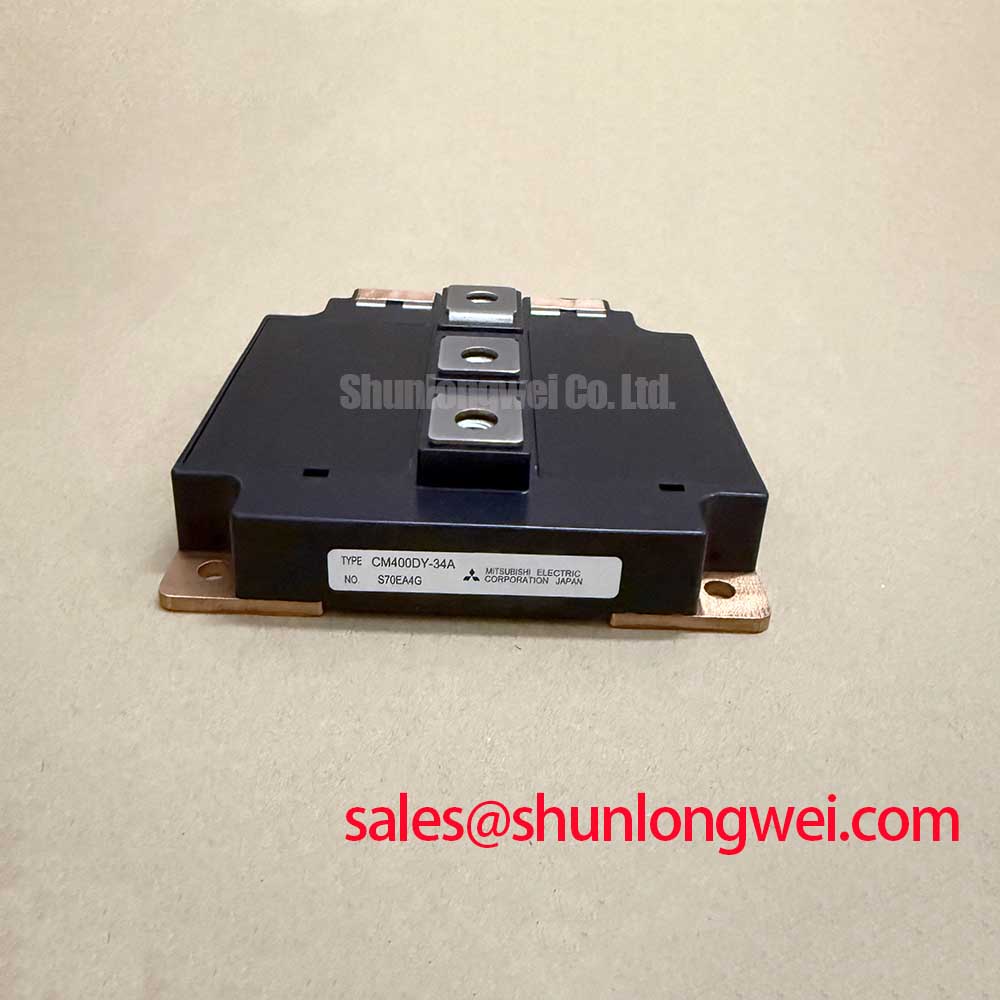
CM400DY-34T: A 1700V/400A Dual IGBT Module for High-Voltage Industrial Applications
Engineered for Efficiency and Reliability in 690V AC Systems
The Mitsubishi CM400DY-34T is a high-performance dual IGBT module from the 7th generation T-Series, engineered to deliver robust performance in demanding high-power switching applications. With core specifications of 1700V and 400A, this module provides the critical voltage headroom and current handling capacity required for systems operating on 690V AC industrial lines. Its integration of Mitsubishi's proprietary CSTBT™ (Carrier Stored Trench-Gate Bipolar Transistor) technology results in significantly reduced conduction losses and superior thermal stability. For engineers designing high-power Variable Frequency Drives (VFDs), solar inverters, or uninterruptible power supplies (UPS), this module offers a direct path to increased system efficiency and enhanced reliability. What is the primary benefit of its 1700V rating? It provides a crucial safety margin against voltage spikes common in heavy industrial environments, ensuring long-term operational integrity.
Engineered for high-voltage industrial inverters where thermal stability and efficiency are paramount, the CM400DY-34T's 1700V rating and low VCE(sat) make it an optimal choice.
Key Parameter Overview
Decoding the Specs for Enhanced Thermal and Electrical Performance
The performance of the CM400DY-34T is defined by key parameters that directly influence system efficiency and reliability. The collector-emitter saturation voltage (VCE(sat)) is exceptionally low for a 1700V device, which is a direct result of the 7th generation CSTBT™ chip technology. This minimizes the power lost as heat during the 'on' state, a critical factor in high-current applications. Think of VCE(sat) as the 'toll' the current pays to pass through the switch; a lower toll means less energy is wasted and more power is delivered to the load. The module also features a robust Safe Operating Area (SOA) and is UL recognized, ensuring reliable performance under demanding load conditions.
| Parameter | Value | Conditions | Engineering Significance |
|---|---|---|---|
| Collector-Emitter Voltage (VCES) | 1700V | VGE = 0V | Provides the essential voltage rating for safe and reliable operation in 690V AC line applications, offering a robust safety margin against transient overvoltages. |
| Collector Current (IC) | 400A | TC = 132°C | Enables high power throughput, making the module suitable for large-scale motor drives and high-capacity inverters. |
| Collector-Emitter Saturation Voltage (VCE(sat)) | Typ. 2.55V | IC = 400A, VGE = 15V, Tvj = 125°C | Indicates very low conduction losses, which leads to higher overall system efficiency and reduced cooling requirements. |
| Total Power Dissipation (Ptot) | 4345W | TC = 25°C | Highlights the module's capacity to handle significant power levels, directly impacting the maximum achievable output power of the inverter. |
| Isolation Voltage (Viso) | 4000Vrms | - | Ensures high electrical isolation between the power circuit and the mounting baseplate, enhancing system safety and compliance. |
| Maximum Junction Temperature (Tvj max) | 175°C | - | A high maximum junction temperature provides a greater thermal operating margin, allowing for more compact designs or higher ambient temperature operation. |
Download the CM400DY-34T datasheet for detailed specifications and performance curves.
Application Scenarios & Value
Achieving System-Level Benefits in High-Power Industrial Drives
The CM400DY-34T is engineered specifically for high-power, high-voltage applications where reliability and efficiency are non-negotiable. Its robust 1700V VCES rating makes it an ideal solution for the core of three-phase inverters connected to 690V AC industrial grids, commonly found in large manufacturing plants, water treatment facilities, and mining operations. In a high-power Variable Frequency Drive (VFD) controlling a multi-megawatt motor, the primary engineering challenge is managing thermal stress caused by power losses. The CM400DY-34T directly addresses this with its low VCE(sat) of 2.55V at 400A, minimizing conduction losses and, consequently, the heat generated. This translates to a smaller, less costly heatsink, a more compact inverter cabinet, and a lower total cost of ownership. The module's robust construction also makes it a strong candidate for renewable energy systems, such as wind turbine converters and large-scale solar inverters, which demand long service life under fluctuating load conditions. While the CM400DY-34T is optimized for 690V systems, applications operating on a standard 400V bus may find a suitable alternative in 1200V modules like the CM600DX-24T, which offers higher current handling in a lower voltage class.
Frequently Asked Questions (FAQ)
What is the primary advantage of the 1700V rating on the CM400DY-34T?
The 1700V rating provides a crucial safety margin for applications connected to 690V AC lines, protecting the module and the system from common industrial voltage transients and ensuring long-term reliability.
How does Mitsubishi's CSTBT™ technology benefit my design?
The Carrier Stored Trench-Gate Bipolar Transistor (CSTBT™) technology enables a superior trade-off between conduction loss (VCE(sat)) and switching speed. For the CM400DY-34T, this means lower heat generation during operation, leading to higher inverter efficiency and potentially simpler thermal management solutions.
Is this module suitable for paralleling to achieve higher current output?
Yes, the datasheet specifies options for VCE(sat) selection for parallel connection. This allows for tighter matching between modules, which is essential for ensuring balanced current sharing and preventing thermal runaway in high-current arrays. For detailed guidance, it is critical to consult resources on IGBT paralleling.
What does the dual or half-bridge configuration of the CM400DY-34T enable?
The dual switch (half-bridge) configuration is the fundamental building block for a three-phase inverter. Three CM400DY-34T modules can be used to construct a complete three-phase inverter bridge for applications like AC motor control.
What is the significance of the 175°C maximum junction temperature?
A high Tvj max of 175°C provides a significant thermal buffer, allowing the module to withstand temporary overload conditions and operate reliably in higher ambient temperatures. This enhances the overall robustness of the power system.
Technical Deep Dive
A Closer Look at 7th Gen CSTBT™ for Loss Reduction
At the heart of the CM400DY-34T lies Mitsubishi's 7th generation CSTBT™ technology, a key differentiator for this module. This advanced chip structure is engineered to optimize the distribution of charge carriers during the 'on' state, effectively lowering the collector-emitter saturation voltage (VCE(sat)) without a significant penalty in switching speed. This addresses a fundamental trade-off in IGBT design: traditionally, reducing VCE(sat) would lead to higher turn-off losses (Eoff). The CSTBT™ design mitigates this, allowing the CM400DY-34T to achieve low conduction losses, critical for applications with high duty cycles like motor drives. This efficiency can be visualized by comparing it to water flowing through a valve; VCE(sat) is like the pressure drop across the valve when fully open. A lower pressure drop means less energy is wasted as turbulence and heat, allowing more water (current) to flow efficiently. This translates directly to reduced thermal load on the heatsink and higher overall system efficiency, a core requirement in modern power conversion systems striving to meet stringent energy standards.
From an engineer's perspective, the CM400DY-34T is not just a set of specifications; it is a solution for thermal and electrical challenges in high-voltage designs. Its combination of a 1700V rating, low conduction losses, and a high-reliability package provides the necessary tools to build compact, efficient, and durable industrial inverters. The thoughtful engineering behind the T-Series ultimately simplifies the design cycle and enhances the end-product's performance in the field.