Content last revised on September 10, 2026
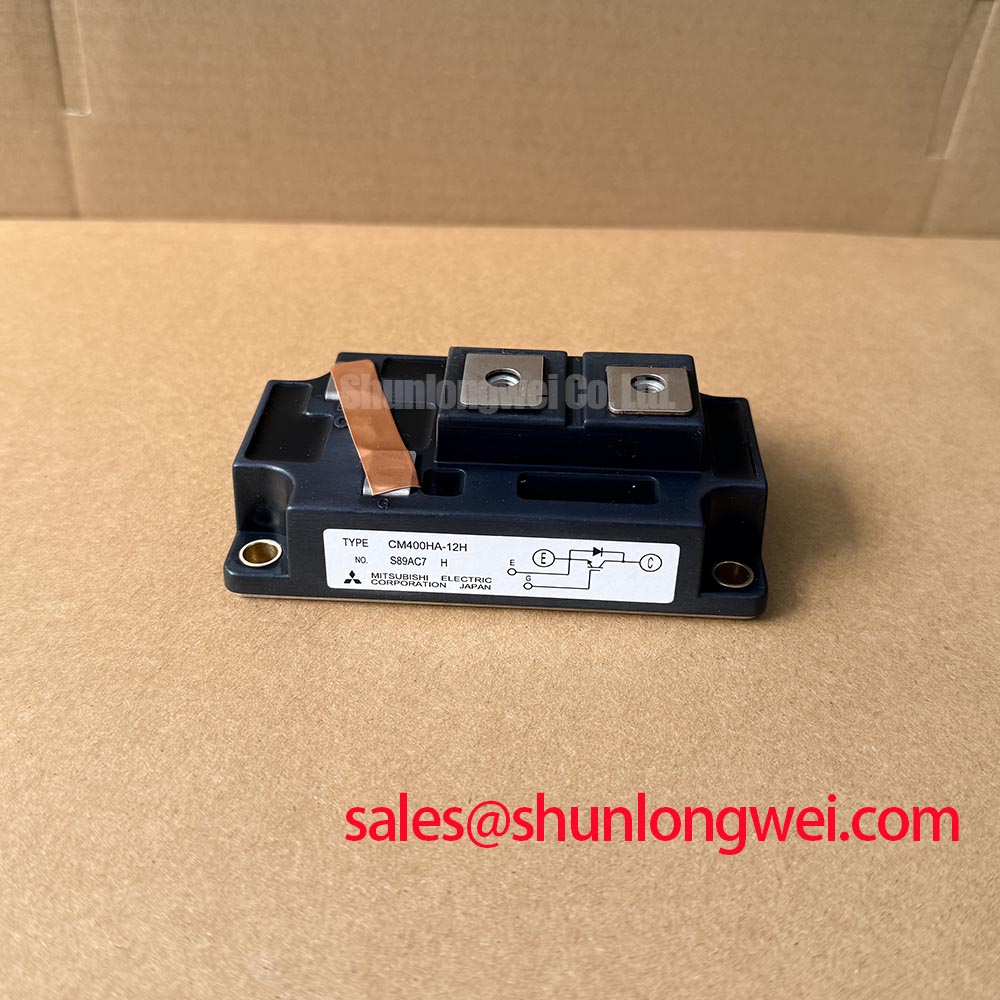
Mitsubishi CM400HA-12E Single IGBT Module | 600V 400A Power Control
This N-channel single module provides robust high-power switching for medium-voltage industrial applications requiring optimized thermal stability. By consolidating a single IGBT switch with an anti-parallel diode on an isolated copper baseplate, the CM400HA-12E simplifies mechanical layout and enhances electrical isolation up to 2500Vrms. For 400V inverter designs prioritizing thermal margin, this 600V, 400A module is the optimal choice.
Key Parameter Overview
Decoding the Specs for Enhanced Thermal Reliability
The following table outlines the key electrical and thermal specifications of the CM400HA-12E. These parameters highlight the module's performance limits and design envelopes under standard operating conditions.
| Parameter | Symbol | Rating / Typ. Value | Status / Impact |
|---|---|---|---|
| Collector-Emitter Voltage | VCES | 600V | Maximum off-state blocking voltage |
| Continuous Collector Current | IC | 400A (at Tc = 25°C) | High-current capacity for heavy loads |
| Collector-Emitter Saturation Voltage | VCE(sat) | 2.1V (Typ. at VGE = 15V) | Low conduction loss during on-state |
| Maximum Power Dissipation | Pc | 1500W (at Tc = 25°C) | Thermal dissipation capacity |
| Thermal Resistance (Junction-to-Case) | Rth(j-c) | 0.085°C/W (Per IGBT) | Excellent thermal transfer pathway |
| Isolation Voltage | Viso | 2500Vrms (AC 1 min) | Ensures safety and chassis protection |
Download the CM400HA-12E datasheet for detailed specifications and performance curves.
Application Scenarios & Value
Achieving High Power Density in Low-Voltage Inverters
Engineers designing low-voltage motor control systems often face severe space constraints and high thermal stress during starting phases. The single switch topology of the CM400HA-12E helps resolve these challenges in several systems, including AC motor drives, welding machines, and uninterruptible power supplies (UPS).
In heavy-duty AC motor drives, managing high starting surge currents is critical. The high continuous current rating of 400A ensures that the system handles motor start-up transients without triggering thermal shutdown. This helps industrial drives achieve compliance with international standards such as IEC 61800-3 for electromagnetic compatibility and drive system reliability. Furthermore, in high-power UPS designs, the CM400HA-12E works efficiently in the primary inverter stage, delivering clean output power under variable load conditions.
For systems requiring higher voltage handling, the related CM400HA-24H offers a higher voltage capability of 1200V. Alternatively, for mid-range power designs, the CM400HA-12H provides a similar 600V, 400A configuration within the H-series family.
Technical & Design Deep Dive
Analyzing Saturation Voltage and Switching Characteristics
The electrical behavior of the CM400HA-12E is defined by its low collector-emitter saturation voltage (VCE(sat)). To understand how VCE(sat) functions, think of it as the friction in a water pipe. A lower saturation voltage means less friction, allowing the 400A of current to flow through with minimal heat generation. How does low VCE(sat) affect system efficiency? It directly reduces on-state conduction losses, preventing excessive thermal dissipation during high-current operation.
This low forward voltage drop minimizes conduction losses, making the module suitable for continuous power transmission. When evaluating the overall efficiency, engineers must perform a thorough decoding of IGBT datasheets to balance these conduction losses against high-frequency switching energy. The thermal design is equally critical. The junction-to-case thermal resistance (Rth(j-c)) is 0.085°C/W for the IGBT.
This thermal path can be compared to a thermal highway. A lower thermal resistance represents a highway with more lanes, allowing the heat generated at the semiconductor junction to escape rapidly to the heatsink. What is the primary benefit of its isolated baseplate? It simplifies system mounting by isolating all active electrical components from the heatsink. This efficient thermal dissipation enables a maximum power dissipation of 1500W, keeping junction temperatures well below the maximum limit of 150°C. Proper gate drive design is required to manage the module’s input capacitance and prevent gate voltage oscillations during turn-off transients.
Industry Insights & Strategic Advantage
Meeting Energy Efficiency Demands in Industrial Systems
In the modern power electronics market, there is a strong shift toward maximizing efficiency and reducing system size. Regulatory standards are pushing manufacturers to optimize motor drive efficiency, where conduction losses play a dominant role. The low conduction loss of the CM400HA-12E helps OEM designers meet these strict environmental requirements.
Achieving reliable system operation depends heavily on staying within the module's Safe Operating Area (SOA) during overcurrent situations. By utilizing the isolated baseplate technology of Mitsubishi, engineers can design more compact enclosures. This eliminates the need for complex internal isolation barriers, directly lowering the overall bill of materials (BOM) cost. For an in-depth analysis of IGBT modules, understanding this packaging advantage is key to ensuring a long system lifecycle in harsh industrial environments. By choosing high-quality switching modules like the CM400HA-12E, developers can achieve high energy efficiency compliance while reducing overall thermal performance and Rth management costs.
Technical FAQ
Engineering Solutions for Common Design Challenges
- How does the Rth(j-c) of 0.085°C/W impact heatsink selection for the CM400HA-12E?A thermal resistance of 0.085°C/W ensures rapid heat transfer. This allows engineers to use smaller heatsinks while maintaining junction temperatures below the absolute maximum limit of 150°C under full load.
- What are the recommended gate drive voltage levels for this module?The gate-emitter voltage (VGES) should typically be driven at +15V for the turn-on state to minimize VCE(sat), and -5V to -15V for reliable turn-off to prevent parasitic turn-on.
- Can the CM400HA-12E be used in high-frequency switching applications above 20 kHz?While the module handles fast switching, conduction losses dominate at lower frequencies. At frequencies above 20 kHz, switching losses rise significantly, requiring careful thermal derating and enhanced cooling strategies.