Content last revised on September 10, 2026
FP15R12W1T3: An Integrated Power Solution for Compact and Efficient Motor Drives
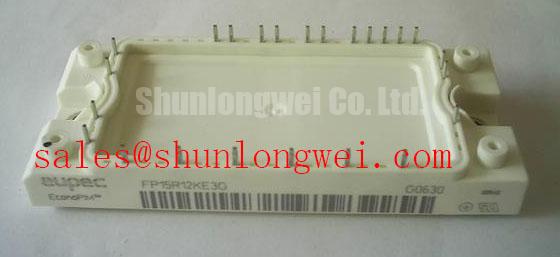
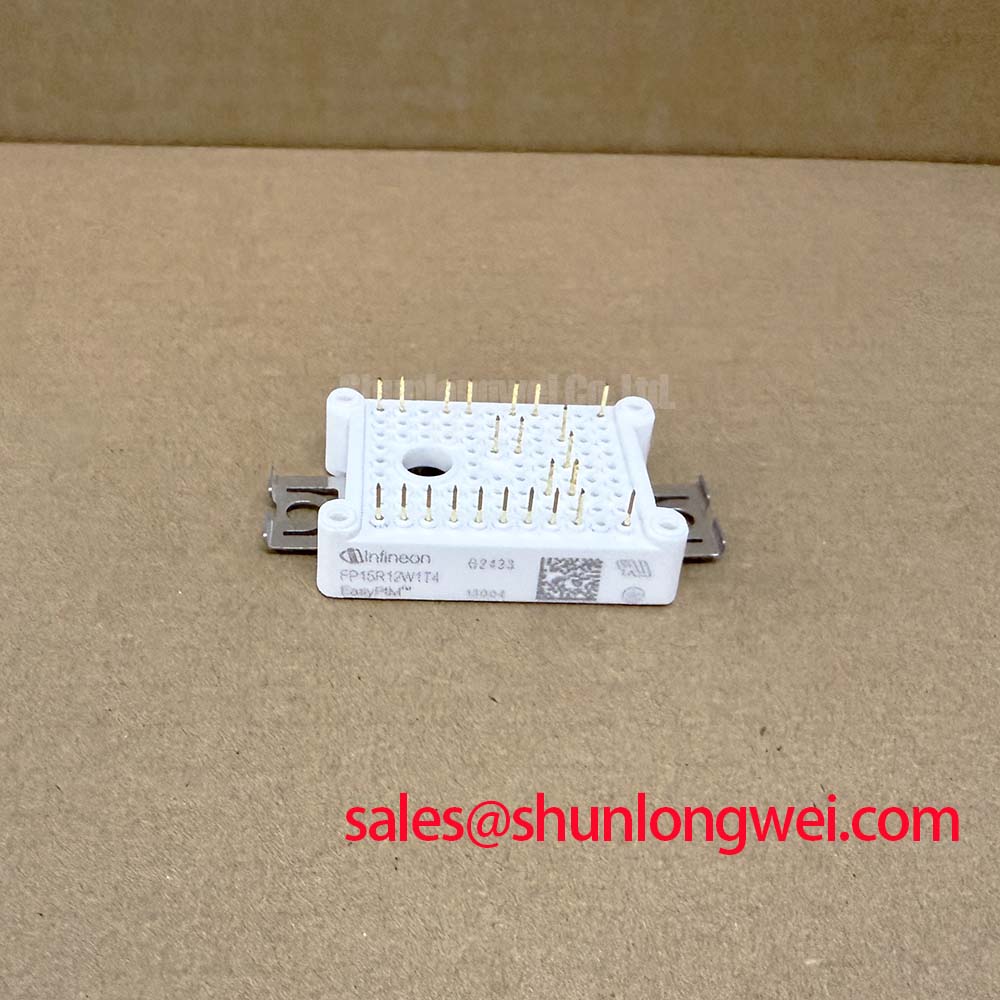
The FP15R12W1T3 is a highly integrated Power Integrated Module (PIM) from Infineon, engineered to streamline the design of low-power motor drives. This module consolidates a three-phase rectifier, a three-phase inverter, and a brake chopper into a single compact EasyPIM™ 1B housing. With its core specifications of 1200V and 15A, it leverages advanced Trench-Field-Stop IGBT3 technology to deliver exceptional efficiency. Key benefits include a significant reduction in system complexity and enhanced thermal performance. For engineers developing compact variable frequency drives, the FP15R12W1T3 directly addresses the challenge of balancing performance, size, and thermal management. For systems that need to handle higher current loads while maintaining a similar integrated topology, the FP25R12KE3 offers a robust alternative.
Key Parameter Overview
Decoding the Specs for Enhanced Thermal Reliability
The technical specifications of the FP15R12W1T3 are pivotal for system designers aiming for efficiency and reliability. The highlighted parameters in the table below are critical for calculating losses, designing thermal solutions, and ensuring the module operates within its safe limits. Understanding these values is the first step toward leveraging the module's full potential in a power conversion system.
| Parameter | Symbol | Condition | Value |
| Collector-Emitter Voltage | VCES | Tvj = 25°C | 1200 V |
| Continuous DC Collector Current | IC | TC = 80°C | 15 A |
| Repetitive Peak Collector Current | ICRM | tP = 1 ms | 30 A |
| Collector-Emitter Saturation Voltage (IGBT) | VCEsat | IC = 15 A, VGE = 15 V, Tvj = 125°C | 2.05 V |
| Total Power Dissipation | Ptot | TC = 25°C | 130 W |
| Gate-Emitter Threshold Voltage | VGE(th) | IC = 0.6 mA | 5.0 V - 6.5 V |
| Thermal Resistance, Junction to Case (per IGBT) | Rth(j-c) | - | 0.95 K/W |
| Isolation Test Voltage | VISOL | RMS, 50 Hz, 1 min | 2500 V |
Download the FP15R12W1T3 datasheet for detailed specifications and performance curves.
Application Scenarios & Value
Achieving System-Level Benefits in High-Frequency Power Conversion
The FP15R12W1T3 is the optimal choice for applications where space, assembly cost, and energy efficiency are critical design constraints. Its high level of integration makes it particularly suitable for low-power industrial systems.
Consider the design of a compact Variable Frequency Drive (VFD) for a conveyor belt system. The challenge is to create a small, reliable drive that can handle motor acceleration, steady-state operation, and braking without complex external circuitry. The FP15R12W1T3 provides a single-component solution. The input rectifier converts the AC line voltage, the three-phase inverter controls the motor's speed and torque with high precision, and the integrated brake chopper efficiently dissipates regenerative energy during deceleration, preventing DC bus overvoltage. This integration eliminates the need for separate rectifier and brake chopper modules, simplifying the PCB layout, reducing assembly time, and minimizing potential points of failure. The module's low VCEsat of 2.05V directly translates to lower conduction losses, enabling the use of a smaller heatsink and contributing to a more compact and energy-efficient final product, a key requirement for modern servo drive and automation applications.
Frequently Asked Questions
Engineering Insights into the FP15R12W1T3
How does the integrated NTC thermistor in the FP15R12W1T3 improve drive reliability?
The integrated NTC thermistor provides real-time temperature feedback directly from the module's substrate. This allows the drive's control system to accurately monitor the operating temperature and implement protective measures, such as reducing the output current or initiating a safe shutdown if a thermal limit is approached. This direct monitoring is far more accurate than external heatsink sensors and is crucial for preventing catastrophic failures due to overheating.
What is the primary advantage of Trench-Field-Stop IGBT3 technology in this module?
Trench-Field-Stop IGBT3 technology offers a superior trade-off between conduction losses (VCEsat) and switching losses. For an application like a motor drive, this means lower heat generation during both the on-state and the switching transitions. This improved efficiency reduces the thermal management requirements and can lead to higher overall system efficiency, which is a critical factor in meeting modern energy standards.
In which scenarios is the integrated brake chopper most beneficial?
The integrated brake chopper is most valuable in applications with frequent start-stop cycles, rapid decelerations, or those involving overhauling loads, such as elevators, cranes, or downhill conveyors. In these situations, the motor acts as a generator, feeding energy back to the DC bus. The brake chopper provides a controlled path to dissipate this regenerative energy, ensuring the DC bus voltage remains stable and protecting the system from overvoltage faults.
How does the EasyPIM™ 1B package contribute to thermal management?
The EasyPIM™ 1B package is designed with an Al2O3 (Aluminum Oxide) substrate, which provides good electrical isolation while maintaining a low thermal resistance. A low Rth(j-c) value of 0.95 K/W per IGBT signifies an efficient thermal path from the semiconductor chip to the case. This allows heat to be transferred effectively to the heatsink, keeping the IGBT junction temperature lower, which directly enhances the module's long-term reliability and operational lifespan.
Technical Deep Dive
Understanding the Synergy of Integration and IGBT Technology
The engineering value of the FP15R12W1T3 lies not just in its individual components, but in their synergistic integration. The Power Integrated Module (PIM) concept is a strategic design choice aimed at reducing parasitic inductance and simplifying the power stage layout. By placing the rectifier, inverter, and brake chopper in close proximity within a single optimized package, the electrical paths are shortened. This inherently lowers stray inductance compared to a discrete solution, which helps to reduce voltage overshoots during high-speed switching events, improving both reliability and EMI performance.
At the heart of this integration is the Infineon TRENCHSTOP™ IGBT3 technology. This technology represents a significant evolution in IGBT design, creating a vertical trench structure for the gate. Think of it like changing from a wide, shallow river to a deep, narrow canal; the deep canal (trench gate) allows for much better control of the current flow. This results in a lower on-state voltage drop (VCEsat), which is the primary source of conduction losses. For a motor running at a steady speed, lower VCEsat is like having a more efficient engine—less energy is wasted as heat. This combination of intelligent packaging and advanced silicon technology makes the FP15R12W1T3 a powerful tool for creating next-generation, power-dense drive solutions.
Strategic Considerations for System Design
Integrating the FP15R12W1T3 into a power system design offers a strategic advantage by reducing the bill of materials (BOM) and shortening the development cycle. By providing a pre-qualified and optimized power stage, it allows engineering teams to focus their resources on higher-level control logic and software development. This accelerates time-to-market and enhances the competitiveness of the final product in the industrial automation landscape.