Content last revised on October 10, 2026
Field Diagnostics & Commissioning: RC Snubber Network Optimization to Prevent Unwanted Conduction in MCC255-18IO1 Topologies
Check the RC snubber connections and gate-return routing before changing firing commands to address unexplained conduction. As a Design Consideration, excessive off-state voltage slew can trigger a thyristor without the intended gate pulse. Compare voltage across the affected thyristor with the gate-to-cathode waveform using suitably rated, isolated measurement equipment; distinguish unwanted triggering from controller timing errors.
Snubber resistance and capacitance should balance transient suppression, discharge current, resistor heating, and repetitive losses. Increasing capacitance without reviewing the discharge path can increase turn-on current stress. Where the original circuit includes a series saturable reactor, inspect its connections and assess its current-limiting behavior during turn-on. Component sizing belongs to the system transient assessment, with measured voltage slew and current rise checked against the manufacturer's applicable limits.
Fuse coordination requires more than matching the 255 A current rating. Compare the protective device's total clearing I²t and let-through behavior with the module's permissible surge conditions, including initial temperature and fault duration. Use the equipment's coordination table alongside the module datasheet rather than transferring a fuse selection from an unrelated assembly.
Field Alert: Keep the equipment isolated while reconnecting power terminals, and use the specified terminal and mounting torques rather than a generic bolt-torque value. Inspect snubber terminations for looseness and heat discoloration before returning the circuit to controlled testing.
MCC255-18IO1 Thermal-Electrical Optimization: Dynamic Firing Delay Angle Adjustment under Practical Tuning
Compare firing delay with measured current conduction before adjusting a phase-control ramp. As a Design Consideration, the relationship between firing angle and output depends on bridge configuration, load inductance, back electromotive force, and whether conduction remains continuous. An AC-to-DC converter characteristic cannot be applied directly to an AC motor controller.
In a controlled rectifier operating with continuous current, increasing firing delay reduces average output voltage; discontinuous conduction changes that relationship. For motor phase control, inspect the actual chopped voltage and current waveforms instead. Delayed conduction introduces waveform distortion, while displacement and distortion both affect power factor. Assess reactive demand and harmonic current at the supply connection rather than interpreting gate timing alone as an efficiency measurement.
The following comparison keeps confirmed MCC255-18IO1 ratings separate from the checks needed for another part number. The MCC200-14IO1 is a comparison candidate, not an established interchangeable replacement.
| Selection item | MCC255-18IO1 | MCC200-14IO1 |
|---|---|---|
| Manufacturer | IXYS | Consult datasheet |
| Voltage rating | 1800 V — Official Specification | Consult datasheet |
| Current rating | 255 A — Official Specification | Consult datasheet |
| Package | Module — Official Specification | Consult datasheet |
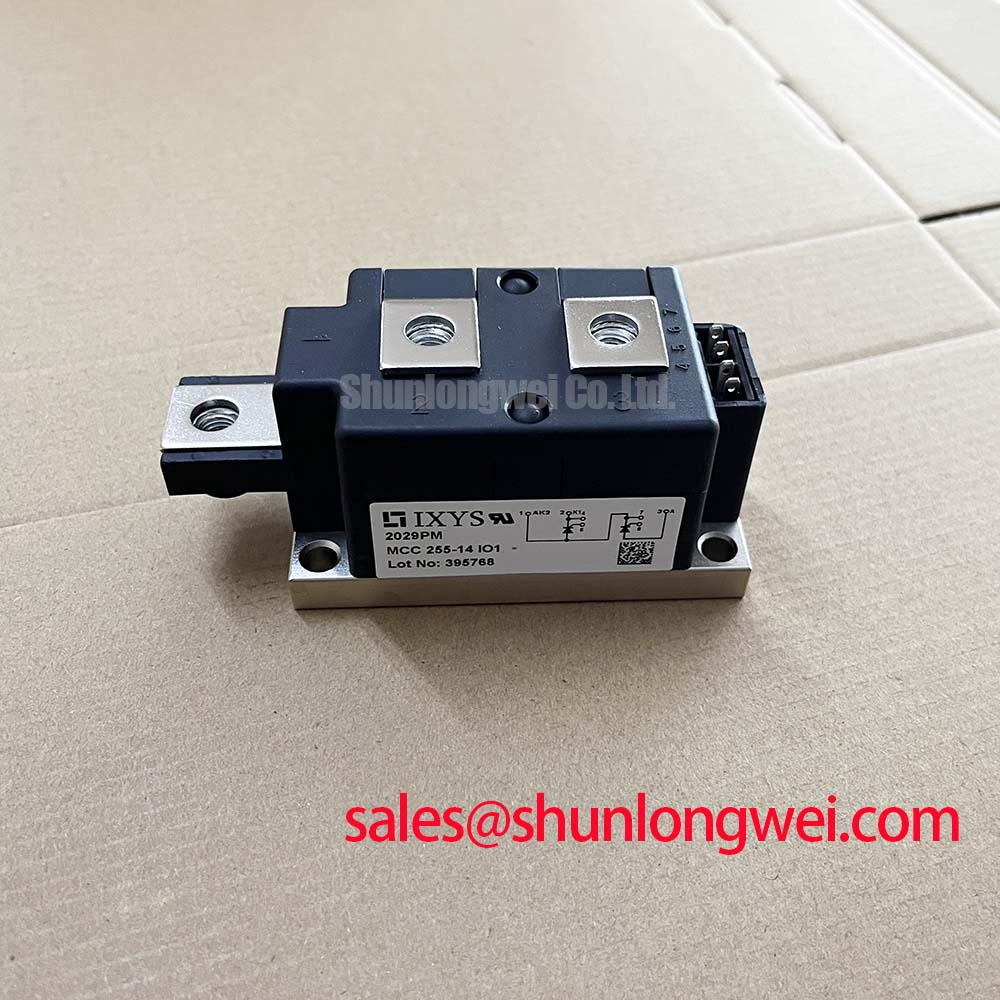
| Replacement checks | Circuit configuration, terminal map, mounting dimensions, thermal characteristics, trigger requirements, and protection coordination | |
During practical tuning, correlate case-temperature trends with conduction duration and load current. Inspect heatsink contact and cooling performance before attributing temperature imbalance to firing delay. Substrate materials influence thermal packaging generally; the silicon nitride materials reference does not establish the substrate composition of this module.
Assembly Integrity & Layout Architecture: Implementing Three-Phase Back-to-Back Thyristor Control for MCC255-18IO1
Trace the module's internal circuit symbol before assigning terminals to a back-to-back phase-control arrangement. “Dual thyristor” does not, by itself, establish an antiparallel connection. When evaluating this module for a high-voltage three-phase motor solid-state soft starter, designers should verify how the module connections implement the required bidirectional phase path.
As an Engineering Recommendation, separate gate and cathode-return wiring from high-current conductors to reduce coupling into the trigger circuit. Use the designated thyristor connections; an IGBT Kelvin-emitter wiring convention is not a terminal definition for this device. Check phase synchronization and gate delivery under load before increasing the starting command.
Starting-current limits must reflect motor acceleration, available torque, load inertia, and permitted starting duration. Reducing applied voltage can limit current but also reduce accelerating torque. Establish the ramp from measured current and acceleration rather than promising a universal inrush reduction or elimination of mechanical shock.
Preserve terminal creepage and clearance when fitting busbars, cable lugs, and insulating barriers, with acceptance determined by the equipment's applicable insulation requirements. For device distinctions, The Ultimate IGBT Knowledge Base provides background rather than thyristor test limits; ROHM's fast recovery diode documentation concerns a separate component class. Complete commissioning by checking phase-current balance, trigger stability, protective-device coordination, and terminal heating under the approved operating sequence.