Content last revised on September 10, 2026
SKT240/18E Semikron 1800V 240A Phase Control Thyristor Module
How can power engineers effectively prevent thermal fatigue failure in heavy-duty 690V industrial line rectifiers subjected to cyclic electrical surges? Operating line-side phase control thyristors under continuous high-current loads requires minimizing internal thermal resistance while withstanding severe line transients. The SKT240/18E line thyristor from Semikron addresses this engineering obstacle through its pressure-contact hermetic capsule design, featuring an off-state voltage rating of 1800V, an average on-state current of 240A (at Tcase = 92°C, double-sided cooling), and an exceptionally low junction-to-case thermal resistance Rth(j-c) of 0.07 K/W. Designed for robust line rectification and motor control, this module eliminates solder-layer degradation to ensure multi-decade operational endurance. For high-voltage industrial rectifiers demanding low thermal resistance and extreme surge capacity, the 1800V SKT240/18E is the optimal choice.
Frequently Asked Questions
Addressing Thermal Stress, Gate Triggering, and Transient Protection Challenges
How does double-sided cooling in the SKT240/18E capsule package impact heatsink design and power density?
Double-sided cooling (DSC) allows thermal energy to dissipate simultaneously through both top and bottom contact faces of the ceramic capsule. This configuration cuts thermal resistance Rth(j-c) down to 0.07 K/W, compared to 0.151 K/W under single-sided cooling (SSC). By reducing junction temperature rise by over 50%, power system designers can utilize smaller heatsinks or achieve significantly higher output power density within existing enclosures. What is the primary benefit of its pressure-contact design? Enhanced long-term reliability by eliminating solder fatigue.
Why is the 1800V voltage rating essential for 690V AC industrial line applications?
In 690V three-phase systems, peak line voltages reach approximately 975V. Standard 1200V components offer insufficient headroom for line switching transients, inductive kickbacks, and lightning surges. The 1800V repetitive peak off-state and reverse voltage (VDRM/VRRM) rating of the SKT240/18E delivers a safety margin exceeding 800V, minimizing the risk of avalanche breakdown without forcing engineers to over-specify snubbers.
What gate drive parameters are required to reliably turn on the SKT240/18E under cold ambient conditions?
The SKT240/18E features a minimum gate trigger voltage VGT of 2.0V and a gate trigger current IGT of 150mA at Tvj = 25°C. To ensure rapid, uniform turn-on across the entire silicon wafer and prevent localized current crowding, gate drive circuits should deliver a steep pulse with diG/dt = 1 A/µs and a peak current above 500mA.
How does the surge current capacity (ITSM) protect systems during output short circuits?
The module provides a 10ms non-repetitive surge current rating ITSM of 5000A at 25°C (and 4500A at 125°C), alongside an I2t rating of 125,000 A2s. This massive energy absorption capability allows protective high-speed fuses to clear fault currents without damaging the internal thyristor wafer.
Can the SKT240/18E replace solder-based power modules in high-cycling applications?
Yes. Traditional solder-bonded modules suffer from thermomechanical fatigue due to thermal expansion mismatch between layers. The pressure-contact construction of the capsule package maintains constant mechanical force (4 to 5 kN), eliminating solder voids and joint cracking over millions of power cycles.
Key Parameter Overview
Decoding the Specs for Enhanced Thermal Reliability
| Technical Parameter | Rated Value | Engineering Significance & Interpretation |
|---|---|---|
| Repetitive Peak Off-State & Reverse Voltage (VDRM / VRRM) | 1800V | Provides high voltage blocking capability suitable for 690V AC line rectified systems and harsh industrial mains. |
| Average On-State Current (ITAV) | 240A (DSC, Tcase = 92°C) / 282A (Tcase = 85°C) | Defines continuous current rating under double-sided cooling conditions; handles heavy motor and inverter front-end loads. |
| Max. Non-Repetitive Surge Current (ITSM) | 5000A (10ms, Tvj = 25°C) | Ensures robustness against sudden load short-circuits and severe line surges during power grid fluctuations. |
| Rating for Fusing (I2t) | 125,000 A2s (10ms, Tvj = 25°C) | Simplifies semiconductor fuse selection by specifying the exact thermal energy threshold the chip withstands before rupture. |
| Critical Rate of Rise of Off-State Voltage (dv/dt)cr | 1000 V/µs (Tvj = 125°C) | Prevents false turn-on induced by steep voltage transients across main terminals in noisy industrial electromagnetic environments. |
| Thermal Resistance Junction-to-Case Rth(j-c) | 0.07 K/W (Continuous, Double Sided) | Minimizes internal temperature gradients, enabling compact heatsink layouts and exceptional power throughput. |
Download the SKT240/18E datasheet for detailed specifications and performance curves.
Technical Deep Dive
Pressure-Contact Capsule Design and Double-Sided Thermal Dynamics
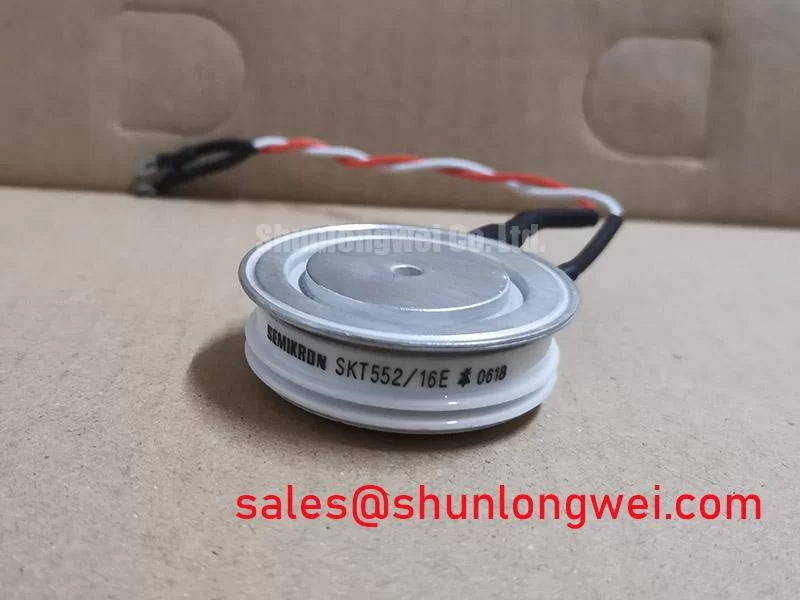
The core structural advantage of the SKT240/18E resides in its hermetic metal-ceramic capsule (hockey-puk) architecture. Unlike conventional planar modules that rely on soldered copper substrates, this phase control SCR utilizes internal spring-loaded pressure contacts. This mechanical arrangement exerts a uniform mounting force of 4 to 5 kN across the silicon wafer. By removing solder joints from the primary thermal expansion path, the device completely bypasses solder delamination—a primary root cause identified in power semiconductor failure analysis principles.
From an electrical perspective, the internal semiconductor wafer features an amplifying gate structure. This architecture accelerates initial plasma spreading during gate turn-on, enabling a critical rate of current rise (di/dt)cr of 125 A/µs. Furthermore, the low threshold voltage VT(TO) of 1.0V coupled with a low slope resistance rT of 1.4 mΩ at 125°C reduces total conduction losses during continuous high-current operation. Understanding these structural dynamics is essential within a comprehensive power semiconductor selection framework.
Thermally, double-sided cooling acts like opening a two-lane highway for heat flux rather than restricting it to a single lane. When clamped between two precision-machined heatsink surfaces, thermal energy generated within the active junction dissipates through both anode and cathode faces simultaneously. This lowers overall thermal impedance, allowing engineers to maintain junction temperatures well below the maximum Tvj limit of 125°C under severe ambient conditions. Evaluating these thermal resistance metrics reveals why disc-type devices remain unmatched in heavy industrial installations.
Application Scenarios & Value
Achieving High Reliability in Industrial Phase Control and Heavy Line Rectification
Industrial motor soft starters and medium-voltage variable speed drives present demanding operational conditions for line-side power semiconductors. During motor startup, line thyristors experience starting currents up to 4 to 6 times the rated nominal current for several seconds. The SKT240/18E easily absorbs these thermal spikes due to its 5000A surge rating and high thermal mass disc structure. In three-phase fully controlled bridge rectifiers (B6 topology), a pair of these thyristors supplies stable DC link voltage to downstream inverters under fluctuating line voltages.
Similarly, high-power industrial heating control systems and resistance welding power supplies require precise AC phase angle firing. The 1000 V/µs dv/dt rating of the SKT240/18E guarantees immunity against dv/dt-induced false triggering caused by adjacent SCR switching noise. Systems designed with these capsule thyristors achieve superior total cost of ownership (TCO) through extended maintenance intervals and zero solder-fatigue downtime.
For systems operating under lower line voltages where 1800V blocking capability is not required, the related SKT240/12E offers a 1200V blocking option with identical mechanical dimensions. Alternatively, for topologies requiring isolated module housings instead of disc packages, the SKKT250/18E provides dual thyristor integration in a screw-terminal module format.