

Content last revised on September 10, 2026
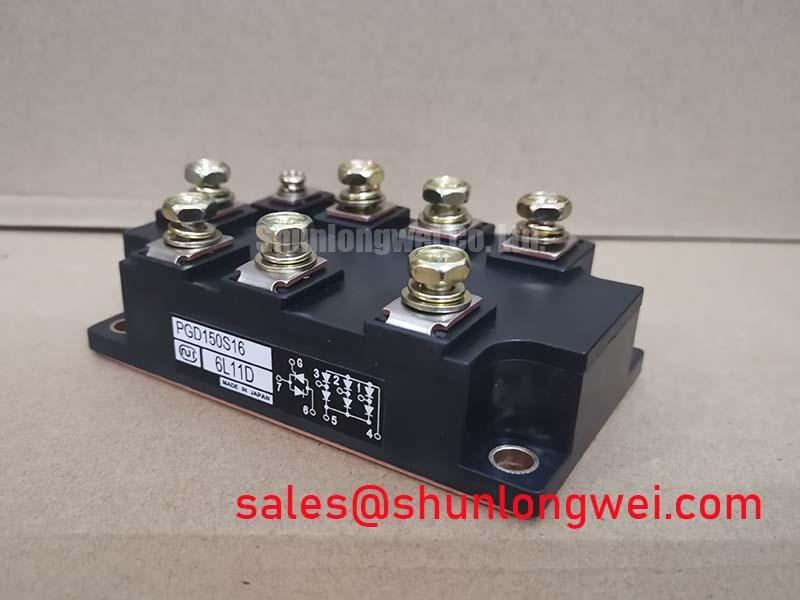
PGD150S16 NIEC 1600V 150A Diode Module
The PGD150S16, manufactured by NIEC (Nihon Inter Electronics Corporation), is a robust power diode module designed to deliver high-performance rectification in demanding industrial power systems. Engineered for high-voltage stability, this module features a 1600V repetitive peak reverse voltage and a 150A average rectified output current, providing the necessary overhead for 480V and 600V AC line applications. By integrating two high-power diode chips in a series-connected configuration within a single isolated package, it simplifies circuit layout while ensuring superior thermal management. For 480V industrial systems requiring significant voltage safety margins against line transients, the PGD150S16 stands as a benchmark for reliable power rectification.
For systems requiring higher current handling with similar voltage ratings, the related SKKD162/16 offers a Vces of 1600V. What is the primary benefit of the PGD150S16's 1600V rating? It provides critical voltage overhead for 480V/600V AC line applications to ensure survival against transient surges.
Key Parameter Overview
Decoding Specifications for Enhanced System-Level Reliability
To support engineering assessment, the following table summarizes the primary electrical and thermal characteristics of the PGD150S16. These values are essential for calculating heatsink requirements and determining the safe operating area (SOA) in diverse thermal environments.
| Parameter Description | Symbol | Value | Unit |
|---|---|---|---|
| Repetitive Peak Reverse Voltage | VRRM | 1600 | V |
| Average Rectified Output Current (Tc=94°C) | Io (AV) | 150 | A |
| Surge Forward Current (1-cycle, 60Hz) | IFSM | 3000 | A |
| Maximum Forward Voltage Drop (at 450A Peak) | VFM | 1.35 | V |
| Thermal Resistance (Junction to Case) | Rth(j-c) | 0.20 | °C/W |
| Isolation Voltage (AC 1 minute) | Visol | 2500 | V |
Application Scenarios & Value
Optimizing Power Conversion in High-Voltage Industrial Environments
Engineers often face the challenge of managing transient voltage spikes in heavy machinery environments where inductive switching is frequent. The PGD150S16 addresses this through its 1600V VRRM rating, acting like a high-pressure valve that prevents backflow even under significant electrical stress. This makes it an ideal choice for the primary rectification stage in Variable Frequency Drives (VFD) and large-scale industrial power supplies. In a typical 480V motor drive application, the PGD150S16's high 3000A surge current capacity allows it to withstand the initial inrush current during the charging of DC-link capacitor banks without degradation.
Beyond motor control, this module is frequently integrated into non-contact switches and induction heating equipment. Its electrically isolated baseplate allows multiple modules to be mounted on a single heatsink, reducing the total footprint of the power assembly. For engineers transitioning to high-frequency designs, understanding the selection criteria beyond voltage drop is vital for long-term efficiency. In applications where space is constrained but high power density is required, the PGD150S16 provides a stable, thermally efficient platform that simplifies the overall cooling architecture.
Technical Deep Dive
Thermal Management and Package Integrity for Harsh Missions
The reliability of the PGD150S16 is fundamentally tied to its 0.20°C/W thermal resistance. To visualize this, consider thermal resistance as a highway for heat: a lower value represents more lanes and fewer bottlenecks, allowing heat to flow rapidly away from the silicon junction to the heatsink. This low Rth(j-c) ensures that even under continuous 150A loads, the internal junction temperature remains within safe limits, preventing thermal runaway. The PGD package employs specialized bonding techniques to minimize mechanical stress during power cycling, which is a common cause of failure in lower-grade components.
Furthermore, the 2500V isolation rating is not merely a safety specification; it is a critical design feature for building multi-phase rectifier bridges. It ensures that the high-voltage power circuit is effectively decoupled from the grounded chassis, protecting sensitive control electronics from common-mode noise. For practitioners focused on advanced thermal management, the PGD150S16 offers a predictable thermal path that allows for precise modeling of system cooling requirements. This predictability is essential when designing systems for 24/7 industrial operations where downtime is not an option.
Frequently Asked Questions
How does the Rth(j-c) of 0.20 °C/W directly impact heatsink selection for the PGD150S16?
The 0.20 °C/W rating determines the maximum allowable temperature rise between the diode junction and the module case. A lower thermal resistance allows for a smaller heatsink or operation in higher ambient temperatures while keeping the junction below its 150°C limit, thereby increasing overall power density.
Why is a 1600V VRRM necessary for a standard 480V AC line application?
In industrial environments, 480V lines often experience spikes exceeding 1000V due to lightning or inductive load switching. The 1600V rating provides a safety factor of over 3x the nominal peak voltage, ensuring the PGD150S16 remains undamaged during these transient events.
Can the PGD150S16 be used in parallel to increase current capacity?
While diodes can be paralleled, it requires careful attention to the forward voltage (VFM) matching and circuit layout to prevent current hogging. Because the PGD150S16 has a negative temperature coefficient for its forward voltage at low currents, external current-balancing resistors or matched-pair modules are often utilized in parallel configurations to ensure longevity.
For high-power rectification where thermal stability is the primary design constraint, the PGD150S16's combination of 150A current handling and low thermal resistance makes it the strategic choice for modern industrial power stages.