Content last revised on September 10, 2026
SKiiP83AC12iS: Engineering for Longevity in High-Reliability Power Systems
A Strategic Overview of a Solder-Free Intelligent Power Module
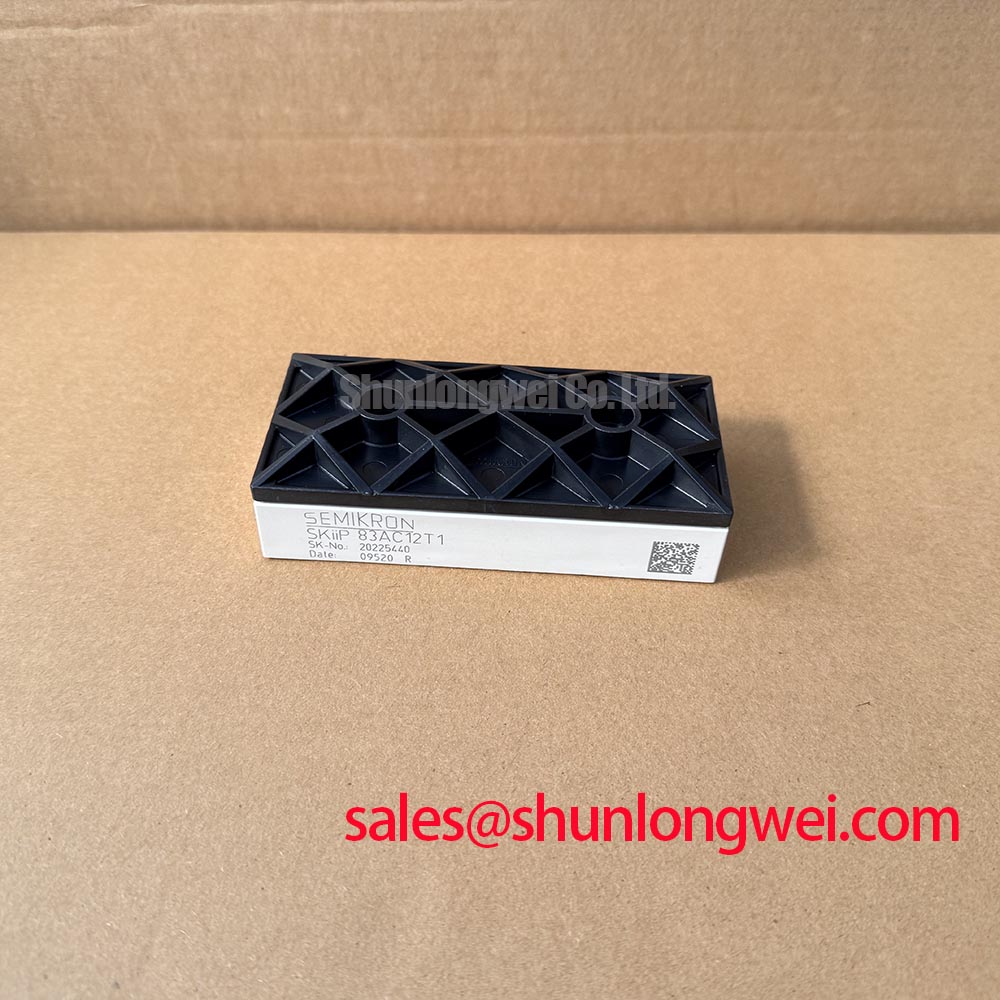
The Semikron SKiiP83AC12iS is an Intelligent Power Module (IPM) designed to offer exceptional operational lifespan and robustness in demanding power conversion applications. With core specifications of 1200V and a maximum collector current of 150A, this three-phase inverter module integrates advanced construction techniques to elevate system reliability. Key engineering benefits include superior thermal cycling capability through solder-free contacts and simplified system design via an integrated driver with comprehensive protection. What is the primary benefit of its pressure-contact design? It delivers enhanced long-term reliability by eliminating solder fatigue, a common failure point in conventional modules. For industrial drives demanding superior thermal cycling performance and sustained reliability, the SKiiP83AC12iS is a standout choice due to its advanced solder-free construction.
Application Scenarios & Value
Achieving System-Level Benefits in High-Cycle Industrial Automation
The SKiiP83AC12iS is engineered for applications where thermal and mechanical stress are significant operational challenges. For design engineers developing a high-performance Variable Frequency Drive (VFD) for multi-axis CNC machinery or robotic arms, the module's architecture provides a distinct advantage. These systems execute rapid, repetitive acceleration and deceleration cycles, inducing significant temperature swings within the power electronics. In conventional modules, this leads to solder joint fatigue and eventual failure. The SKiiP83AC12iS directly mitigates this primary failure mode by employing Sintering Technology for die attachment and pressure contacts for electrical connections. This solder-free approach creates an intrinsically more robust assembly, capable of withstanding severe thermal cycling and mechanical vibration. This translates directly to increased machine uptime, reduced field service costs, and a lower total cost of ownership. For systems requiring significantly higher current handling, the related SEMIX453GB12VS offers a current rating up to 450A.
Key Parameter Overview
Decoding the Specs for Enhanced Thermal Reliability
The specifications of the SKiiP83AC12iS are optimized for performance and durability. The highlighted values below are critical for engineers focused on designing resilient and efficient power stages.
| Parameter | Value |
| Collector-Emitter Voltage (Vces) | 1200V |
| Maximum Continuous DC Collector Current (Ic @ Tc=80°C) | 85A |
| Maximum Repetitive Peak Collector Current (Icrm) | 150A |
| Collector-Emitter Saturation Voltage (Vce(sat), Typ. @ Ic,nom) | 1.85V |
| Topology | Three-Phase Bridge Inverter |
| Integrated Features | Integrated Gate Driver, Temperature Sensor (NTC), Protection (UVLO, Overcurrent) |
| Thermal Resistance, Junction-to-Case (Rth(j-c) per IGBT) | 0.25 K/W |
Frequently Asked Questions (FAQ)
Engineering Insights into the SKiiP83AC12iS
How does the integrated driver in the SKiiP83AC12iS simplify system design?
The integrated gate driver eliminates the need for external driver circuitry, reducing component count, PCB complexity, and potential EMI issues. It provides optimized switching characteristics and includes built-in protection features like under-voltage lockout (UVLO) and overcurrent detection, which significantly shortens the design and testing phases.
What is the practical benefit of using sintering technology instead of solder for the die attach?
What is the key advantage of sintered connections? They provide superior thermal conductivity and mechanical strength, enhancing the module's power cycling capability. Sintering creates a robust, homogeneous bond that is far more resistant to the fatigue and cracking that plagues solder joints during thermal cycles. This directly translates to a longer operational lifetime in applications with frequent temperature fluctuations.
Can the integrated NTC temperature sensor be used for active thermal protection?
Yes, the integrated NTC thermistor provides a real-time analog voltage signal corresponding to the module's substrate temperature. This allows the system controller to implement sophisticated thermal management strategies, such as derating the output power or triggering a controlled shutdown before a critical temperature is reached, preventing catastrophic failure.
Is the SKiiP83AC12iS suitable for high-vibration environments?
Absolutely. The module's construction relies on pressure contacts and spring connections rather than traditional bond wires and soldered leads for power terminals. This design is inherently more resilient to mechanical shock and vibration, making it an excellent choice for applications like commercial vehicle inverters, construction equipment, and wind turbine pitch controls.
Technical Deep Dive
A Closer Look at Sintering and Pressure-Contact Technology for Enhanced Longevity
At the core of the SKiiP83AC12iS's exceptional reliability is its departure from traditional soldering processes. In high-power applications, the constant expansion and contraction of different materials during operation puts immense stress on soldered connections. Think of a soldered connection like a seam held together by glue; over time, repeated bending and stretching can crack the glue. A sintered connection, in contrast, is like welding the pieces together. It forms a single, robust metal joint with significantly higher melting point and superior fatigue resistance. This dramatically improves the module's Power Cycling Capability, a critical metric for determining lifetime in industrial drives and renewable energy inverters.
This philosophy extends to the external connections. The use of pressure contacts eliminates large solder joints, which are another common point of failure. This solder-free design not only enhances thermal transfer but also ensures a consistent, reliable connection over the module's entire lifespan, even under severe mechanical stress.
Application Vignette
Optimizing Uptime in Automated Material Handling Systems
Consider a large-scale automated warehouse where robotic sorting arms and high-speed conveyors operate continuously. The motors powering this equipment are controlled by VFDs that execute thousands of start-stop-reverse cycles daily. This places extreme thermal stress on the inverter's IGBTs. A failure here is not just a component failure; it's a costly line-down situation. The SKiiP83AC12iS is engineered precisely for this scenario. Its solder-free construction is inherently more resilient to the thermal shock induced by such demanding cycles. Relying on a standard soldered module in this application is like using regular tires on a Formula 1 car—they'll wear out prematurely under the extreme stress. The SKiiP83AC12iS, with its sintered and pressure-contact design, is the equivalent of a high-performance racing slick: purpose-built to endure punishing conditions without failure. The integrated temperature sensor further adds value by enabling predictive maintenance, allowing system operators to monitor thermal health and plan service intervals, maximizing system uptime and operational efficiency.
Selecting a power module extends beyond initial specifications; it is a strategic decision impacting long-term system reliability and cost. By integrating a solder-free design with proven driver technology, the SKiiP83AC12iS provides a robust foundation for building next-generation power systems that are designed not just to perform, but to last.