

Content last revised on September 10, 2026
Engineered for High-Frequency Power Conversion with CAL Technology
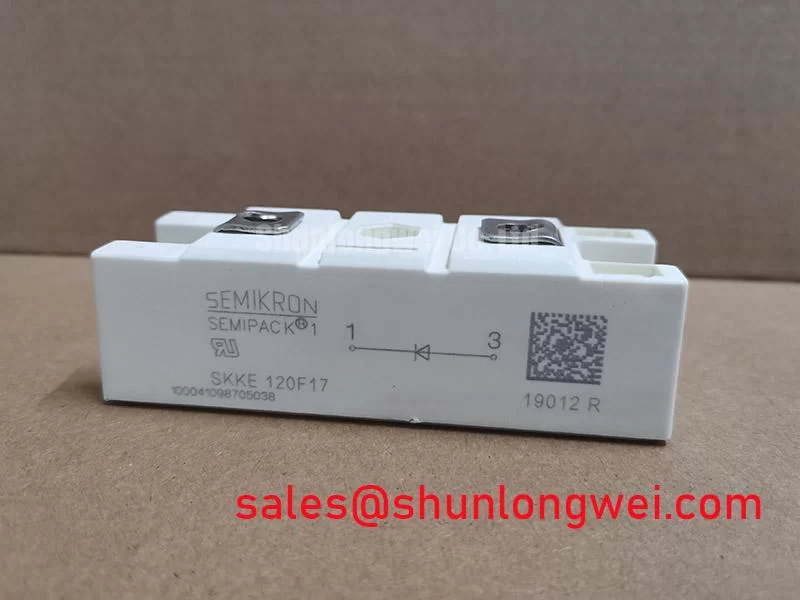
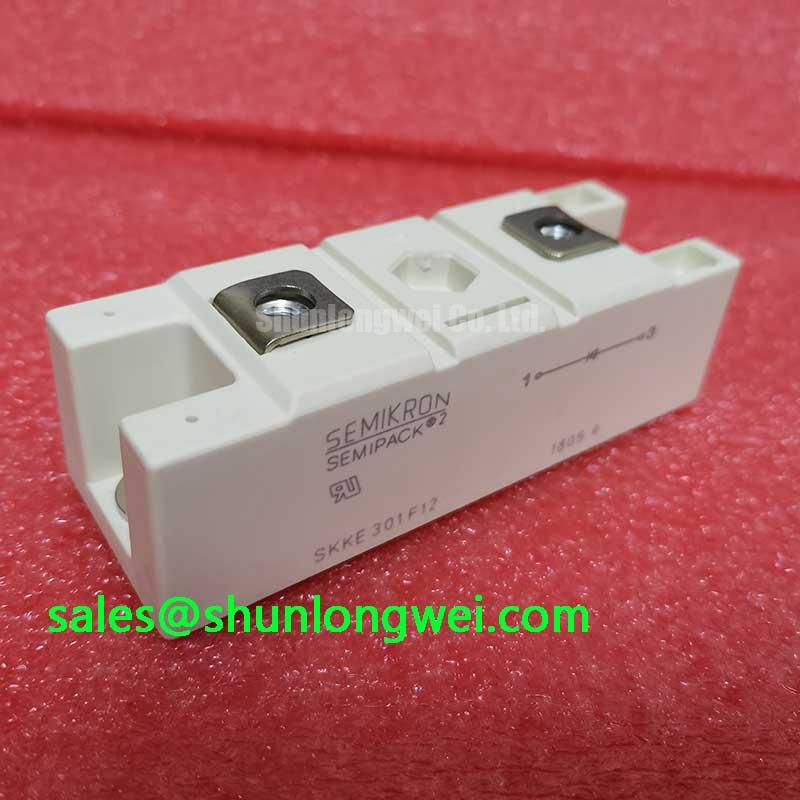
The Semikron SKKE 301F12 is a fast recovery diode module designed to deliver superior performance in demanding power conversion systems. It leverages advanced CAL technology to provide exceptionally low switching losses and soft recovery characteristics, directly enhancing system efficiency and long-term reliability. With core specifications of 1200V | 300A | Rth(j-c) 0.11 K/W, this module offers robust thermal performance and high current handling. Its primary benefits include minimized power loss during switching and improved electromagnetic compatibility (EMC) through controlled recovery behavior. For engineers designing high-frequency applications like electronic welders or uninterruptible power supplies (UPS), the SKKE 301F12 provides a direct path to reducing component stress and simplifying thermal management. What is the primary benefit of its CAL technology? It ensures a very soft and fast recovery, drastically reducing switching losses and electrical noise.
Key Parameter Overview
Decoding the Specs for Enhanced Switching Performance
The technical specifications of the SKKE 301F12 are tailored for high-efficiency power systems. Each parameter is a critical piece of the design puzzle, directly influencing thermal management, reliability, and overall performance. The following table highlights key values and their direct engineering implications.
| Parameter | Value | Engineering Value & Interpretation |
|---|---|---|
| Repetitive Peak Reverse Voltage (VRRM) | 1200 V | Provides a substantial safety margin for applications operating on 400V and 690V industrial lines, ensuring resilience against voltage transients. |
| Forward Current (IFAV) @ Tc=85°C | 220 A | Indicates a strong continuous current capability at a realistic case temperature, foundational for designing reliable power stages in DC choppers and inverters. |
| Thermal Resistance, Junction to Case (Rth(j-c)) | 0.11 K/W | This low value signifies highly efficient heat transfer from the semiconductor junction to the heatsink. It's like having a wider pipe for heat to escape, allowing for smaller heatsink designs or higher power density. |
| Reverse Recovery Time (trr) | 690 ns | A fast recovery time is crucial for minimizing the period where the diode is still conducting in reverse, a primary source of switching losses in high-frequency systems. |
| Reverse Recovery Charge (Qrr) | 42 µC | A low Qrr is the hallmark of an efficient diode. It directly correlates to lower energy loss (Err) during each switching cycle, which is paramount in applications like inductive heating that operate at high frequencies. |
| Surge Forward Current (IFSM) | 4000 A (10 ms) | This high surge rating demonstrates the module's robustness, ensuring it can withstand significant inrush currents during motor startup or fault conditions without failure. |
For a complete list of specifications, electrical characteristics, and performance curves, please Download the SKKE 301F12 datasheet for detailed specifications and performance curves.
Application Scenarios & Value
Achieving System-Level Benefits in Demanding Power Topologies
The SKKE 301F12 is not merely a component but an enabler of more efficient and reliable power systems. Its unique characteristics make it an ideal choice for engineers tackling specific design challenges in modern power electronics. For systems requiring robust rectification and freewheeling capabilities, such as those found in AC motor speed controls, this module offers a compelling solution.
Consider the design of a high-power Uninterruptible Power Supply (UPS). A primary engineering challenge is managing the efficiency of the output inverter stage, where diode switching losses contribute significantly to overall heat generation. The SKKE 301F12's low reverse recovery charge (Qrr) of 42 µC directly addresses this. This parameter means less energy is wasted each time the diode turns off, leading to lower operating temperatures and reducing the demand on the cooling system. This allows for a more compact and cost-effective thermal design. The module's "soft recovery" behavior also minimizes high-frequency EMI, potentially simplifying the filtering requirements and reducing the need for complex snubber circuit designs needed to suppress voltage overshoots.
This module is particularly well-suited for self-commutated inverters, electronic welders, and inductive heating systems where fast and clean switching is paramount for performance. For applications demanding even higher current handling, designers might evaluate related components like the SKKD162/16.
Frequently Asked Questions (FAQ)
What is the primary advantage of the CAL (Controlled Axial Lifetime) technology used in the SKKE 301F12?
CAL technology is a manufacturing process that precisely controls charge carrier lifetime within the silicon. This results in a "soft" recovery characteristic—meaning the reverse recovery current subsides smoothly rather than abruptly. This significantly reduces voltage overshoots and high-frequency oscillations (EMI), leading to more reliable system operation and potentially lower filtering costs.
How does the Rth(j-c) of 0.11 K/W impact heatsink selection and system power density?
A lower thermal resistance from junction-to-case allows heat to be extracted from the diode chip more effectively. This means that for a given power loss, the semiconductor's operating temperature will be lower. This gives engineers two options: use a smaller, less expensive heatsink for the same operating current, or push more current through the module while staying within thermal limits, thereby increasing the system's power density.
Is the SKKE 301F12 suitable for paralleling to achieve higher current output?
While the datasheet does not explicitly detail paralleling procedures, diode modules are often paralleled in high-power applications. Successful paralleling requires careful consideration of the forward voltage (VF) characteristics to ensure current sharing. Engineers should consult Semikron application notes on paralleling fast diode modules to ensure proper thermal and electrical layout for balanced performance and long-term reliability.
Given its 690 ns recovery time, what is the ideal frequency range for this module?
The combination of a fast trr and low Qrr makes the SKKE 301F12 highly effective in applications operating in the tens of kilohertz range. It provides a significant efficiency improvement over standard rectifier diodes, making it a strong candidate for switching power supplies, DC choppers, and the output stages of PWM inverters where minimizing switching losses is a critical design objective.
Technical Deep Dive
A Closer Look at Soft Recovery and its Impact on System Reliability
The concept of "soft recovery" is central to the value of the SKKE 301F12. In a standard fast diode, the reverse recovery current can terminate very sharply (a "snappy" recovery). This rapid change in current (di/dt) interacting with stray inductance in the circuit layout can induce significant voltage spikes (V = L * di/dt). These spikes can exceed the diode's voltage rating or stress other components, like the partnering IGBT, forcing designers to use larger, more expensive snubber circuits to clamp them.
The CAL technology in the SKKE 301F12 fundamentally changes this dynamic. By engineering a smoother decay of the reverse recovery current, the di/dt is significantly lowered. This is analogous to easing off the brakes in a car instead of slamming them. The result is a dramatic reduction in induced voltage overshoots. This inherent soft recovery characteristic enhances system-level reliability by reducing component stress and simplifies the design process by minimizing the need for external snubber components, saving both board space and cost.
Strategic Outlook for High-Efficiency Systems
Integrating components like the SKKE 301F12 is a strategic decision that aligns with long-term industry trends toward greater power density and efficiency. As regulations on energy consumption become more stringent and end-users demand more compact, reliable equipment, the focus on reducing every watt of power loss becomes critical. The superior switching performance of this CAL diode module provides a direct, component-level solution to these system-level challenges, enabling the design of next-generation power conversion equipment that is more efficient, robust, and cost-effective over its operational lifetime.