Content last revised on September 10, 2026
Semikron SKKE81/16 Diode Module: Engineering Reliability in High-Voltage Rectification
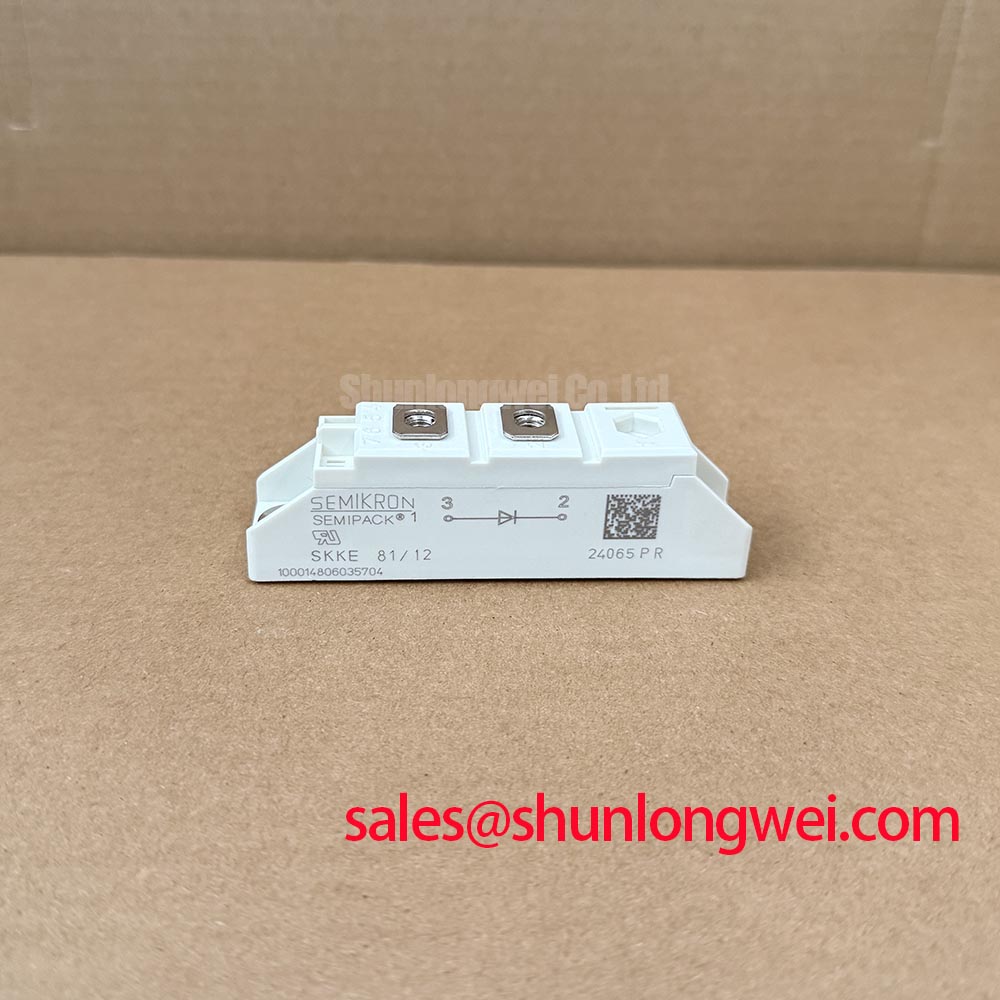
The Semikron SKKE81/16 delivers exceptional thermal integrity and cycle stress resistance for demanding industrial power delivery. Core specifications include a 1600V repetitive reverse voltage, 82A continuous forward current, and a massive 2000A IFSM rating. These metrics ensure optimized thermal transfer and unmatched operational resilience against fluctuating loads. What ensures the long-term field reliability of the Semikron SKKE81/16? Its hard-soldered joints and ceramic baseplate resist thermomechanical stress. For heavy-duty line rectifiers prioritizing thermal margin, this 1600V module is the optimal choice.
Key Parameter Overview
Highlighting Metrics for Thermal Reliability
| Parameter | Value | Engineering Impact |
| Repetitive Reverse Voltage (VRRM) | 1600V | Provides a robust safety margin against grid transient spikes. |
| Average Forward Current (IFAV) | 82A | Supports continuous high-power loads without excessive derating. |
| Surge Forward Current (IFSM) | 2000A | Absorbs massive transient surges during motor start-up phases. |
| Isolation Type | Aluminium Oxide Ceramic | Maximizes thermal conductivity directly to the mounting heatsink. |
| Housing Package | Case A12 (SEMIPACK 1) | Streamlines mechanical integration and chassis grounding. |
Download the SKKE81/16 datasheet for detailed specifications and performance curves.
Application Scenarios & Value
Achieving System-Level Stability in High-Stress Environments
System architects frequently encounter severe challenges with high-inrush currents during motor start-up sequences. The Semikron SKKE81/16 directly addresses this critical vulnerability. It utilizes a robust 2000A surge forward current capacity to safely absorb unexpected transient spikes. This characteristic actively prevents semiconductor degradation within demanding AC/AC converters and high-capacity UPS platforms. By mitigating thermal runaway risks during peak electrical loads, engineers can significantly extend the operational lifespan of the entire power stage. While this model is ideal for demanding line potentials, for systems operating at lower voltages, the related SKKE81/08 offers an 800V rating.
Integrating the SKKE81/16 into the field supply of massive DC motors ensures strict compliance with rigorous industrial profiles. It directly supports electromagnetic compatibility strategies outlined in IEC 61800-3 by maintaining stable, predictable rectification under fluctuating line conditions. The isolated metal baseplate significantly reduces the complexity of managing ground loops in multi-axis drives, allowing for much denser PCB layouts and simplified chassis grounding.
Technical Deep Dive
A Closer Look at the Ceramic Isolation Design
What is the primary benefit of its hard-soldered construction? Enhanced long-term reliability by eliminating interface fatigue under cyclic loads. The SKKE81/16 integrates an advanced aluminium oxide ceramic isolated metal baseplate. This structural architecture drastically improves thermal transfer efficiency from the active silicon die to the external cooling apparatus. Excellent Thermal Management prevents the formation of localized hot spots during continuous 82A forward current operation, maintaining safe junction temperatures even in restrictive enclosures.
We can interpret the 1600V VRRM by comparing it to a high-pressure dam. Just as a heavily reinforced dam holds back massive water reserves without structural compromise, this robust voltage rating blocks reverse potentials safely, preventing catastrophic reverse recovery failures. Furthermore, the hard-soldered internal joints act much like steel rebar inside concrete. They provide the necessary mechanical resilience to withstand the aggressive expansion and contraction caused by extreme thermal cycling. You can explore further durability validation strategies in our field engineer's handbook.
Frequently Asked Questions
Addressing Core Engineering Inquiries
How does the Semikron SKKE81/16 manage cyclic thermal stress?
The module relies on hard-soldered connections rather than conventional pressure contacts alone, preventing micro-layer separation during aggressive temperature fluctuations.
What makes the 1600V VRRM critical for AC motor controllers?
This elevated voltage ceiling provides a necessary safety buffer against grid transients, preventing avalanche breakdown during rapid switching and regenerative events.
Why is the 2000A IFSM essential for heavy industrial loads?
It empowers the component to survive the massive initial inrush currents required to overcome mechanical rotor inertia without sustaining thermal damage.
Does the Case A12 package simplify thermal integration?
Yes, the internally isolated metal baseplate allows direct screw-mounting to grounded heatsinks, optimizing thermal resistance mapping and reducing total assembly time.
Transitioning toward modular power architectures demands components that inherently mitigate thermal bottlenecks. Specifying robust rectification platforms ensures that overarching infrastructure remains continuously online, driving the next generation of automated electrification forward.