Content last revised on September 10, 2026
Semikron SKKH72/18E: Engineering Robust Thermal Management in 1800V Thyristor/Diode Modules
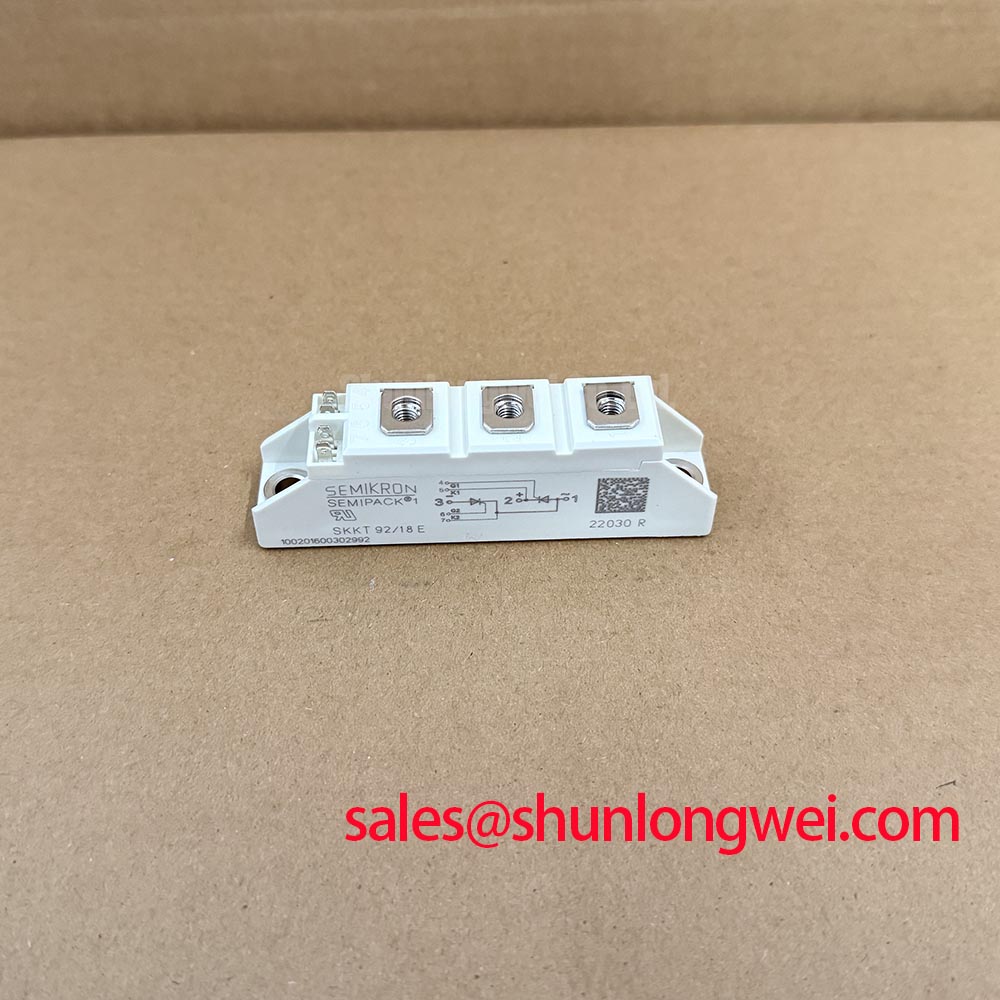
The Semikron SKKH72/18E sets a definitive standard for field-proven power control in heavy-duty phase regulation. Engineered with a distinct focus on thermal endurance, this half-controlled thyristor/diode module delivers an authoritative 1800V reverse voltage capacity alongside a 70A continuous current rating. Its core thermal resistance stands at a thermally optimized Rth(j-c) of 0.35 K/W per thyristor, ensuring exceptional heat dissipation through an aluminium oxide ceramic isolated metal baseplate. How does a hard-soldered module perform in continuous industrial phase control? By eliminating micro-cracking vulnerabilities, it guarantees extended longevity under extreme cyclic loads. Providing optimal functional integrity and simplified chassis mounting, this component substantially reduces system-level maintenance interventions. For industrial motor soft starters prioritizing thermal margin, this 1800V module is the optimal choice.
Application Scenarios & Value
Achieving System-Level Benefits in High-Stress Phase Regulation
Engineers often face formidable challenges when designing phase control networks for heavy-duty manufacturing environments, particularly regarding thermal runaway during continuous operation. In industrial AC motor soft starters, starting surge currents can quickly degrade standard semiconductor junctions. The SKKH72/18E directly resolves this engineering bottleneck. By leveraging its robust 70A continuous current capability and high 1800V threshold, the module easily absorbs transient voltage spikes without compromising the isolation barrier.
Consider a 400V to 690V industrial conveyor system requiring precise start-up torque. Implementing this thyristor/diode package ensures that the initial inductive load switching is managed gracefully. The aluminium oxide ceramic baseplate acts as a highly effective thermal conduit, moving heat away from the silicon die to the heatsink. This prevents localized hotspots, which are the primary culprits in premature component failure. What is the primary benefit of its hard-soldered construction? It provides exceptional mechanical robustness, preventing thermal fatigue in demanding applications. While this module excels in rugged phase control, for systems demanding high-frequency pulse-width modulation, the related SKM300GA123D offers complementary high-speed IGBT capabilities. Furthermore, its seamless integration into temperature control units for chemical processes underscores its versatility in environments where maintaining precise thermal profiles is strictly mandated.
Technical Deep Dive
Decoding the Hard-Soldered Architecture for Peak Endurance
To truly appreciate the operational superiority of the Semikron SKKH72/18E, one must analyze its internal packaging architecture. Unlike conventional wire-bonded assemblies that may succumb to flexural stress, this module utilizes hard-soldered joints. Think of this construction like the steel rebar within a concrete foundation—it provides rigid, unyielding support that prevents structural degradation under constant thermal expansion and contraction cycles.
Furthermore, the isolation mechanism relies on an aluminium oxide (Al2O3) ceramic baseplate. This material exhibits an exceptionally high dielectric strength coupled with commendable thermal conductivity. When operating near its maximum junction temperature of 125°C, the thermal resistance (Rth(j-c)) remains strictly controlled at 0.35 K/W. This metric is analogous to a wide, unobstructed highway for heat transfer, preventing thermal traffic jams that inevitably lead to catastrophic silicon breakdown. By conforming to stringent UL recognized standards, this package ensures that leakage currents remain firmly suppressed across all industrial voltage fluctuations. You can explore more about these underlying thermal methodologies directly through authoritative semikron resources.
Key Parameter Overview
Critical Specifications for Superior Thermal Design
The following data reflects the precise operational boundaries defining this component's field-proven resilience.
| Parameter | Highlight Value | Engineering Impact |
|---|---|---|
| Maximum Repetitive Peak Reverse Voltage (VRRM) | 1800V | Provides massive headroom for industrial grid fluctuations, preventing avalanche breakdown. |
| Continuous On-State Current (ITAV) | 70A (@ Tc = 85°C) | Ensures stable phase control in continuous-duty motor and heavy heating applications. |
| Thermal Resistance, Junction to Case (Rth(j-c)) | 0.35 K/W (per thyristor) | Minimizes temperature gradients, drastically reducing the required heatsink footprint. |
| Max Operating Junction Temperature (Tvjm) | 125°C | Allows for safe operation in enclosed industrial cabinets without aggressive active cooling. |
Download the SKKH72/18E datasheet for detailed specifications and performance curves.
FAQ
Resolving Field Engineering Inquiries
- How does the 1800V voltage rating of the Semikron SKKH72/18E dictate its use in industrial AC networks?
The elevated 1800V rating offers critical protection against voltage transients typical in heavy industrial grids. This massive safety margin prevents accidental triggering and avalanche failures during intense inductive load switching events. - What specific advantage does the aluminium oxide ceramic baseplate provide over standard epoxy encapsulation?
The Al2O3 ceramic baseplate delivers superior dielectric isolation while maintaining a highly conductive thermal path. This ensures that electrical noise is suppressed without sacrificing the module's critical ability to shed heat rapidly. - Why is a hard-soldered joint preferred for continuous motor soft starters?
In cyclic load applications like soft starters, internal components experience aggressive and repetitive thermal cycling. Hard-soldered joints resist the micro-fractures and thermal fatigue that typically degrade softer solder interfaces, ensuring absolute long-term operational integrity.
The strategic integration of thermally robust thyristor/diode modules fundamentally shifts the maintenance economics of heavy industrial infrastructure. By prioritizing components with unyielding mechanical architectures, procurement and design teams can effectively future-proof phase control systems against unpredictable operational stresses.