Content last revised on September 10, 2026
SKKL 92/12E Semikron Diode / Thyristor Module: Factual Engineering Assessment
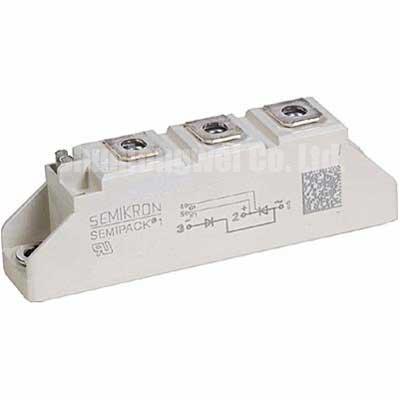
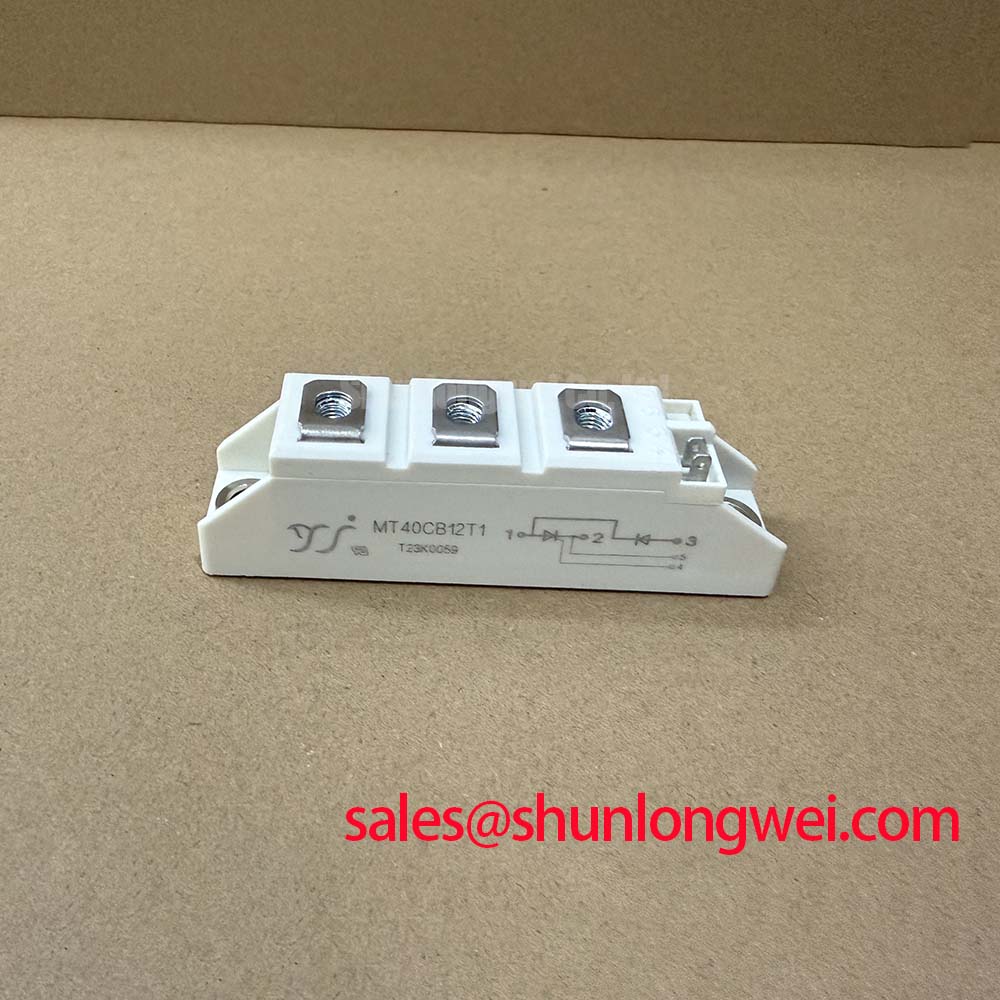
Providing reliable rectifying and phase control within motor drives, this SEMIPACK 1 module offers rugged thermal performance and long-term reliability under cyclic loads. Specifically engineered with a blocking voltage of 1200V and an average on-state current of 95A (at Tcase = 85°C), the SKKL 92/12E is built for robust power handling.
Key benefits include hard-soldered joints for enhanced cycling life and high surge current handling up to 1750A. Engineers seeking replacement parts often ask: Can it handle 400V line inputs? Yes, the 1200V blocking voltage provides ample headroom for standard 400V and 460V industrial three-phase systems. For VFD input rectifiers prioritizing thermal margin under frequent start-stop cycles, this 1200V thyristor-diode module is the optimal choice.
Application Scenarios & Value
Optimizing Motor Controller Input Stages and DC Braking Systems
Engineers often face the challenge of managing high surge currents and thermal cycling in standard industrial enclosures. The SKKL 92/12E is a diode-thyristor halfbridge module designed specifically to address these issues. In a typical Variable Frequency Drive (VFD) configuration, this module serves as a robust line rectifier or is utilized for DC braking of AC motors.
The integrated thyristor-diode topology—where the thyristor is positioned at the bottom of the half-bridge—allows for controlled pre-charging of DC-link capacitors, effectively reducing inrush currents during system startup. This design is highly valuable in applications such as industrial soft starters, temperature control circuits for ovens, and professional stage lighting control.
The ability to handle a transient surge current of 1750A (at 125°C) ensures that the module can withstand the high-stress conditions of motor-starting surges without degradation. When selecting components using a power semiconductor selection guide, engineers must weigh these current ratings against system-level thermal limits. For systems requiring higher blocking voltage, the related SKKH92/16E offers a 1600V rating. Alternatively, for purely uncontrolled rectifier applications, the related SKKD100/12 provides a dual diode configuration in a similar package footprint.
Technical & Design Deep Dive
Analyzing the Hard-Soldered Joints and Thermal Management in SEMIPACK 1 Packaging
The physical construction of the SKKL 92/12E is optimized for harsh industrial environments. Unlike modules that rely purely on wire bonding, this device utilizes hard-soldered joints between the semiconductor chips and the DBC (Direct Bonded Copper) substrate. To visualize the mechanical benefit of hard-soldered joints compared to wire bonding, think of a solid steel weld versus a bundle of thin copper wires. The hard-soldered contact establishes a uniform metallurgical interface across the entire surface of the chip.
This wide metallurgical connection minimizes current crowding and significantly enhances the module's power cycling capability, preventing thermal fatigue failures over years of continuous operation. What is the primary benefit of its hard-soldered joints? Enhanced thermal cycling reliability by mitigating solder fatigue. What is the main function of the SKKL 92/12E? It provides half-controlled rectification.
Effective thermal management design is further facilitated by the module's isolated baseplate. The internal heat transfer occurs through an aluminium oxide (Al2O3) ceramic layer. This layer has a junction-to-case thermal resistance (Rth(j-c)) of 0.28°C/W per thyristor. By separating the electrical circuit from the metal heatsink, the package achieves an isolation rating of 3000V AC. Think of the isolated metal baseplate's alumina ceramic layer like a highly efficient thermal highway with a high-voltage toll gate: it permits heat to flow freely to the heatsink while completely blocking up to 3000V of electrical voltage from escaping.
This high-voltage isolation ensures safety and simplifies physical layout, allowing multiple modules to share a single heatsink. Designers can consult a failure analysis handbook to appreciate how maintaining low junction temperatures protects the gate structures from thermal runaway.
Key Parameter Overview
Factual Voltage, Current, and Thermal Ratings for Design Verification
The following tables categorize the key parameters of the SKKL 92/12E module based on Semikron's official specifications.
Voltage and Current Ratings
| Parameter | Test Conditions | Nominal Value |
|---|---|---|
| Repetitive Peak Reverse/Off-State Voltage (VRRM / VDRM) | Tvj = 125°C | 1200V |
| Average On-State Current (ITAV) | Sinusoidal 180°; Tcase = 85°C | 95A |
| RMS On-State Current (ITRMS) | Continuous operation | 150A |
| Surge On-State Current (ITSM) | Tvj = 25°C; 10 ms | 2000A |
| Surge On-State Current (ITSM) | Tvj = 125°C; 10 ms | 1750A |
| I²t Value | Tvj = 25°C; 10 ms | 20000 A²s |
Thermal and Isolation Parameters
| Parameter | Test Conditions | Nominal Value |
|---|---|---|
| Thermal Resistance, Junction to Case (Rth(j-c)) | Continuous per thyristor / diode | 0.28°C/W |
| Thermal Resistance, Case to Heatsink (Rth(c-s)) | Per module (with thermal paste) | 0.1°C/W |
| Isolation Voltage (Visol) | AC 50 Hz; r.m.s.; 1 min | 3000V |
| Operating Junction Temperature (Tvj) | Continuous | -40°C to +125°C |
Download the SKKL 92/12E datasheet for detailed specifications and performance curves.
FAQ
Practical Engineering Clarifications for Implementation
How does the hard-soldered construction of the SKKL 92/12E improve reliability compared to bonded wire designs?
Hard-soldered joints provide a broad, uniform metallurgical connection across the entire chip surface rather than localized bond wire points. This structure significantly increases the power and thermal cycling capability, preventing solder fatigue and wire lift-off failures caused by repeated thermal expansion.
Can the SKKL 92/12E be used directly in 480V AC input systems without risking overvoltage failure?
Yes. The module's 1200V repetitive peak off-state blocking voltage provides a safe design margin (typically >2x peak line voltage) for standard 400V and 480V AC three-phase industrial inputs, shielding the system from transient grid spikes.
What is the significance of the 0.28°C/W thermal resistance rating per thyristor for thermal management?
A junction-to-case thermal resistance (Rth(j-c)) of 0.28°C/W indicates the efficiency of heat dissipation from the active silicon to the baseplate. Think of this thermal resistance like a narrow plumbing pipe: a lower value means heat flows out faster, preventing the junction temperature from exceeding the 125°C limit during continuous 95A operation.
For procurement inquiries, technical assistance, or to verify current availability, please contact our engineering sales department.