
Content last revised on September 10, 2026
Technical Analysis of the Semikron SKM100GB124D Half-Bridge IGBT Module
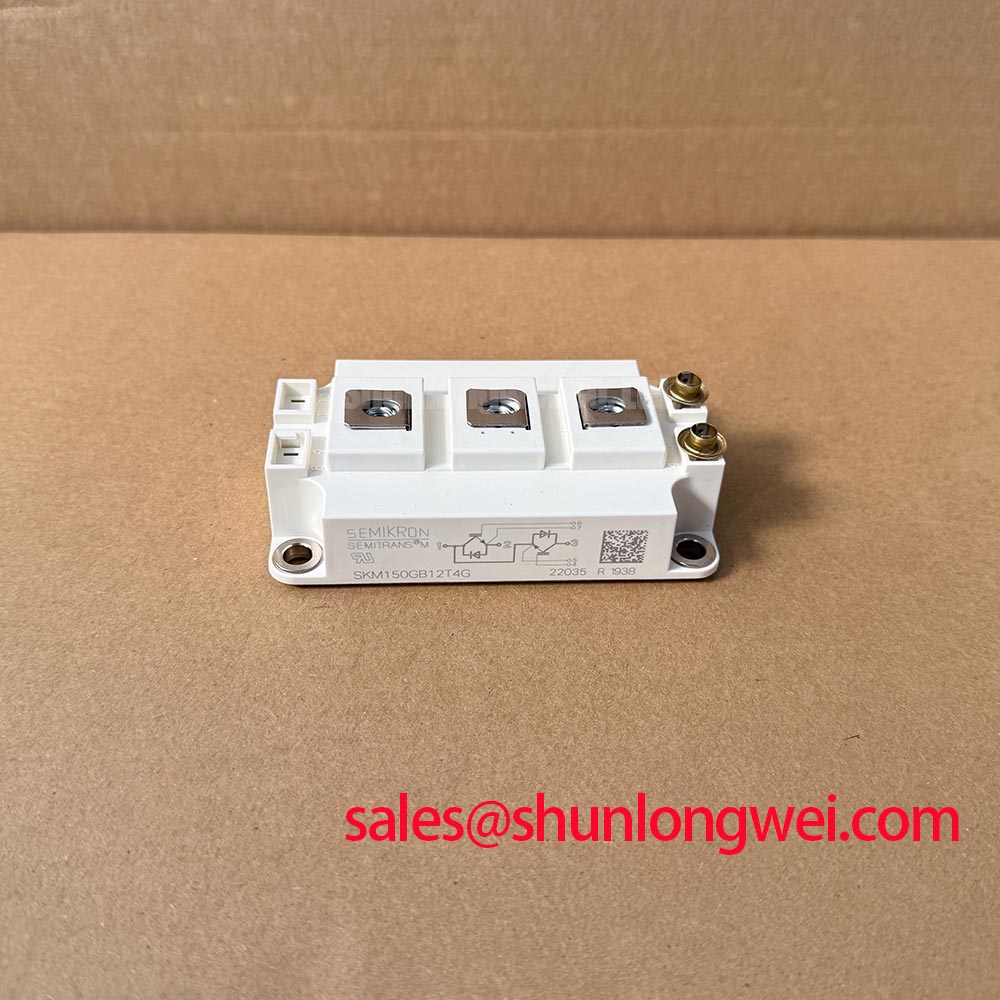
The Semikron SKM100GB124D is a 1200V, 100A half-bridge IGBT module housed in a SEMITRANS 2 package. Featuring a homogeneous Non-Punch-Through (NPT) silicon structure, the module is designed for motor drives, uninterruptible power supplies (UPS), and switched-mode power systems. It provides robust electrical isolation and low switching tail currents to support high-efficiency power stages.
High-Ruggedness 1200V Silicon Switching Block for Industrial Converters
A low-loss 1200V half-bridge NPT IGBT module in a SEMITRANS 2 package designed for high short-circuit ruggedness in industrial inverter drives. This module offers a 1200V blocking rating, 100A continuous collector current at a case temperature of 80 °C, and a low junction-to-case thermal resistance (Rth(j-c)) of 0.18 K/W. Key operational benefits include a self-limiting short-circuit capability up to 6 times the nominal current and solder-free baseplate isolation using Direct Copper Bonding technology. The homogeneous NPT silicon structure eliminates susceptibility to mechanical stress and gate oxide breakdown under heavy industrial vibrations. For 1200V industrial applications prioritizing robust short-circuit ride-through, this 100A module serves as the ideal switching block.
Application Scenarios & Value
Optimizing Performance in Demanding Power Conversion Topologies
Engineers often face the challenge of managing high surge currents and transient thermal loads during the start-up phases of heavy industrial motors. In a typical three-phase AC motor drive application, the startup of a high-inertia load generates massive inductive current spikes. The SKM100GB124D utilizes its robust homogeneous Silicon structure to withstand these startup conditions. Its integrated CAL (Controlled Axial Lifetime) inverse diode features an I2t rating of 6000 A²s, allowing the system to handle these transient return currents without risking overtemperature failure or diode degradation.
The modular design of modern IGBT modules simplifies mounting and layout complexity in high-power converters. While this device is optimized for 100A motor drives, other designs might require alternative specifications. For systems requiring higher current handling capacity, the related SKM200GB124D provides a continuous collector current rating of 200 A, while the SKM100GB125D offers ultra-fast switching optimized for high-frequency induction heating.
Technical Deep Dive
Analyzing Silicon Physics and Thermal Mechanics of the NPT Platform
The N-channel homogeneous silicon structure (Non-Punch-Through) forms the foundation of this module. Unlike punch-through designs that rely on a thin drift region and an n+ buffer layer, the NPT structure uses a thicker, homogeneous wafer. This design naturally limits the short-circuit current to 6 times the nominal current (6 × ICnom) under fault conditions, preventing catastrophic thermal runaway. When assessing IGBT failure modes, overcurrent and thermal stress are the most common drivers of destruction.
What is the primary benefit of the homogeneous NPT structure? It provides excellent short-circuit capability and latch-up free operation under transient stresses. What is the thermal resistance of this module? The junction-to-case thermal resistance per IGBT is 0.18 K/W for reliable heat dissipation.
Direct Copper Bonding (DCB) technology bonds the copper layer directly to the ceramic substrate. This layout minimizes the thermal contact resistance (Rth(c-s) = 0.05 K/W). The Rth(j-c) of 0.18 K/W serves as a thermal highway, ensuring that heat generated at the silicon junction is efficiently transferred to the external heatsink.
Think of thermal resistance as a highway lane width. A lower resistance of 0.18 K/W is like a 10-lane highway that allows thermal energy to flow rapidly from the junction to the baseplate. In contrast, higher thermal resistance acts like a bottleneck, restricting heat dissipation and raising junction temperatures.
The I2t rating of the CAL diode acts like a temporary flood barrier. Just as a dam absorbs a sudden rainfall surge to protect a valley, the 6000 A²s energy absorption capacity safeguards the module against severe regenerative feedback loops during motor braking. Engineers looking for field diagnostics can refer to guides on how to test an IGBT module using standard multimeters.
Key Parameter Overview
Quantifying Electrical and Thermal Bound Limits
| Parameter | Symbol | Value | Unit | Test Conditions / Engineering Context |
|---|---|---|---|---|
| Collector-emitter voltage | VCES | 1200 | V | Maximum blocking voltage limit |
| Continuous collector current | IC | 100 (150) | A | Measured at Tc = 80 °C (Tc = 25 °C) |
| Saturation voltage | VCE(sat) | 2.5 (3.0) | V | Typ. value at IC = 75 A, VGE = 15 V, Tj = 25 °C (Tj = 125 °C) |
| Short-circuit withstand time | tsc | 10 | µs | Tj = 125 °C, VCC = 600 V, VGE = 15 V |
| Thermal resistance (IGBT) | Rth(j-c) | 0.18 | K/W | Junction-to-case per single switch |
| Isolation voltage | Visol | 2500 | V | AC for 1 minute, control to baseplate |
Download the SKM100GB124D datasheet for detailed specifications and performance curves.
Frequently Asked Questions
Resolving Field Engineering and Integration Challenges
- How does the homogeneous NPT structure affect the turn-off tail current in motor drives?
The NPT structure of the SKM100GB124D ensures a low tail current with very low temperature dependence. This minimizes switching losses at high temperatures compared to standard PT technologies, ensuring consistent thermal behavior. - What is the significance of the 10 µs short-circuit withstand time (tsc) for system protection?
A withstand time of 10 µs gives gate drivers enough window to detect desaturation and safely shut down the module before thermal destruction occurs, preventing catastrophic failure. - Why is a negative gate-emitter voltage (-15 V) recommended for turn-off?
Applying a negative voltage prevents parasitic turn-on caused by high dv/dt transients through the Miller capacitance, securing the half-bridge against shoot-through conditions. - How do CAL (Controlled Axial Lifetime) diodes improve system electromagnetic compatibility?
CAL diodes exhibit soft-recovery characteristics during reverse recovery. This soft turn-off reduces voltage overshoot and high-frequency ringing, significantly lowering radiated electromagnetic interference (EMI). - Can the SKM100GB124D be used in parallel configurations for higher current output?
Yes, because NPT IGBTs exhibit a positive temperature coefficient of VCE(sat) at high currents, they naturally share current when paralleled, preventing thermal imbalance and current crowding.
For engineers designing robust power stages, evaluating the thermal performance and transient limits of the SKM100GB124D is a critical step. To discuss technical integration details, check availability, or request detailed pricing for your production run, contact our sales and engineering support team today.