
Content last revised on September 10, 2026
SKM500GA123D: A 1200V 500A IGBT Module for High-Efficiency Power Conversion
An Engineering-Focused Overview
Optimized for Low-Loss, High-Reliability Systems
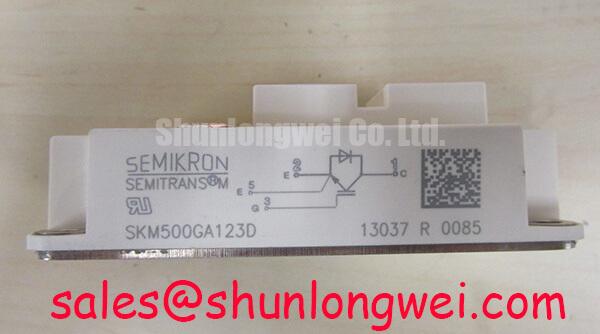
The SKM500GA123D is a SEMITRANS 4 IGBT module from Semikron, engineered to deliver robust performance and high efficiency in demanding power conversion systems. With core specifications of 1200V and 500A, and a typical collector-emitter saturation voltage (VCE(sat)) of 3.0V, this module is built for high-power switching applications. Its key benefits include minimized switching losses, enabled by a very low tail current, and enhanced system reliability through its self-limiting short-circuit capability. This module provides the high current handling and voltage blocking capability essential for developing efficient and robust Variable Frequency Drives (VFDs) and high-power inverters. For high-power inverter designs up to approximately 250kW that require a balance of low switching losses and proven reliability, the SKM500GA123D is an optimal choice.
Key Parameter Overview
Decoding the Specs for Enhanced Switching Performance
The technical specifications of the SKM500GA123D highlight its suitability for high-frequency and high-efficiency applications. A critical parameter is the collector-emitter saturation voltage, VCE(sat). Think of VCE(sat) as the electrical "friction" the current encounters when the switch is fully on. A lower VCE(sat), like the 3.0V (typical) of this module, is analogous to a well-lubricated bearing—less energy is wasted as heat during the on-state, allowing the system to run cooler and more efficiently. This directly reduces conduction losses, a major factor in the overall thermal budget of a power system.
| Parameter | Value | Conditions |
| Collector-Emitter Voltage (VCES) | 1200 V | Tj = 25 °C |
| Continuous Collector Current (IC) | 500 A | Tc = 25 °C |
| Continuous Collector Current (IC) | 420 A | Tc = 80 °C |
| Collector-Emitter Saturation Voltage (VCE(sat)) | 3.0 V (typ) / 3.7 V (max) | IC = 400 A, VGE = 15 V, Tj = 125 °C |
| Gate-Emitter Threshold Voltage (VGE(th)) | 5.5 V (typ) | IC = 16 mA |
| Turn-On/-Off Energy (Eon/Eoff) | 45 mJ / 53 mJ (typ) | IC = 400 A, Tj = 125 °C |
| Operating Junction Temperature (Tvj, op) | -40 to +150 °C |
Download the SKM500GA123D datasheet for detailed specifications and performance curves.
Application Scenarios & Value
Achieving System-Level Benefits in Renewable Energy and Industrial Drives
The SKM500GA123D is an excellent fit for applications where minimizing switching losses is as critical as robust performance under heavy loads. Its feature set translates directly into tangible system-level advantages across several key industrial sectors.
- Solar Inverters: In the design of a 200kW central solar inverter, maximizing energy harvest requires high conversion efficiency. The SKM500GA123D addresses this by featuring a very low tail current, which significantly reduces the turn-off energy (Eoff). This allows engineers to reduce the required heatsink size, leading to a more compact, cost-effective, and reliable inverter.
- Variable Frequency Drives (VFDs): For industrial motor control, the module's high short-circuit capability provides a critical safety margin to handle fault conditions, such as a stalled motor. This robustness, combined with its efficient switching, enables the design of durable and energy-efficient VFDs compliant with modern efficiency standards.
- Uninterruptible Power Supplies (UPS): In high-power UPS systems, reliability and efficiency are paramount. The module's use of Direct Copper Bonding (DBC) technology ensures a low thermal resistance path, improving heat dissipation and enhancing the operational lifetime under continuous load.
While this module is well-suited for these applications, for systems requiring lower current, the related SKM300GA123D offers similar voltage characteristics in a lower power class. For designs needing a half-bridge configuration, the SKM600GB12M7 provides a different topological solution.
Technical Deep Dive
Analyzing the Synergy Between IGBT Design and CAL Diode Performance
A deeper analysis of the SKM500GA123D reveals a thoughtful synergy between its core silicon and integrated components. The module employs an N-channel, homogeneous silicon IGBT, which provides a solid foundation for achieving low conduction losses. However, the true performance advantage lies in its dynamic characteristics, heavily influenced by the integrated freewheeling diode.
This module incorporates a "Fast & soft" CAL (Controlled Axial Lifetime) diode. In power switching, the diode's recovery behavior is critical. A "soft" recovery is analogous to a car with an advanced anti-lock braking system stopping smoothly. In contrast, a "snappy" or hard-recovery diode is like slamming on old brakes—it creates sharp electrical jolts (voltage spikes and high-frequency oscillations) that stress the entire system. The soft recovery of the CAL diode minimizes this electrical "jolting," significantly reducing EMI and improving the reliability of both the IGBT and adjacent components.
Frequently Asked Questions
How does the integrated "Fast & soft CAL diode" in the SKM500GA123D benefit my design?
The soft recovery characteristic of the CAL diode minimizes voltage overshoots and ringing during the diode's turn-off. This reduces electromagnetic interference (EMI), which can simplify filter design and improve EMC compliance. It also lowers the voltage stress on the IGBT, contributing to higher overall system reliability.
What does the "self-limiting short circuit capability" mean for system protection?
It means the module can withstand a direct short-circuit event for a specified duration (typically microseconds) without immediate destruction. The IGBT's internal characteristics limit the peak fault current to a manageable level (e.g., 6 times the nominal current), giving the gate drive and control circuitry time to detect the fault and safely shut the device down. This is a critical feature for building robust Variable Frequency Drives (VFDs).
How does the low tail current characteristic of the SKM500GA123D impact thermal management?
Tail current occurs during the turn-off phase of the IGBT and is a primary source of switching loss (Eoff). By engineering the device for a very low tail current that changes little with temperature, the SKM500GA123D generates less heat during each switching cycle. This reduction in thermal load simplifies heatsink selection, potentially allowing for smaller, lighter, and lower-cost thermal solutions, or enabling higher switching frequencies without thermal runaway.
Is the SKM500GA123D suitable for use in parallel to achieve higher current ratings?
Yes, IGBT modules like the SKM500GA123D can be paralleled, but it requires careful design considerations. Key parameters such as VCE(sat) and VGE(th) have negative temperature coefficients, which can lead to current imbalance. A well-designed gate driver circuit that ensures simultaneous switching and careful thermal and mechanical layout to balance heat distribution are essential for successful paralleling.
Strategic Considerations for System Design
Integrating a component like the SKM500GA123D is a strategic decision that impacts not just electrical performance but also mechanical design and long-term reliability. Its foundation on proven silicon technology from a reputable manufacturer like Semikron provides a baseline of quality and predictable performance. For engineering teams, this means a reduced risk profile and a more streamlined development cycle. The module's characteristics support the broader industry trends toward higher power density and greater energy efficiency, enabling the creation of next-generation power electronics that are more compact, cost-effective, and reliable over their operational lifespan.