Content last revised on September 10, 2026
Vicor VI-252-EY DC-DC Converter: 150V to 15V 50W Power Module Analysis
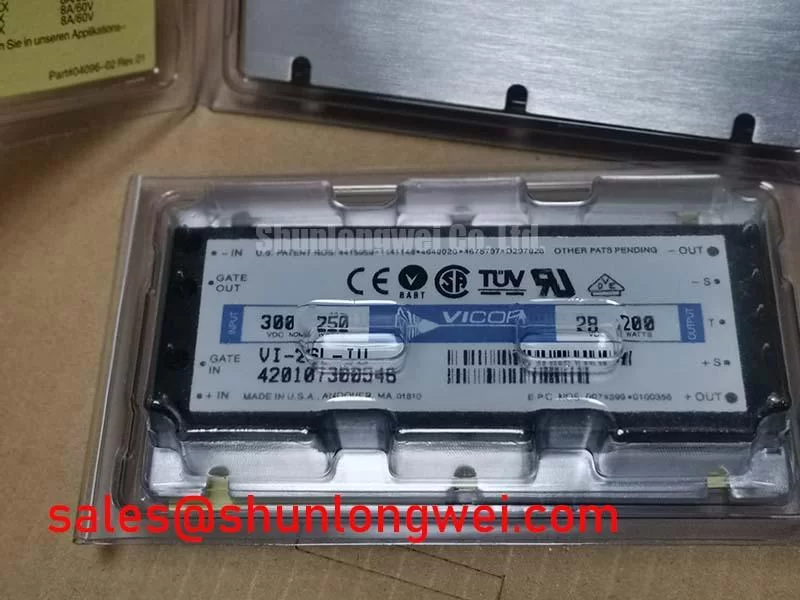
The Vicor VI-252-EY is a high-density, isolated DC-DC Converter module belonging to the legendary VI-200 family. It is specifically designed to transform a wide-range industrial input of 100V to 200V (150V nominal) into a stable, regulated 15V DC output at 50W. Utilizing Vicor patented Zero-Current Switching (ZCS) technology, this module overcomes the efficiency and noise limitations of traditional fixed-frequency pulse-width modulation (PWM) converters. For engineering teams managing high-voltage industrial rails that require a reliable 15V logic or auxiliary supply, the VI-252-EY provides a robust, field-proven solution that prioritizes thermal stability and high power density. Best Fit: For industrial 150V bus systems requiring a stable 15V rail with minimal EMI, this 50W ZCS module is the optimal choice.
Top Specs: 150V DC Input | 15V DC Output | 50W (3.33A)
- Enhanced Reliability: ZCS architecture significantly reduces switching stresses on internal components.
- Superior Thermal Management: Integrated baseplate design allows for flexible mounting to heatsinks or cold plates.
How does the ZCS architecture impact system-level EMI? By switching the power transistors when current is zero, the VI-252-EY minimizes the high-frequency harmonics typically associated with hard-switching converters, simplifying filter design and compliance with electromagnetic standards.
Key Parameter Overview
Decoding the Specs for Enhanced Thermal Reliability
The following technical data reflects the performance standards of the VI-252-EY as established by the Vicor VI-200 series specifications.
| Functional Category | Parameter Description | Specification Value |
|---|---|---|
| Input Specifications | Nominal Input Voltage | 150V DC |
| Input Specifications | Input Range (Continuous) | 100V – 200V DC |
| Output Specifications | Output Voltage | 15V DC |
| Output Specifications | Maximum Output Power | 50W |
| Output Specifications | Maximum Output Current | 3.33A |
| Isolation & Safety | Input-to-Output Isolation | 3,000V RMS |
| Environmental | Operating Temperature (Grade E) | -10°C to +85°C (Baseplate) |
| Mechanical | Dimensions (Standard Brick) | 4.6" x 2.4" x 0.5" |
Download the VI-252-EY datasheet for detailed specifications and performance curves.
Application Scenarios & Value
Achieving System-Level Benefits in High-Voltage Industrial Rails
The VI-252-EY is frequently deployed in Automated Test Equipment (ATE) and industrial automation control systems where a 150V intermediate bus is standard. In these environments, the primary challenge is managing voltage transients and maintaining high conversion efficiency in a compact form factor. The 15V output is ideal for powering Gate Drive circuits, sensors, and analog control logic.
Consider an industrial power distribution system where a 150V rail must support multiple low-voltage sub-systems. Using a high-loss linear regulator or an inefficient PWM converter would necessitate bulky cooling solutions. By integrating the VI-252-EY, engineers can leverage the ZCS technology to reduce heat dissipation, thereby increasing the overall power density of the control cabinet. For systems requiring much higher power levels at the inverter stage, the related BSM50GB120DN2 IGBT module can be paired with this converter to manage the primary power switch logic.
In high-precision applications, the low-noise characteristics of the VI-252-EY reduce the burden on local linear regulators, improving the signal integrity of the downstream sensors. This makes it a strategic choice for medical HMI power stages or precision robotic servo drives, where electrical noise can interfere with sensitive measurements. For further reading on power system optimization, explore our guide on high-efficiency power systems and IGBT module analysis.
Technical & Design Depth
The Engineering Behind Zero-Current Switching (ZCS) Efficiency
The technical core of the VI-252-EY is its ZCS topology. Unlike standard converters that force a transistor to turn off while current is still flowing (hard switching), ZCS is analogous to turning off a water faucet only when the water pressure has naturally dropped to zero. This prevents the "water hammer" effect—which in electronics translates to voltage spikes and switching power losses.
This "soft switching" mechanism allows the VI-252-EY to operate at higher frequencies without a proportional increase in heat generation. Because the switching losses are minimized, the thermal resistance path from the internal silicon to the baseplate is utilized more effectively. For designers, this means that the 50W rating is achievable with simpler heatsink requirements compared to PWM-based competitors. When scaling these designs for EV inverters or high-power UPS systems, understanding the thermal limits of these modules is as critical as selecting the right SKiiP24NAB12T4V3 for the power stage.
Series Internal Comparison & Positioning
Optimizing Selection Within the VI-200 and VI-J00 Families
The VI-252-EY sits within the full-size VI-200 series, which is optimized for maximum power handling and thermal dissipation. For space-constrained applications that still require the 150V to 15V conversion but at lower power levels (typically up to 25W-100W in smaller sizes), the VI-J00 Junior series offers a half-size footprint. However, the full-size VI-252-EY is the preferred choice for industrial environments where ruggedness and thermal management are paramount, as the larger baseplate surface area provides superior heat transfer to the system chassis.
Comparing grades, the "E" in VI-252-EY denotes a standard commercial/industrial temperature range. For aerospace or extreme outdoor deployments, Vicor offers "I" (Industrial) and "M" (Military) grades with wider temperature windows. Designers must ensure that the baseplate temperature does not exceed +85°C to maintain the 50W output without derating.
FAQ
How does the input voltage range of the VI-252-EY affect its performance in industrial 150V systems?
The 100V to 200V input range allows the VI-252-EY to remain operational during significant line dips and surges on a 150V rail. This wide window provides a safety margin against the voltage transients common in PFC stage outputs or battery-backed industrial buses, ensuring the 15V output remains stable even under fluctuating input conditions.
What are the cooling requirements for operating the VI-252-EY at its full 50W capacity?
To maintain a baseplate temperature below +85°C at a full 50W load, the VI-252-EY typically requires either a dedicated heatsink or mounting to a metal chassis that acts as a heat spreader. The ZCS technology keeps efficiency high (typically above 80-90%), but the 5-7W of dissipated heat must be managed to prevent thermal shutdown. For high-power density designs, always refer to Infineon thermal design methodologies as a reference for secondary power stages.
For engineering support regarding the integration of Vicor power modules into your next-generation industrial platform, please consult the full technical documentation. Our team provides data-driven insights to help you optimize power density and system reliability.