

Content last revised on September 10, 2026
VI-2T0-EW | 15V 13.3A DC-DC Converter | High-Efficiency Power Module
Product Overview
High-Density, Low-Noise 200W DC-DC Converter for Demanding Applications
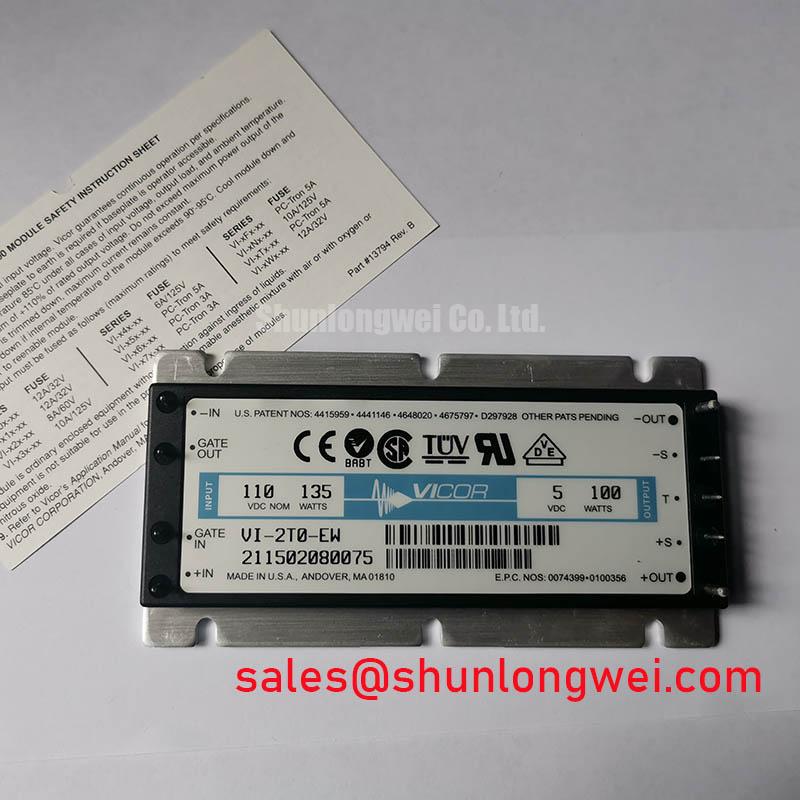
The VI-2T0-EW is a high-efficiency DC-DC converter module engineered to deliver a precisely regulated 15V output from a wide-range DC source, providing a robust power foundation for demanding industrial, communications, and defense systems. Leveraging a high-frequency, zero-current-switching (ZCS) topology, this power component provides exceptional performance in a compact, board-mountable package. Its key specifications include a 300V Nominal Input | 15V Output | 200W Power rating. The primary engineering benefits are significantly simplified thermal management and a drastic reduction in system-level electromagnetic interference (EMI). For engineers asking how to mitigate EMI from power conversion stages, the VI-2T0-EW's integrated ZCS design provides a fundamental solution by minimizing noise at the source. For space-constrained industrial systems requiring a reliable, low-noise 15V rail from a wide DC input, the VI-2T0-EW is the optimal power building block.
Application Scenarios & Value
System-Level Benefits in Distributed Power Architectures
The VI-2T0-EW is a critical enabler for modern Distributed Power Architectures (DPA), where performance and density are paramount. In systems such as ruggedized computing platforms or complex industrial automation controllers, bringing power conversion close to the point-of-load is essential to minimize voltage drop and noise pickup.
Consider a sealed, fanless control unit deployed in a harsh factory environment. A conventional, bulky central power supply would create a thermal hot spot and radiate significant EMI, potentially disrupting sensitive analog sensor inputs. By deploying the compact VI-2T0-EW module directly on the mainboard, designers can provide a clean, isolated 15V rail precisely where it is needed. Its high efficiency of up to 90% drastically reduces dissipated heat, a critical factor for reliable operation within a sealed enclosure and simplifying the overall thermal design. This approach not only improves electrical performance but also allows for a more compact and environmentally resilient end-product.
Key Parameter Overview
Decoding Key Specifications for System Performance
The performance of the VI-2T0-EW is defined by a set of parameters optimized for reliability and efficiency. The table below highlights key specifications and their direct impact on system-level design decisions.
| Parameter | Value | Engineering Significance |
|---|---|---|
| Output Voltage (Vout) | 15 VDC | Provides a standard, regulated voltage for a wide range of analog and digital circuits, operational amplifiers, and sensor interfaces. |
| Output Power (Pout) | 200 Watts | Delivers substantial power in a compact footprint, capable of driving multiple downstream loads or high-power components. |
| Input Voltage Range (Vin) | 100 VDC to 375 VDC | Offers exceptional design flexibility, allowing operation from various sources including rectified 230/277 VAC lines or fluctuating DC buses without requiring a pre-regulator. |
| Efficiency | Up to 90% | Minimizes energy waste as heat, enabling higher power density, smaller heatsinks, and improved system reliability, especially at elevated temperatures. |
| Load Regulation | ±0.2% (No Load to Full Load) | Ensures a stable output voltage under dynamic load conditions, critical for maintaining the precision and performance of sensitive electronics. |
| Switching Frequency | 1 MHz (Nominal) | The high switching frequency allows for smaller magnetic components and capacitors, which is fundamental to the module's high power density. |
Download the VI-2T0-EW datasheet for detailed specifications and performance curves.
Technical Deep Dive
A Closer Look at the Zero-Current-Switching Topology
A defining feature of the VI-2T0-EW is its use of a Zero-Current-Switching (ZCS) resonant topology. Unlike traditional hard-switching converters that force transistors to turn on and off while significant current is flowing, ZCS intelligently times the switching event to coincide with the moment the current naturally drops to zero. What is the key benefit of the ZCS topology? It significantly reduces switching noise and improves EMI performance.
To understand the impact, think of ZCS like closing a door only when no one is passing through. A conventional hard-switching converter is like slamming the door shut while people are still in the doorway—it creates a lot of noise, stress on the hinges, and energy loss. The VI-2T0-EW's ZCS topology waits for the current to naturally fall to zero before acting, virtually eliminating the "slam" and the associated high-frequency electrical noise and switching losses. This inherent low-noise characteristic greatly simplifies the challenge of EMI filter design, saving board space, component cost, and engineering time required to meet stringent regulatory standards.
Industry Insights & Strategic Advantage
Strategic Advantage in Ruggedized and COTS Systems
The VI-2T0-EW module is well-aligned with key industry trends, particularly the move towards ruggedization and the adoption of Commercial Off-The-Shelf (COTS) components in the defense and aerospace sectors. These industries require power modules that are not only electrically robust but also mechanically resilient. The encapsulated design of the VI-2T0-EW provides excellent protection against shock, vibration, and humidity, making it suitable for deployment in challenging operational environments governed by standards like MIL-STD-810.
By leveraging a pre-qualified, high-reliability power module like the VI-2T0-EW, developers can significantly accelerate their design cycle. Instead of undertaking a lengthy, high-risk discrete power supply design, teams can integrate this proven building block, allowing them to focus resources on their core application logic. This COTS strategy reduces development costs, shortens time-to-market, and simplifies the logistics of sourcing and qualification for mission-critical systems.
Frequently Asked Questions (FAQ)
Engineering Questions on Implementation and Performance
What does the 'T' input range designation in the part number signify?
The 'T' designation specifies the wide input voltage range of 100V to 375V DC. This broad range makes the VI-2T0-EW highly versatile, suitable for systems with poorly regulated DC buses or for direct connection to rectified high-voltage AC mains.
How does the 90% efficiency rating impact heatsink selection?
With 200W of output power, a 90% efficiency means only about 22W is dissipated as heat. This low thermal load allows for the use of a much smaller, lighter heatsink compared to a less efficient converter, which might dissipate 40W or more. This directly contributes to higher overall system power density and lower physical weight.
Can multiple VI-2T0-EW modules be paralleled for higher power?
Yes, these modules are designed to be easily paralleled for redundancy or higher power output. The current sharing is typically managed by connecting the PC pins of the modules together, which ensures they share the load current evenly without the need for complex external balancing circuitry.
What is the primary benefit of the module's 1 MHz switching frequency?
The high switching frequency is a core reason for the module's excellent power density. It allows for the use of very small inductors and capacitors within the module. For the system designer, this also pushes the fundamental ripple frequency higher, making it easier and less costly to filter out.
Is an external input filter required for the VI-2T0-EW?
While the module's ZCS topology inherently minimizes generated noise, system-level conducted EMI requirements (such as those from the FCC or CISPR) will typically necessitate an external input filter. The low noise signature of the module simplifies the filter's design, often allowing for a smaller and more cost-effective solution.
Design & Integration Considerations
From an engineering standpoint, integrating the VI-2T0-EW is a straightforward process focused on maximizing its inherent advantages. Proper layout to ensure short, low-impedance connections is key. The module's high efficiency reduces the thermal burden, but a well-designed thermal path to a heatsink or chassis is still critical for ensuring long-term reliability under full load conditions. By leveraging its low-noise characteristics and wide input range, designers can develop compact, robust, and compliant power solutions with an accelerated time-to-market.