Content last revised on September 10, 2026
VUB72-12NOXT IXYS/Littelfuse: 1200V 75A Rectifier Bridge with Brake Chopper
The VUB72-12NOXT maximizes drive reliability by consolidating a 1200V rectifier bridge, an insulated gate bipolar transistor (IGBT) brake chopper, and an NTC thermistor onto a highly conductive DCB ceramic base plate. Key specifications include a 1200V maximum reverse voltage, 75A diode average rectified current, and an IGBT saturation voltage of 1.85V. By combining these stages within a single V1-A-Pack module, engineers reduce parasitic inductance and minimize assembly complexity. Why use an integrated brake chopper? It simplifies DC link overvoltage protection during rapid motor deceleration. This architecture is specifically targeted at industrial motion control where space and thermal margins are strictly constrained.
Key Parameter Overview
Decoding the Specs for Enhanced Thermal Reliability
To support rapid evaluation, the table below highlights the most critical voltage, current, and thermal indicators that dictate the operational boundaries of this component.
| Functional Stage | Parameter | Value | Engineering Implication |
|---|---|---|---|
| Rectifier Bridge | Maximum Peak Reverse Voltage (V_RRM) | 1200V | Provides sufficient headroom for stable operation on 400V to 480V AC lines. |
| Rectifier Bridge | Average Rectified Current (I_FAV) | 75A | Defines the continuous current handling capability at a case temperature of 110°C. |
| Brake Chopper (IGBT) | Collector-Emitter Saturation Voltage (V_CE(sat)) | 1.85V | Ensures low conduction losses during dynamic braking events. |
| Brake Chopper (IGBT) | Collector Current (I_C) | 40A | Determines the peak regenerative energy dissipation capacity. |
| Thermal | Junction-to-Case Thermal Resistance (RthJC) | 1.1 K/W (Diode) | Dictates heatsink requirements; lower values prevent thermal runaway. |
Download the VUB72-12NOXT datasheet for detailed specifications and performance curves.
Application Scenarios & Value
Achieving System-Level Benefits in High-Frequency Power Conversion
For compact 400V variable frequency drives requiring built-in dynamic braking, this 1200V integrated module is the optimal choice. In high-inertia applications like industrial conveyor belts or heavy-duty mixers, motors frequently alternate between accelerating massive loads and rapidly decelerating them. During deceleration, the motor acts as a generator, forcing energy back into the drive and causing the DC link voltage to spike.
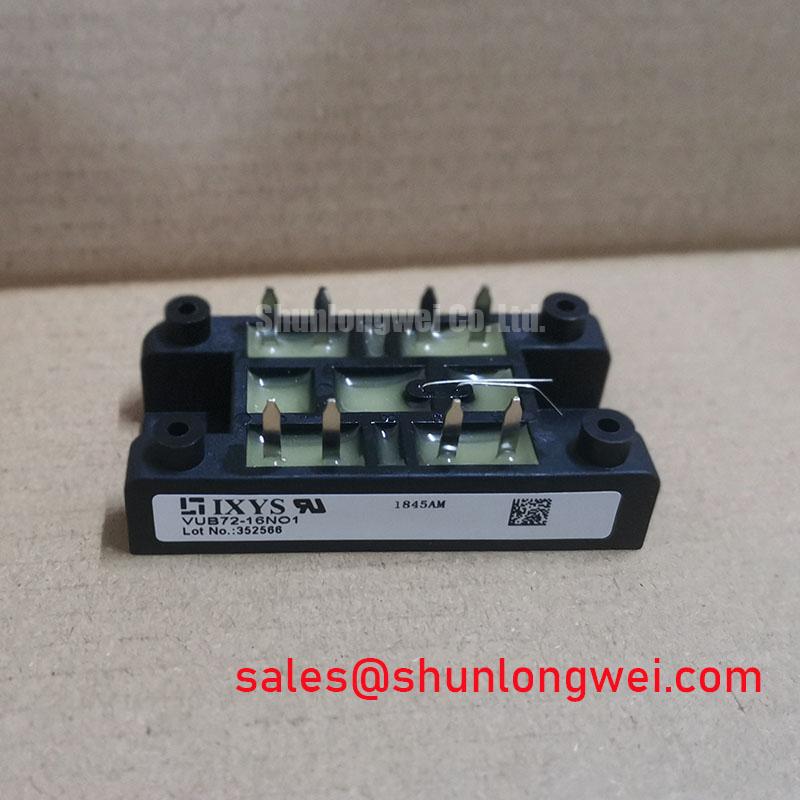
Managing this regenerative energy typically requires external discrete components, which add layout complexity and increase stray inductance. The VUB72-12NOXT solves this by integrating the brake chopper directly alongside the input rectifier. When the DC link voltage exceeds a safe threshold, the internal 40A IGBT activates, shunting the excess energy through an external resistor. This protects the DC link capacitors from catastrophic overvoltage while maintaining a compact footprint. Furthermore, for systems exposed to higher transient overvoltages, the related VUB72-16NO1 offers an upgraded 1600V rating, providing an extra layer of design safety.
Technical Deep Dive
A Closer Look at the DCB Architecture and Thermal Intelligence
The structural foundation of the VUB72-12NOXT is its isolated Direct Copper Bonded (DCB) ceramic base plate. This material choice is fundamental to the module's power density. Think of the DCB plate as a dedicated multi-lane highway for heat; it rapidly transports thermal energy away from the silicon junctions while maintaining a robust electrical isolation barrier of 3000V. This dual-purpose characteristic eliminates the need for individual insulating pads under discrete devices, effectively lowering the overall thermal resistance and preventing localized hotspots during heavy load cycles.
Complementing the DCB is the embedded NTC (Negative Temperature Coefficient) thermistor. Rather than relying on a heatsink-mounted sensor, which introduces thermal lag, the internal NTC thermistor acts like a localized temperature radar. It provides the central controller with real-time, highly accurate temperature data directly from the substrate. This allows the drive software to implement dynamic derating or trigger safe shutdowns long before the junction temperature approaches its 150°C maximum limit. Understanding these thermal integration techniques is crucial; you can explore broader IGBT module design principles to see how packaging drives overall system longevity.
FAQ
Field Engineering Inquiries and System Integration Answers
- How does the 1200V rating benefit a standard 400V industrial line application?
A 1200V blocking capability provides a necessary safety margin against grid fluctuations, switching transients, and lightning-induced voltage spikes. For a nominal 400V AC input, the rectified DC voltage sits around 565V. The 1200V rating ensures the module remains well within its Safe Operating Area (SOA) even during severe transient events.
- What specific thermal advantages does the V1-A-Pack package provide?
The V1-A-Pack utilizes an isolated ceramic baseplate that allows all internal components (rectifier, chopper, and NTC) to share a single, highly efficient thermal path to the heatsink. This integration eliminates the cumulative thermal impedance found in multi-component discrete layouts.
- Can the integrated NTC thermistor directly switch the control logic in a drive system?
No, the NTC thermistor outputs an analog resistance value that varies inversely with temperature. It must be connected to an external signal conditioning circuit (typically a voltage divider feeding into an MCU's ADC) to translate this resistance into actionable thermal data for the system's control logic.
- How does the integrated brake chopper manage the generated regenerative energy?
The brake chopper itself does not dissipate the bulk of the energy. Instead, the internal IGBT acts as a high-speed switch. When the DC link voltage rises too high, the IGBT turns on, routing the excess current into an external braking resistor where the electrical energy is converted to heat and safely dissipated.
The shift toward tightly integrated power stages reflects a broader industry mandate: achieving higher power density without sacrificing operational lifespan. By evaluating how components address both electrical switching and thermal extraction simultaneously, engineers can build more resilient motion control architectures capable of withstanding the rigors of modern automated manufacturing.