Content last revised on October 24, 2026
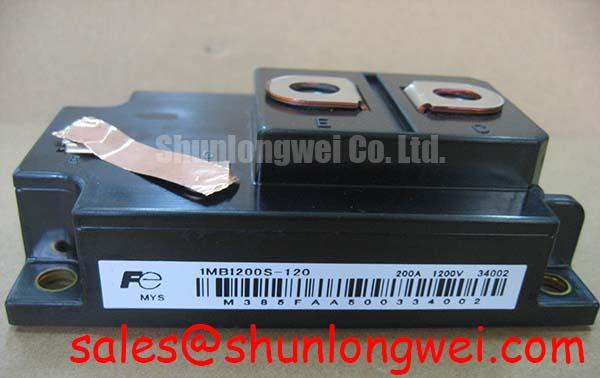
With the DC link discharged and the module disconnected from its driver, match the collector, emitter, and gate markings to the equipment schematic before making cold measurements. The Fuji Electric 1MBI200F-120 is an IGBT module with official specifications of 1200 V collector-emitter blocking voltage and 200 A continuous collector current at a case temperature of 80°C. Record the case temperature alongside incoming inspection results so later comparisons have a meaningful baseline.
Other official specifications include ±20 V gate-emitter absolute maximum voltage, 1500 W maximum collector power dissipation per device, and 2500 V AC isolation withstand for one minute. The specified typical collector-emitter saturation voltage is 2.7 V at a gate-emitter voltage of 15 V; this is a powered conduction characteristic, not an expected multimeter diode-mode reading.
Assembly Integrity & Layout Architecture: Implementing Heatsink Surface Flatness and Thermal Grease for 1MBI200F-120
Inspect the module mounting surface and heatsink for burrs, embedded debris, scoring, and uneven contact before applying thermal grease. As a design consideration, check flatness against the applicable mechanical drawing rather than assuming the baseplate must be perfectly flat or have a particular convex profile. Do not grind the module mounting surface to correct an apparent mismatch.
Use a thermal interface material compatible with the assembly, spreading it according to the material supplier’s instructions and the module mounting requirements. Tighten progressively in a diagonal sequence with a calibrated tool, using the specified fastener torque. Neither an arbitrary grease thickness nor a generic bolt torque establishes correct contact for this module.
The official 1500 W dissipation rating is a device limit under its stated thermal conditions, not a heatsink cooling specification. As a design consideration, assess interface contact and cooling performance over the actual load cycle. For bidirectional battery conversion, reducing avoidable case-temperature excursions can help manage thermal cycling stress without implying a quantified service-life extension.
Transient Dynamics & Electrical Design: Optocoupler vs Digital Coreless Transformer on 1MBI200F-120
Compare gate-driver isolation, propagation-delay variation, and common-mode transient immunity at the driver level before choosing between optocoupler and coreless-transformer implementations. Neither architecture alone establishes adequate immunity to switching-node transients. As a design consideration, the required ratings depend on working voltage, insulation coordination, and measured switching conditions.
The module’s official 2500 V AC for one minute isolation rating does not establish reinforced isolation for an external driver or authorize repeating that test across arbitrary terminals. Use the prescribed test connections and acceptance procedure. Manufacturer technical resources from Fuji Electric Global Power Semiconductor Technologies and Fuji Electric Europe Semiconductor & Power Electronics provide relevant reference points for module application guidance.
For complementary switching positions, assess dead time against driver-delay spread and measured turn-off behavior, with interlocking that prevents overlapping commands. Keep the gate-drive return close to its outgoing path. The ±20 V gate rating is an absolute boundary, not a recommended drive amplitude. The IGBT Design & Integration reference provides additional context for coordinating gate drive, protection, and thermal assessment.
Field Diagnostics & Commissioning: Diagnosing Latent Gate-Emitter Dielectric in 1MBI200F-120 Topologies
Use diode-check mode across the identified main terminals with the gate held at emitter potential, recording polarity and comparing results with an equivalent known-good module under matching conditions. Where the circuit diagram identifies an antiparallel diode, assess its forward and reverse behavior separately. Parallel circuit paths and residual gate charge can alter readings, so isolate the module before interpreting an apparent short.
💡 Bench Tip: Use ESD protection and hold the gate at emitter potential during cold comparisons to avoid charging the gate through the meter leads. A handheld meter can reveal gross gate-to-emitter leakage or a short, but it cannot certify dielectric integrity or exclude latent damage. Any controlled leakage measurement should follow the manufacturer’s test conditions.
During replacement assessment, compare the 1MBI300S-120 only as a separate candidate requiring electrical, mechanical, and gate-drive review, not as an established drop-in substitute. For electric material-handling or forklift low-voltage traction equipment, evaluate the actual switching losses, drive compatibility, and mounting arrangement; the voltage rating alone does not establish suitability.
Assembly Integrity & Layout Architecture: Implementing Damping of Tail Current Oscillations during Recovery for 1MBI200F-120
Separate IGBT turn-off tail current from diode reverse-recovery behavior when examining switching traces. As a design consideration, correlate collector voltage, current, and gate voltage using appropriately rated probes; probe-loop pickup can resemble genuine ringing. Reverse-recovery peak current and softness depend on operating conditions and should not be assigned unsupported values for this module.
Minimize commutation-loop inductance through compact outgoing and return conductor geometry, including closely coupled busbar paths where appropriate, then verify turn-off overshoot against the blocking limit. Evaluate gate resistance or an RC snubber through measured switching loss and transient behavior rather than fixed recipes. In motor-drive installations, assess long-cable reflections at the motor terminals separately from module-terminal overshoot, selecting any output filtering from the measured cable and motor response.