Content last revised on September 10, 2026
High-Performance Power Switching: Engineering the 2MBI200F-060 IGBT Module
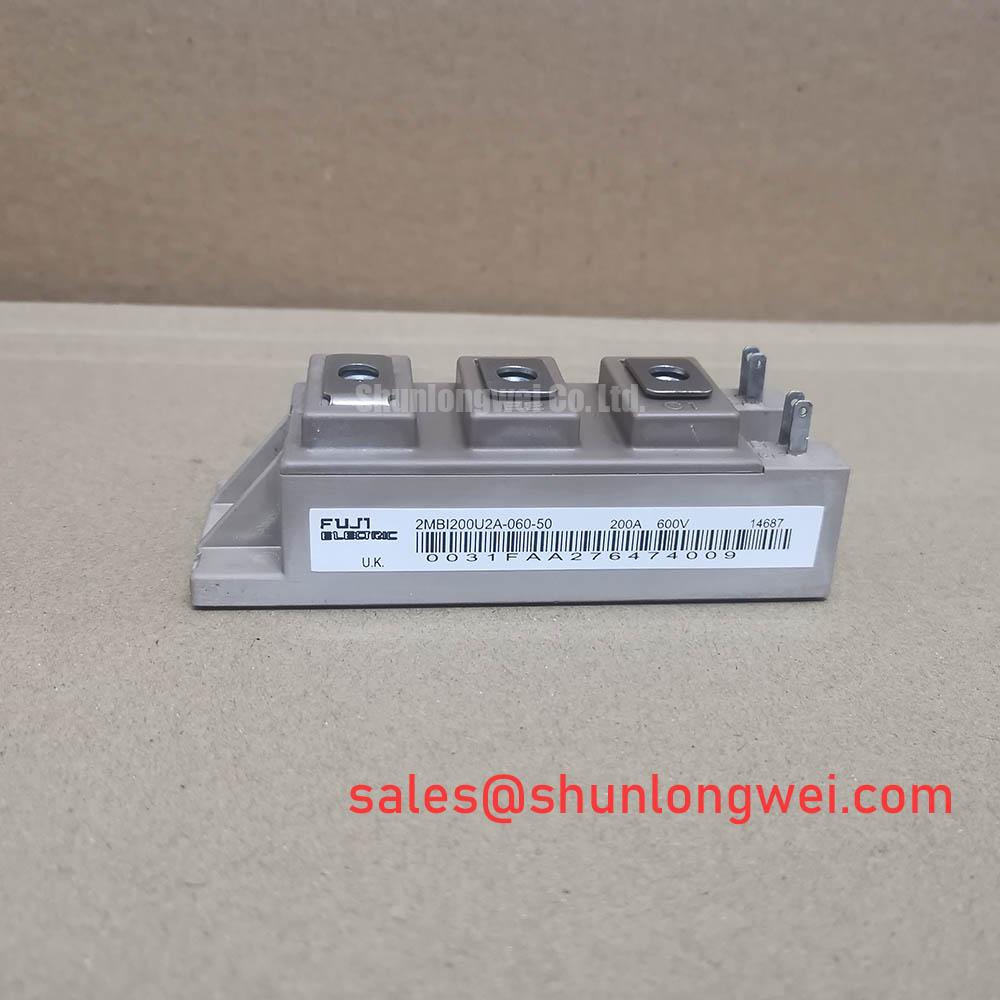
The 2MBI200F-060 is a high-speed IGBT module from Fuji Electric, designed to provide a robust solution for medium-voltage power conversion. With its dual-pack configuration, this module integrates two IGBT chips into a single package to streamline inverter circuit design. It functions as a high-efficiency switch, handling 600V and 200A while maintaining low power dissipation. This technical profile focuses on how its specific saturation characteristics and switching speeds empower engineers to build reliable Variable Frequency Drives (VFDs) and Uninterruptible Power Supplies (UPS).
Top Specs: 600V | 200A | Vce(sat) 2.1V (Typical)
Key Benefits: Reduced switching losses for high-frequency operation; Integrated freewheeling diode for voltage spike suppression.
How does the 2MBI200F-060 address thermal management in compact enclosures? By maintaining a low collector-emitter saturation voltage, it minimizes heat generation during the conduction phase, allowing for smaller heatsink footprints in 600V industrial power blocks. For 690V systems requiring higher voltage overhead, the 2MBI200F-060 serves as a high-density benchmark for 400V-480V line applications.
Key Parameter Overview
Decoding the Specs for Enhanced Switching Reliability
The performance of the 2MBI200F-060 is defined by its thermal stability and efficiency under load. To understand its role in a power stage, engineers must look beyond the peak ratings to the dynamic switching characteristics. This module utilizes planar technology to balance ruggedness with speed.
| Functional Category | Parameter Description | Typical Value / Rating |
|---|---|---|
| Voltage & Current | Collector-Emitter Voltage (Vces) | 600V |
| Voltage & Current | Continuous Collector Current (Ic) | 200A |
| Switching Characteristics | Vce(sat) at Ic=200A, Tj=25°C | 2.1V |
| Switching Characteristics | Turn-on Time (ton) | 0.6µs |
| Thermal Limits | Junction Temperature Range (Tj) | -40 to +150°C |
| Mechanical Data | Package Type | M235 Dual-Pack |
Download the 2MBI200F-060 datasheet for detailed specifications and performance curves.
Application Scenarios & Value
Optimizing Power Conversion in Industrial Motor Drives
In the context of industrial automation, the 2MBI200F-060 is frequently deployed in the inverter stage of motor control systems. A common challenge for engineers is managing the high-frequency switching noise and heat in Servo Drives. The low gate charge of this Fuji Electric module allows for faster gate driver response, which translates to cleaner switching transitions and lower electromagnetic interference (EMI).
Consider a scenario where an engineer is designing a power source for industrial welding. The high duty cycle requires a module that can withstand repeated thermal cycling without wire bond fatigue. The 2MBI200F-060 uses an insulated base plate that facilitates efficient heat transfer to the cooling system. For systems that demand even higher current handling within a similar voltage class, the related 2MBI200VA-060 offers a comparable current rating with specialized high-speed characteristics. Utilizing these modules correctly involves a deep understanding of how an IGBT works to optimize dead-time and prevent cross-conduction in half-bridge topologies.
Technical Deep Dive
Planar Technology and the Physics of Low Conduction Loss
The internal architecture of the 2MBI200F-060 is based on a planar gate structure. This mature technology is favored for its predictable behavior during short-circuit events and its relative ease of driving compared to some trench-gate alternatives. The Vce(sat)—the saturation voltage—can be thought of as the "friction" the current encounters when the switch is fully open. A value of 2.1V means that for every 200A flowing through the module, approximately 420W of conduction loss is generated per switch.
Analogy: Imagine a water pipe with a valve. The Vce(sat) is like the pressure drop across that valve when it is wide open. A lower pressure drop means more energy reaches the motor rather than being wasted as heat. This efficiency is critical for maintaining long-term reliability and preventing the IGBT failure modes associated with overtemperature. By choosing a planar module with stable temperature coefficients, engineers can parallel multiple units with less risk of current hogging.
Industry Insights & Strategic Advantage
Sustainability Through Efficient Power Conversion
As global regulations for industrial energy efficiency tighten, the selection of power semiconductors becomes a strategic decision for OEMs. The 2MBI200F-060 addresses the "Efficiency First" mandate by minimizing the energy lost during the DC-to-AC conversion process. In modern grid-tie inverters, reducing losses by even 1% can result in significant cost savings over the 10-year lifespan of a system. This module aligns with the technical requirements of IEC 61800-3 standards for adjustable speed electrical power drive systems.
FAQ
What is the primary benefit of the dual-pack configuration in the 2MBI200F-060? It allows for the construction of a full-bridge or three-phase inverter with fewer discrete components, reducing parasitic inductance and simplifying the PCB or busbar layout.
How does the switching frequency affect the thermal performance of this module? As the switching frequency increases, the energy lost during the transitions (Eon and Eoff) becomes the dominant heat source. For applications above 15kHz, engineers must carefully calculate the total losses to ensure the junction temperature remains within the 150°C limit.
The 2MBI200F-060 remains a staple for designers who prioritize a balance of proven reliability and straightforward thermal management. By leveraging its high-speed switching capabilities, engineers can achieve higher power density in industrial motor drives and power supplies. For procurement and design teams, evaluating this module against current system requirements is a key step in ensuring long-term field stability.