
Content last revised on September 10, 2026
Fuji Electric 6MBI50J-120A IGBT Module: Technical Analysis and Specifications
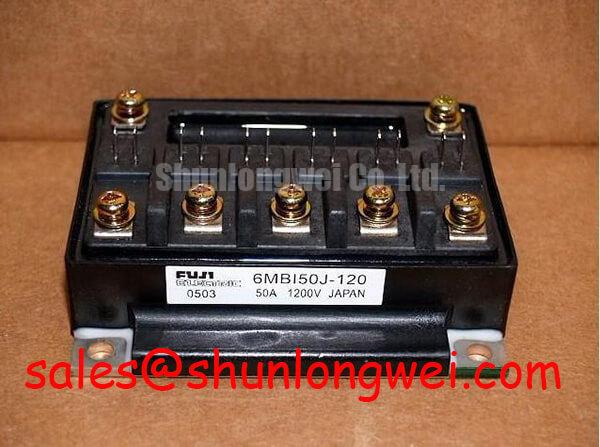
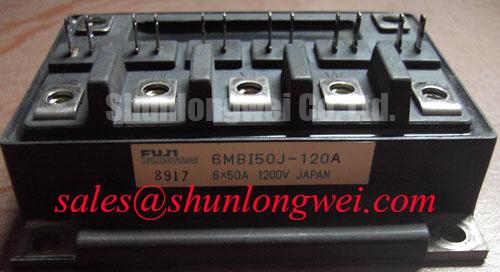
For three-phase inverter designs requiring 1200V isolation and 50A peak capability, the 6MBI50J-120A provides a highly efficient, compact solution. This high-reliability IGBT Module manufactured by Fuji Electric integrates six IGBTs into a single housing to streamline motor drive layouts. With a maximum power dissipation of 400W and 2500V AC isolation, it solves critical thermal and space constraints. Active designs benefit from its optimized switching performance.
Key Parameter Overview
Functional Grouping of Electrical and Thermal Ratings
We group the specifications of the Fuji Electric 6MBI50J-120A into three primary areas: electrical, thermal, and physical. This grouping allows engineering teams to easily cross-reference absolute maximum limits during design reviews.
| Functional Group | Specification Parameter | Value / Rating |
|---|---|---|
| Electrical Characteristics | Collector-Emitter Voltage (VCES) | 1200V |
| Gate-Emitter Voltage (VGES) | ±20V | |
| Continuous Collector Current (IC) | 50A (at Tc=25°C) | |
| Pulsed Collector Current (ICp) | 100A | |
| Thermal and Isolation | Max Power Dissipation (PC) | 400W |
| Isolation Voltage (Viso) | 2500V AC (1 minute) | |
| Physical and Operating | Operating Junction Temp (Tj) | Up to 150°C |
| Typical Net Weight | 510g |
Application Scenarios & Value
Optimizing Efficiency in Medium-Power Industrial Converters
Industrial design teams face challenges when engineering motor control platforms. Standard drives require compact solutions to manage starting surge currents without triggering thermal runaway. The 6MBI50J-120A addresses this by housing a complete three-phase inverter bridge in one module. This configuration simplifies circuit layout and reduces stray inductance.
This module serves as a reliable building block for variable frequency drives, solar inverters, and industrial uninterruptible power supplies. By integrating the switches, designers avoid paralleling multiple discrete components, reducing system complexity. To gain a deeper understanding of module configurations, you can consult the engineers ultimate guide to IGBT modules.
Selecting the correct topology is vital when designing active front-ends. Engineers can reference the IGBT vs MOSFET vs BJT selection guide to evaluate tradeoffs between switching speeds and conduction losses. This is particularly relevant in systems like IGBTs in inverter applications, where thermal efficiency directly impacts operating lifetimes.
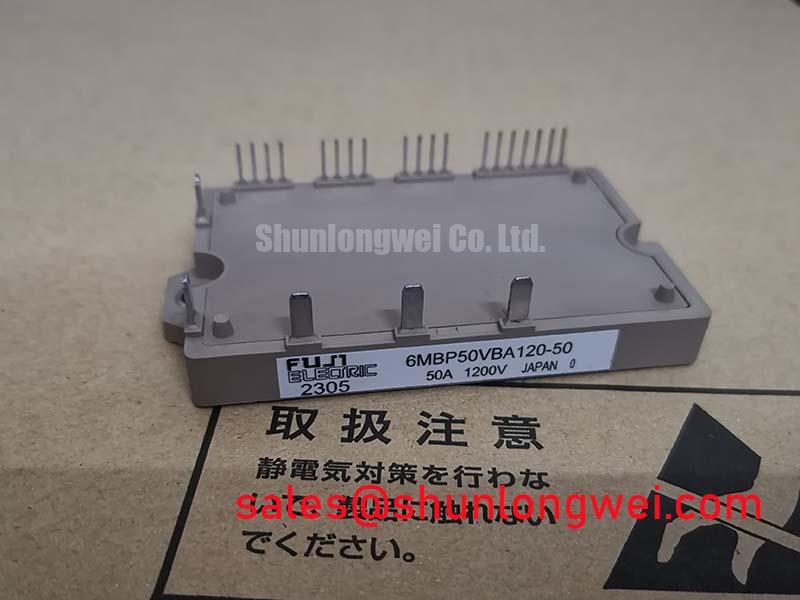
For designs requiring alternative configurations, several related components are available. If your layout requires a different packaging footprint, the 6MBI50S-120-02 offers a similar 1200V 50A rating. Alternatively, for half-bridge topologies, the 2MBI50N-120 provides a dual-pack configuration, while the 7MBR50VP120-50 integrates a converter-inverter-brake layout.
Technical & Design Deep Dive
Mitigating Switching Losses and Managing Thermal Boundaries
Achieving high power density requires careful control over switching transients. The Fuji Electric 6MBI50J-120A utilizes an optimized gate structure to minimize input capacitance. This design reduces gate charge demands, allowing engineers to utilize smaller gate drive circuits. By decreasing turn-on and turn-off times, the module lowers switching losses during high-frequency operation.
VCE(sat) represents the on-state voltage drop across the collector-emitter junction when the device is fully turned on. To put this in perspective, think of the collector-emitter channel as a water pipe. A high collector-emitter saturation voltage functions like a narrow, rough pipe that restricts flow. This restriction creates high friction (conduction losses) and generates unwanted heat. Conversely, a lower drop acts like a smooth, wide pipe, minimizing friction.
Managing the heat generated during these transitions is another critical design challenge. Let us use a thermal analogy: think of thermal resistance (Rth(j-c)) as a highway. A high thermal resistance behaves like a congested two-lane road, trapping heat inside the junction. In contrast, a low Rth(j-c) serves as an open superhighway, allowing heat to escape quickly to the heat sink, keeping the junction temperature safely below 150°C.
Design teams can study the characteristics of the Fuji Electric V-Series IGBT lineup to understand how advanced packaging technologies achieve these thermal margins.
Frequently Asked Questions
Engineering Queries and Design Clarifications
How does the isolation rating of the 6MBI50J-120A protect control-side electronics?
The module provides 2500V AC isolation for one minute, preventing high-voltage transients from damaging low-voltage controller circuitry.
What is the primary benefit of its integrated 6-pack configuration?
It integrates a complete three-phase bridge in a single package.
How does low switching loss improve system design?
It reduces heatsink size requirements and enhances power density.
To integrate this high-performance module into your next converter design, explore our inventory and request a technical quote from our product experts today.