Content last revised on September 10, 2026
6MBI75S-120-01 Operational Boundaries: Evaluating SCSOA Overcurrent Protection: Implementing Limits
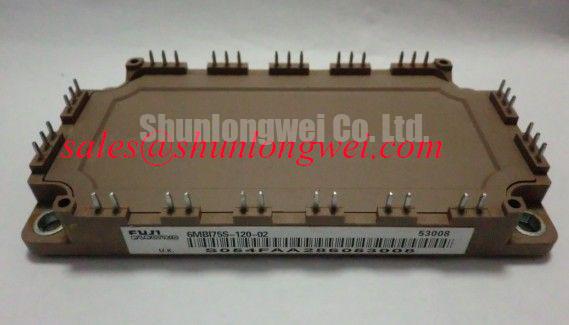
Before energizing a replacement, inspect the package and terminals for mechanical damage, confirm the nameplate rating, and compare cold resistance readings with a known-good power path. The Fuji Electric 6MBI75S-120-01 is a high-power IGBT module specified for a maximum collector-emitter voltage of 1200 V, a rated collector current of 75 A, and total power dissipation of 600 W. These are official specification values supplied for engineering evaluation; actual operating limits remain dependent on switching conditions, heatsink performance, gate-drive control, and the complete traction inverter design.
| Parameter | Official Specification |
|---|---|
| Manufacturer | Fuji Electric |
| Product category | IGBT Module |
| Collector-emitter voltage, VCES | 1200 V |
| Rated collector current, IC | 75 A |
| Total power dissipation, PC | 600 W |
| Collector-emitter saturation voltage, VCE(sat) | 2.30 V typical |
| Gate-emitter threshold voltage, VGE(th) | 6.0 V typical |
| Turn-on time, ton | 0.35 µs |
| Turn-off time, toff | 0.45 µs |
| Isolation voltage, VISO | 2500 V AC for 1 minute |
For a forklift or warehouse vehicle traction inverter, the first protection task is to identify whether an overcurrent event develops during startup, regenerative braking, or a stalled motor condition. The listed turn-on and turn-off times describe switching behavior, but they do not by themselves define a short-circuit safe operating area. Designers should verify the applicable Fuji Electric short-circuit withstand data, gate-drive response, desaturation detection method, and DC-link conditions before implementing protection.
A practical protection review should confirm that the current-sensing path detects abnormal conduction quickly, then applies a controlled turn-off sequence rather than removing gate drive abruptly. A two-stage soft turn-off approach may reduce the rate of current change and associated inductive overshoot, but its timing and gate resistance must be validated on the actual module, busbar, motor cable, and load. Oscilloscope testing should capture collector-emitter voltage, gate-emitter voltage, phase current, and fault response under controlled conditions. Keep the high-current commutation loop compact, provide suitable creepage and clearance for the working voltage, and verify peak voltage against the module rating during switching tests.
In a replacement assessment, the 2MBI400TB-060-01 may be reviewed as a separate high-power module reference, but its electrical ratings and gate-drive requirements must not be treated as interchangeable with this device.
6MBI75S-120-01 Thermal-Electrical Optimization: DC-Bus Operating Voltage Headroom Derating Practical Tuning
The 1200 V VCES rating is an absolute device boundary, not a target DC-bus operating voltage. Bus-voltage selection should account for regenerative rise, stray inductance, braking transients, temperature, control delay, and the measured switching overshoot. Claims about terrestrial neutron flux, single-event burnout, FIT rate, altitude derating, or lifetime require a qualified reliability source and cannot be inferred from the ratings listed above.
Thermal verification should begin with a clean heatsink, an even interface layer, and a mechanically stable mounting surface. The specified 600 W total power dissipation must not be interpreted as available dissipation under every ambient condition; the system thermal path determines the permissible junction temperature and current duty. Check fan operation, airflow direction, blocked filters, and enclosure condensation after cold starts. Gate interlock design should prevent complementary devices from conducting at the same time, while dead-time must be established from the driver delay, module switching behavior, temperature, and measured commutation waveform rather than copied from an unrelated inverter.
For rectifier coordination or an auxiliary power stage, engineers can review the 2MBI200UR-120-01 as a separate circuit element. The voltage, current, isolation, and thermal interfaces of that device require independent confirmation.
Preventing Spurious Faults: Derating Guidelines and Mismatched Parameter Guidelines for 6MBI75S-120-01
The typical 2.30 V VCE(sat) value is useful for estimating conduction loss, but it is not a guaranteed value across current, temperature, gate voltage, and production tolerance. IGBT modules connected in parallel should use symmetrical power paths and matched gate-loop geometry so that dynamic current sharing can be measured rather than assumed. The positive temperature coefficient commonly associated with conduction voltage can support static sharing, yet it does not eliminate transient imbalance during turn-on or turn-off.
When a traction inverter reports intermittent overcurrent or desaturation faults, inspect gate supply stability, driver reference connections, connector seating, current-sensor alignment, and the physical routing of power and control conductors. Compare gate-emitter and collector-emitter waveforms with a known-good phase. A mismatch may indicate parasitic coupling, driver timing variation, or an abnormal load condition; confirm the cause through measurement instead of assigning the fault to the module alone. The Fuji Electric Europe Semiconductor and Power Electronics resource provides manufacturer-level technical context for power semiconductor evaluation.
⚠️ Maintenance Note: Isolate the DC link before inspection, and periodically check heatsink cleanliness, interface-material condition, terminal tightness, and contact temperature under comparable load.
Preventing Spurious Faults: Thermal Cycling Margins of Internal Braking Guidelines for 6MBI75S-120-01
Regenerative braking in electric material handling equipment can return substantial energy to the DC link. Whether the braking function uses an internal arrangement or a separate braking IGBT depends on the inverter topology and the original equipment documentation; this product page does not establish an internal braking circuit for the 6MBI75S-120-01. The braking switch and ballast resistor must be evaluated against deceleration energy, duty cycle, resistor temperature, DC-link rise, switching transients, and enclosure airflow.
Thermal cycling review should include repeated acceleration and braking tests, not only a steady-load measurement. Monitor module case temperature, heatsink temperature, resistor temperature, bus voltage, and fault timing. A resistor that absorbs one braking event may still be unsuitable for repeated warehouse duty if its cooling path or pulse-energy capability is insufficient. Surge suppression, including a properly coordinated MOV network where appropriate, should be selected from the complete bus transient profile; the MOV must not be treated as a substitute for correct commutation layout or braking control.
Gate-loop inductance and Miller coupling can produce unintended gate movement during rapid collector-voltage transitions. Designers should evaluate the gate waveform at the module terminals, consider active clamping only when supported by the complete gate-drive architecture, and verify the resulting voltage margin experimentally. Additional application background is available in the Industrial Applications reference. For forklift traction service, final approval should be based on measured thermal cycling, braking energy, insulation testing, and switching waveforms in the intended equipment.