Content last revised on October 18, 2026
Field Diagnostics & Commissioning: Protection Coordination for 6MBP75RA060 Topologies
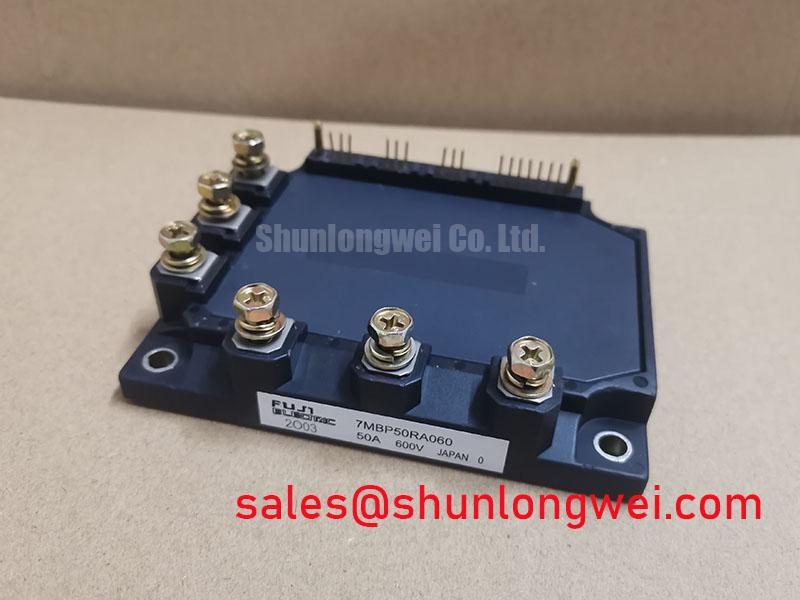
When a forklift traction inverter reports an overcurrent fault, isolate the DC link, wait for the control circuit to discharge, and compare the cold state resistance and diode readings of the removed power module with a known good unit. The Fuji Electric 6MBP75RA060 is specified for a 600 V collector emitter voltage and a 75 A DC collector current at TC = 80°C, making those two ratings the first electrical boundaries to check against the original drive design.
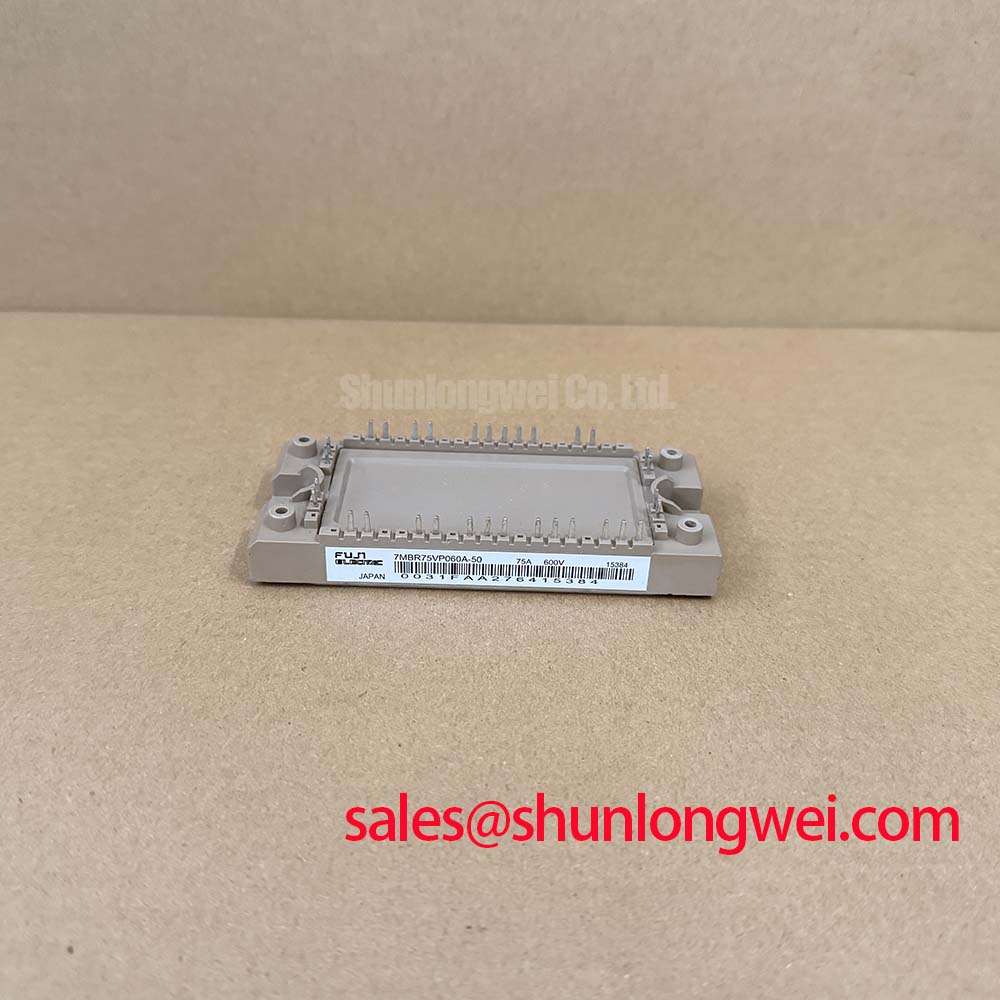
For incoming inspection, confirm the part marking, terminal identification, mounting condition, and insulation path before applying any powered test. The listed maximum collector emitter saturation voltage is 2.8 V at IC = 75 A, while the antiparallel freewheeling diode has a listed maximum forward voltage of 3.0 V at −IC = 75 A. These values are official specification points for loss estimation, not substitutes for a complete switching and thermal validation.
The module also lists an overheating protection temperature of approximately 125°C and an isolation voltage of 2500 V AC for one minute. The isolation rating should be compared with the equipment safety architecture and test procedure rather than treated as an independent certification for the complete forklift controller. The device may be evaluated in electric material handling equipment, forklift traction inverters, and related motor drive cabinets when the original electrical, mechanical, and thermal interfaces match.
Protection coordination begins with matching the semiconductor protection fuse clearing behavior to the switching module’s short circuit stress, rather than selecting a fuse from the 75 A current rating alone. A fuse that interrupts a DC link fault too slowly can expose the IGBT chips and bond connections to excessive energy; a fuse that clears aggressively without coordinating with the drive topology can create a severe voltage transient across the module. The complete protection study should therefore include the fuse total clearing I²t, DC link voltage, prospective fault current, bus impedance, and the module’s applicable short circuit and surge data from the engineering documentation.
For a forklift traction controller, inspect the positive and negative DC link paths, braking chopper branch, phase output conductors, and fuse mounting points as related parts of the power circuit. Loose laminated bus connections, oxidized contact surfaces, or a replacement fuse with a different clearing curve can alter the fault waveform even when the nominal current rating appears correct. Keep the high current path compact and physically separated from gate drive signal wiring. The objective is to reduce unintended inductive voltage rise and prevent the gate circuit from being exposed to the switching event.
A MOV network can assist with clamping externally driven overvoltage events, but its voltage class, energy capability, leakage behavior, and coordination with the DC link must be selected by the system designer. The MOV should not be treated as a replacement for a correctly rated semiconductor fuse, a low inductance bus structure, or a validated snubber. During commissioning, monitor the DC link at the module terminals and inspect the clamp waveform during controlled switching tests. A clamp that remains inactive during normal operation but responds before the module’s voltage boundary is a design objective; its actual margin must be demonstrated on the assembled inverter.
When a drive trips after a fuse replacement, record the fault sequence before replacing the module again. Check whether the trip occurred during acceleration, regenerative braking, battery charging, or a rapid direction change. Inspect the gate driver supply, desaturation protection path, phase current feedback, and brake resistor circuit. Cold resistance readings between power terminals can identify a gross short circuit, but they cannot prove that the gate insulation, freewheeling diode, or dynamic switching behavior remains healthy.
The 6MBP75RA060’s listed 75 A current rating is specified at TC = 80°C; therefore, the heatsink interface, airflow, switching frequency, modulation method, and overload duration remain part of the system assessment. In a low voltage forklift traction system, a battery powered DC link can deliver substantial fault energy even when the motor operates at a moderate mechanical power level. The fuse and contactor arrangement must interrupt the available battery and capacitor energy under the actual wiring conditions.
| Official parameter | Specified condition | Value | Commissioning relevance |
|---|---|---|---|
| Collector emitter voltage | VCES | 600 V | Check DC link transients and switching overshoot |
| DC collector current | IC, TC = 80°C | 75 A | Compare with thermal and duty cycle calculations |
| Collector emitter saturation voltage | IC = 75 A | 2.8 V maximum | Use for conduction loss estimation |
| Freewheeling diode forward voltage | −IC = 75 A | 3.0 V maximum | Include diode conduction intervals in loss analysis |
| Isolation voltage | AC for one minute | 2500 V | Compare with the approved isolation test method |
For a neutral same family comparison, engineers may review the electrical and mechanical documentation for 6MBP100RTB060. That reference should be treated as a separate device evaluation. Pin arrangement, gate drive behavior, protection functions, and thermal limits must be checked independently before any substitution is considered.
💡 Bench Tip: Use an ESD controlled bench, keep the module unpowered and fully discharged, and record cold diode polarity and forward voltage against a known good reference before connecting the gate driver.
6MBP75RA060 Thermal Electrical Optimization: Diode Softness and Practical Tuning
The freewheeling diode is central to thermal optimization because its reverse recovery current interacts with the opposite IGBT during turn on. A high peak reverse recovery current or a steep recovery slope can increase commutation overshoot, radiated disturbance, and local heating. The listed 3.0 V maximum forward voltage at −IC = 75 A helps estimate diode conduction loss, but it does not define reverse recovery softness, peak recovery current, or dynamic switching loss.
Begin tuning by capturing the phase node voltage, DC link voltage, gate emitter voltage, and phase current with suitable differential and current probes. Compare the recovery event at several load currents and temperatures. A sharp current excursion that coincides with a voltage spike may indicate excessive loop inductance, unsuitable gate resistance, diode recovery interaction, or probe measurement error. Adjustments should be made one variable at a time so that the effect of the gate network, bus structure, and snubber can be separated.
An RC snubber can damp a ringing component when its placement, voltage rating, pulse energy, and thermal dissipation are appropriate for the assembled power loop. The component values are system determined; they should be selected from measured ringing frequency, damping behavior, and switching loss rather than copied from an unrelated inverter. An RCD clamp or MOV arrangement may address a different transient mechanism, so the protection network must be evaluated at the exact module terminals and operating temperature.
Gate resistance is another practical tuning variable. A larger turn on resistance can reduce current slew rate and recovery interaction, while excessive damping may increase switching loss and junction temperature. Use the gate driver manufacturer’s voltage limits and the Fuji Electric application data as the governing references. The module’s official saturation voltage is a static loss parameter and should not be confused with a desaturation protection threshold.
Desaturation protection belongs to the external gate driver and protection circuit. A fast fault response is desirable, but a target such as a sub three microsecond response must be validated against the driver blanking interval, propagation delay, noise immunity, and the actual short circuit current rise. The 6MBP75RA060 listing does not establish that timing as an internal module specification. A practical two stage soft turn off arrangement can first limit the gate drive energy and then complete turn off at a controlled rate, provided the driver and module are tested together.
For battery powered traction systems using bidirectional DC DC charging and regenerative braking, thermal cycling can be more important than a single peak current event. Compare the calculated IGBT and diode losses with the heatsink temperature, baseplate interface condition, fan performance, and enclosure temperature. Repeated battery charge and discharge transitions should be tested while monitoring the temperature response of the module and the surrounding bus components. No universal lifetime hours figure should be assigned without a defined mission profile, thermal model, material stack, and validated cycling test.
Long motor cables can behave as transmission lines at fast switching edges. Reflected voltage may increase the phase node peak beyond the value observed at the inverter output. Cable length, motor impedance, termination behavior, common mode path, and switching speed all influence the result. Designers should evaluate the motor terminal waveform and, where required, use a properly rated output filter or dv/dt control network. The module’s 600 V VCES rating remains an absolute device boundary, while the allowable operating margin is determined by the complete switching waveform.
General packaging references can help explain why thermal interfaces and assembly materials matter, but they do not confirm the internal construction of this Fuji Electric module. Background information on PPS high temperature engineering plastics and silver sintering should therefore be used only as general materials context, not as evidence of a specific internal material stack in the 6MBP75RA060.
6MBP75RA060 Operational Boundaries: Evaluating Isolation Barrier Integrity and Limits
Isolation verification should start with the module’s official 2500 V AC one minute isolation voltage rating and the test configuration used by the equipment manufacturer. Disconnect sensitive gate driver electronics, control wiring, sensors, and communication interfaces before applying any production insulation test. The test voltage, ramp rate, dwell time, leakage limit, and discharge process must follow the approved safety procedure for the complete assembly.
The listed isolation value is not the same as a reinforced-insulation certification or a common-mode transient immunity specification. Those characteristics are system-level design considerations only when required by the gate driver, isolation barrier, or equipment standard. The 6MBP75RA060 data supplied here should not be represented as confirming either characteristic.
During a gate fault investigation, compare the high side and low side gate emitter references with isolated probes. Look for a gate pulse that appears during a rapid phase transition, a disturbed driver supply, or an unexpected change in the isolated feedback signal. Such behavior may arise from common mode coupling, insufficient driver supply decoupling, parasitic gate inductance, poor probe reference, or an isolation component outside its operating conditions. The corrective action should follow the measured signal path rather than assume that the power module alone caused the event.
Minimize the physical area of the gate drive loop and keep its return path paired with the gate path. Separate high di/dt collector and emitter conductors from control traces, avoid routing sensitive signals parallel to the phase output, and connect the driver reference according to the module pin arrangement. The actual clearance and creepage requirements belong to the equipment insulation system and applicable safety standard. They must account for pollution, altitude, coating, enclosure design, and working voltage.
For industrial forklift controllers, the isolation test should be repeated after mechanical assembly, busbar installation, cable routing, and enclosure closure. A passing bench test can change after a conductive washer, damaged insulator, contaminated heatsink, or misplaced shield is introduced. Check that the heatsink and baseplate arrangement does not unintentionally bridge the isolation barrier. The module’s approximate 125°C overheating protection temperature should also be considered when interpreting thermal trips, but a protection event is not a substitute for measuring the actual case and heatsink temperature.
Application engineers can use the technical guidance in IGBT Design & Integration when reviewing gate drive layout, thermal management, and switching topology. In the final commissioning record, retain the cold static readings, isolation test conditions, fuse coordination data, switching waveforms, thermal observations, and motor cable configuration so that future service work can be compared with the original operating baseline.