
Content last revised on September 10, 2026
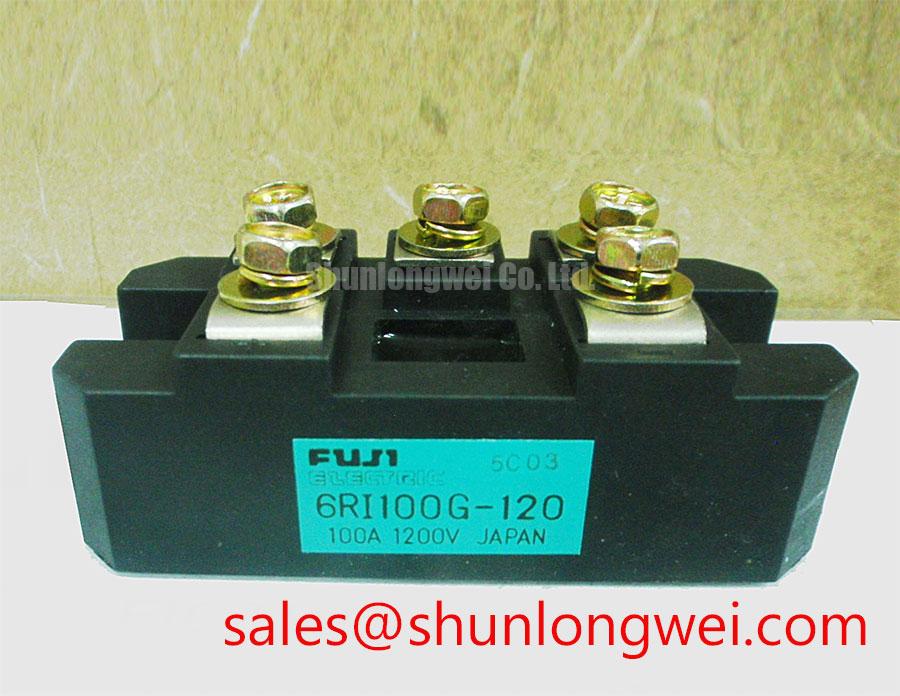
Fuji Electric 6RI100G-120 Three-Phase Diode Bridge Module for Industrial Power Conversion
The 6RI100G-120, a cornerstone of the Fuji Electric power semiconductor lineup, provides high-efficiency AC-to-DC rectification for demanding 400V-class industrial systems. Featuring a 1200V repetitive peak reverse voltage and a 100A average forward current rating, this three-phase diode bridge is designed to withstand the rigors of heavy-duty power cycles and high-temperature environments.
1200V | 100A | 3-Phase Bridge
- Enhances system longevity through high surge current ($I_{FSM}$) handling capabilities.
- Reduces cooling requirements with optimized junction-to-case thermal resistance.
What is the primary benefit of its glass-passivated chip structure? It ensures high voltage stability and prevents leakage current degradation under thermal stress. For industrial drives prioritizing thermal margin in 400V AC grids, this 1200V module is the optimal choice for the input rectification stage.
Application Scenarios & Value
Achieving System-Level Benefits in High-Frequency Power Conversion
Engineers often face the challenge of managing input inrush currents and thermal spikes in Variable Frequency Drive (VFD) designs. In a typical industrial motor control application, the 6RI100G-120 serves as the primary rectification stage, converting 380V-480V AC utility power into a stable DC bus voltage. The module's robust 100A rating ensures it can handle the startup current of large inductive loads without premature failure.
In Uninterruptible Power Supply (UPS) systems, the reliability of the input bridge is non-negotiable. The 6RI100G-120 utilizes high-purity materials to minimize forward voltage drop, which translates directly to lower heat generation and higher overall system efficiency. For engineers designing more complex power stages, this module pairs effectively with downstream switching components. For instance, systems requiring high-power switching might utilize the 2MBI200NB-120 as the inverter stage following the DC rectification provided by the 6RI100G-120. Similarly, for integrated power management in smaller drives, the 6MBP25VAA120-50 offers an alternative topology for different power densities.
Technical & Design Deep Dive
Engineering Thermal Pathways for Long-Term Reliability
The internal architecture of the 6RI100G-120 is engineered to function like a "thermal highway." Heat generated at the diode junction must be moved to the heatsink with minimal impedance. Fuji Electric achieves this by using a high-conductivity ceramic isolation layer that provides 2500V AC isolation while maintaining low thermal resistance ($R_{th(j-c)}$). This allows for higher power densities in compact cabinet designs where airflow may be restricted.
Analytically, the 1200V rating provides a necessary safety buffer against transient voltage spikes common in industrial power grids, such as those caused by lightning or large-scale load switching. This "overhead" is critical for complying with IEC 61800-3 standards regarding electromagnetic compatibility and surge immunity. The glass-passivation technology applied to the diode chips acts as a molecular shield, protecting the sensitive PN junctions from moisture and ionic contaminants, which is a common cause of failure in industrial welding equipment or outdoor power enclosures.
When compared to discrete diode solutions, the integrated 3-phase bridge package significantly reduces parasitic inductance. By minimizing the length of the internal interconnects, the 6RI100G-120 reduces the risk of voltage ringing during high-load transitions. For a deeper understanding of how these modules fit into broader power architectures, engineers can explore the engineers' ultimate guide to power modules.
Key Parameter Overview
Decoding the Specs for Enhanced Thermal Reliability
The following specifications are derived from official technical documentation to support precise engineering calculations and component selection.
| Absolute Maximum Ratings (at Tc=25°C unless specified) | |
|---|---|
| Repetitive Peak Reverse Voltage ($V_{RRM}$) | 1200V |
| Non-Repetitive Peak Reverse Voltage ($V_{RSM}$) | 1320V |
| Average Output Current ($I_O$) | 100A (3-Phase Full Wave, Tc=101°C) |
| Surge Forward Current ($I_{FSM}$) | 1200A (1 cycle, 50/60Hz) |
| Isolation Voltage ($V_{isol}$) | 2500V AC (1 minute) |
| Junction Temperature ($T_j$) | -40 to +150°C |
| Electrical and Thermal Characteristics | |
|---|---|
| Forward Voltage Drop ($V_{FM}$) | Max. 1.30V (at $I_F$=100A) |
| Reverse Leakage Current ($I_{RRM}$) | Max. 10mA (at $V_R$=$V_{RRM}$) |
| Thermal Resistance ($R_{th(j-c)}$) | Max. 0.24 °C/W |
Download the 6RI100G-120 datasheet for detailed specifications and performance curves.
Frequently Asked Questions
How does the 1200A surge current ($I_{FSM}$) rating of the 6RI100G-120 impact fuse selection in the PFC stage?
The high $I_{FSM}$ allows engineers to select faster-acting fuses that protect the downstream IGBTs while ensuring the diode bridge itself survives the initial charging of the DC-link capacitor bank. This creates a more robust protection coordination scheme for industrial welder applications.
Why is the Rth(j-c) of 0.24 °C/W significant for the thermal management of a 100A bridge?
A lower thermal resistance means that for every watt of power lost as heat, the junction temperature rises by only 0.24°C relative to the case. This efficiency allows the 6RI100G-120 to operate at full 100A load even at higher baseplate temperatures, reducing the size and cost of the required external heatsink.
For procurement professionals and design engineers, ensuring the reliability of the input stage is the first step toward a failure-resistant power system. By leveraging the technical strengths of the Fuji Electric 6RI100G-120, systems gain the durability required for the next generation of high-efficiency industrial automation. Technical insights into these structures are further detailed in our deep dive into power module technology. For more information on Thermal Management or Gate Drive optimization, visit the Infineon technical resources page.