Content last revised on September 10, 2026
CM75TF-12H: Engineering a Balance of Efficiency and Durability in Power Conversion
An In-Depth Analysis of the H-Series Six-IGBT Module
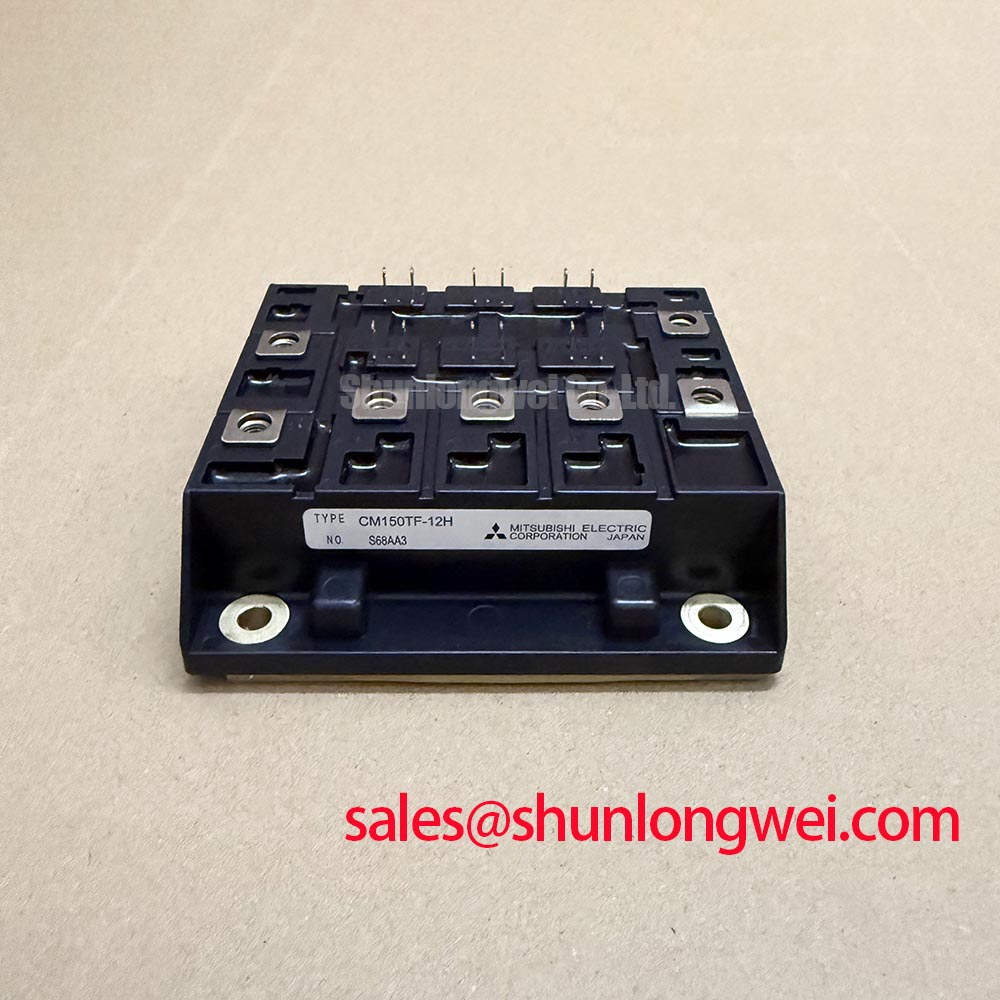
The Mitsubishi CM75TF-12H is an H-Series IGBT module engineered to provide a precise balance between low conduction losses and robust, high-frequency switching performance. With core specifications of 600V and 75A, this module integrates six IGBTs and six super-fast recovery free-wheel diodes in a full three-phase bridge configuration. A key performance metric is its low typical collector-emitter saturation voltage (V_CE(sat)) of 2.2V, which directly contributes to higher operational efficiency by minimizing heat generation. This design addresses the critical need for reliable power stages in dynamic, high-speed applications. For motor drives or servo systems requiring higher current handling at the same voltage class, the CM150DY-12H offers an increased current rating.
Key Parameter Overview
Highlighting the Core Metrics for System Design
The technical specifications of the CM75TF-12H are foundational to its performance in demanding power systems. The parameters below have been selected to provide engineers with the critical data needed for thermal modeling, gate drive design, and reliability assessment.
| Parameter | Symbol | Test Conditions | Value |
|---|---|---|---|
| Collector-Emitter Voltage | V_CES | V_GE = 0V | 600V |
| Collector Current (DC) | I_C | T_C = 25°C | 75A |
| Peak Collector Current | I_CM | Pulse | 150A |
| Collector-Emitter Saturation Voltage | V_CE(sat) | I_C = 75A, V_GE = 15V | Typ. 2.2V / Max. 2.7V |
| Thermal Resistance (Junction to Case, per IGBT) | R_th(j-c) | - | Max. 0.35°C/W |
| Diode Forward Voltage | V_EC | I_E = 75A | Max. 2.7V |
| Operating Junction Temperature | T_j | - | -40 to +150°C |
Download the CM75TF-12H datasheet for detailed specifications and performance curves.
Application Scenarios & Value
Achieving System-Level Benefits in High-Frequency Power Conversion
For systems engineers designing Variable Frequency Drives (VFDs) or motion control systems, the CM75TF-12H provides a distinct advantage in managing thermal performance and efficiency. The module's low V_CE(sat) of 2.2V at its nominal current directly translates to lower conduction losses. In a VFD application, this means less waste heat is generated within the power stage during motor operation. This characteristic is not just a number; it allows for a smaller, more cost-effective heatsink or enables the drive to operate reliably at higher ambient temperatures without derating. This thermal efficiency is crucial for creating more compact and power-dense industrial automation equipment, a key objective in modern factory design.
The integrated nature of this three-phase module simplifies the assembly process compared to using discrete components. By housing all six IGBTs and their corresponding free-wheeling diodes in a single isolated baseplate, the CM75TF-12H reduces component count, simplifies the PCB layout, and minimizes parasitic inductance, which is critical for clean switching at frequencies up to 20-25 kHz. This integrated approach accelerates time-to-market for applications including general-purpose inverters, Servo Drives, and Uninterruptible Power Supplies (UPS). Understanding these device-level specifications is crucial for optimizing system performance, a topic further explored in our guide to decoding IGBT datasheets.
Technical Deep Dive
A Closer Look at the H-Series Trade-offs for Switching Performance
The designation "H-Series" signifies that the CM75TF-12H is engineered to balance on-state losses and switching losses, a critical trade-off in power electronics design. The module utilizes Mitsubishi's advanced trench-gate technologies to achieve its low V_CE(sat). Think of the V_CE(sat) as the "toll" the current pays to pass through the switch when it's on. A lower toll means less energy is wasted as heat. The CM75TF-12H achieves this low toll without excessively slowing down its switching speed, making it suitable for high-frequency Pulse Width Modulation (PWM) schemes used in motor control.
What is the primary benefit of its integrated design? Simplified thermal management and assembly by isolating all components from the baseplate. The inclusion of a discrete, super-fast recovery free-wheel diode (FWDi) is another deliberate design choice. In an inductive load application like a motor, the diode's performance during the turn-off phase is critical. A fast and "soft" recovery minimizes voltage overshoots and reduces electromagnetic interference (EMI). This helps engineers meet stringent EMC standards and improves overall system reliability. For more insights on ensuring device longevity, a practical guide on preventing common IGBT failure modes can provide valuable context.
Frequently Asked Questions (FAQ)
What is the primary engineering advantage of the CM75TF-12H's low V_CE(sat)?
The typical V_CE(sat) of 2.2V at 75A significantly reduces conduction losses (P_cond = V_CE(sat) * I_C). This leads to lower operating temperatures and higher overall system efficiency, allowing for more compact heatsink designs and improved power density.
How does the three-phase bridge configuration benefit system design?
It integrates six IGBTs and six free-wheeling diodes into a single, electrically isolated module. This drastically simplifies mechanical assembly, reduces the complexity of busbar and gate drive layouts, and minimizes stray inductance, which is crucial for mitigating voltage spikes during high-speed switching.
What does the "H-Series" designation imply for this module's application?
The "H-Series" typically denotes a balance between low saturation voltage and fast switching speeds. This makes the CM75TF-12H well-suited for applications like motor control and UPS, which operate at moderate to high switching frequencies (e.g., up to 25 kHz) and require both high efficiency and robust performance.
Is the CM75TF-12H suitable for hard-switching topologies?
Yes, the module is designed for hard-switching applications. The inclusion of a discrete super-fast recovery free-wheel diode with a typical reverse recovery time (t_rr) of 70ns is specifically intended to handle the stresses of hard switching in bridge configurations, minimizing switching losses and improving reliability.
Strategic Considerations for System Integration
Integrating the CM75TF-12H into a power system offers a strategic pathway to achieving a balance of performance, reliability, and manufacturing efficiency. Its design characteristics are particularly aligned with the industry trend towards more compact, energy-efficient power conversion systems. The module's consolidated three-phase topology serves to de-risk the power stage design by providing a pre-validated, thermally-managed component, allowing engineering teams to focus on higher-level system control and software development. This approach can shorten design cycles and enhance the overall robustness of the final product.