




Content last revised on September 10, 2026
FS100R12KE3_B3: Engineering Analysis of a 1200V, 100A TRENCHSTOP™ IGBT3 Module
Product Overview: FS100R12KE3_B3
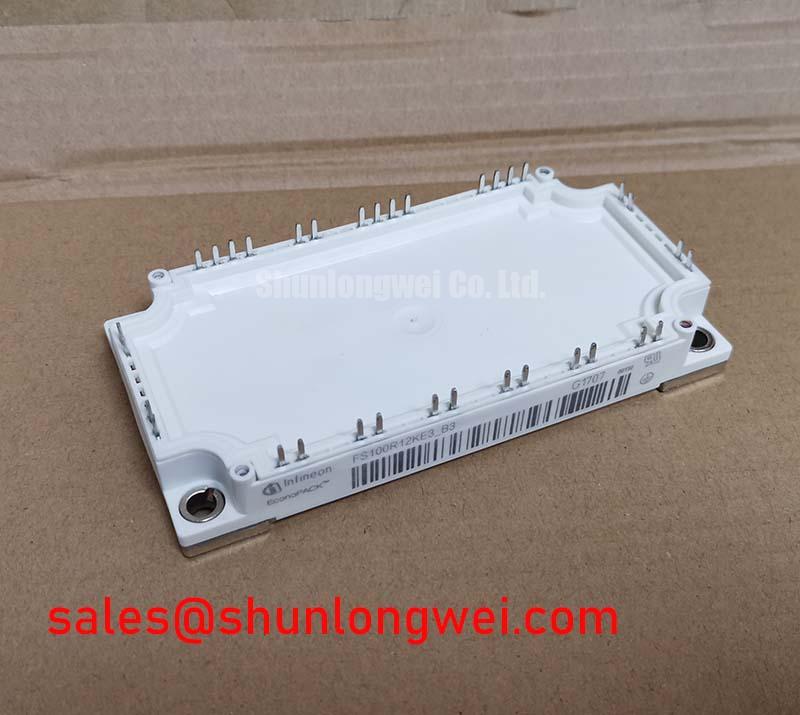
The Infineon FS100R12KE3_B3 is a 1200 V, 100 A sixpack IGBT module engineered for high-reliability industrial applications. It combines proven TRENCHSTOP™ IGBT3 technology with the industry-standard EconoPACK™ 3 housing to offer a robust foundation for power conversion systems. Key specifications include: 1200V | 100A | VCE(sat) (typ.) 1.70V. This integration delivers two primary engineering benefits: superior thermal management and simplified mechanical design. For engineers designing for 380V to 480V AC line-fed inverters, the 1200V blocking voltage provides a substantial safety margin against transient overvoltages. With its well-balanced switching and conduction losses, this module is an optimal choice for variable frequency drives requiring high operational reliability and efficiency.
Application Scenarios & Value
System-Level Benefits in Industrial Motor Control and Power Conversion
The FS100R12KE3_B3 is engineered to address the demanding operational cycles of modern industrial motor drives and power converters. Its primary value lies in providing a thermally stable and reliable power stage, which is a critical factor in minimizing system downtime and maintenance costs. What is the primary benefit of the EconoPACK™ 3 housing? It offers a standardized footprint and excellent thermal interface, simplifying heatsink selection and manufacturing processes.
Consider a high-performance Variable Frequency Drive (VFD) controlling an industrial conveyor system. The challenge is maintaining consistent performance under fluctuating loads, which causes significant temperature swings in the power module. The FS100R12KE3_B3's low thermal resistance from junction to case (Rth(j-c) of 0.29 K/W per IGBT) acts like a wide-open channel, efficiently evacuating heat from the silicon chip to the heatsink. This superior thermal transfer capability prevents the junction temperature from exceeding its maximum limit, even during high-torque motor starts. This robust thermal design, combined with an integrated NTC thermistor for real-time temperature feedback, allows engineers to design a more compact and cost-effective cooling system while ensuring the drive's long-term operational reliability. The result is a more durable system capable of withstanding the rigors of an industrial environment.
While this 100A module is well-suited for a wide range of mid-power applications, for systems with lower power requirements, the related FS75R12KE3 provides a similar voltage class in a 75A rating. For a deeper understanding of thermal design, refer to our guide on mastering IGBT thermal management.
Key Parameter Overview
Decoding the Specs for Thermal Stability and Switching Efficiency
The technical specifications of the FS100R12KE3_B3 reflect a design philosophy focused on balance and reliability. The parameters below are critical for system-level design, directly influencing efficiency, thermal performance, and overall durability. Understanding these values is the first step in leveraging the module's full potential.
| Specification | Value (Typical, unless stated) | Engineering Implication |
|---|---|---|
| Collector-Emitter Voltage (V_CES) | 1200 V | Provides a robust safety margin for applications running on 380V to 480V AC lines, protecting against voltage spikes common in industrial grids. |
| Continuous Collector Current (I_C,nom) | 100 A (@ T_C = 80°C) | Defines the nominal current handling capability, suitable for a wide range of motor drive applications in the 30-45 kW power class. |
| Collector-Emitter Saturation Voltage (V_CEsat) | 1.70 V (@ I_C = 100 A, T_vj = 25°C) | This value represents the 'on-state' voltage drop. The low V_CEsat, a hallmark of Infineon TRENCHSTOP™ IGBT3 technology, directly reduces conduction losses, which are a major source of heat in the module. |
| Total Switching Energy (E_ts) | 13.5 mJ (@ I_C = 100 A, T_vj = 150°C) | Indicates the energy lost during each turn-on and turn-off cycle. This balanced value makes the module efficient in applications with moderate Pulse Width Modulation (PWM) frequencies (typically 2-8 kHz). |
| Thermal Resistance, Junction-to-Case (R_th(j-c)) | 0.29 K/W (Per IGBT) | A critical metric for thermal design. This low thermal resistance signifies highly efficient heat transfer from the IGBT chip to the module's baseplate, enabling more effective cooling. |
| Short Circuit Withstand Time (t_SC) | 10 µs | Defines the module's ability to survive a direct short-circuit event, a crucial safety feature that allows the system's protection circuitry time to react and prevent catastrophic failure. |
Download the FS100R12KE3_B3 datasheet for detailed specifications and performance curves.
Technical Deep Dive
Inside the EconoPACK™ 3: A Focus on Reliability and Thermal Design
The FS100R12KE3_B3 module's performance is not just a function of its silicon; its physical construction within the EconoPACK™ 3 housing is fundamental to its reliability. This industry-standard package is designed with screw terminals for secure power connections and solder pins for control signals, ensuring robust electrical and mechanical interfaces. The direct-bonded copper (DBC) substrate provides excellent thermal conductivity while ensuring high electrical isolation between the power circuit and the heatsink.
Internally, the TRENCHSTOP™ IGBT3 technology offers a mature and well-understood performance profile. It strikes an engineered compromise between conduction and switching losses. The collector-emitter saturation voltage, or VCE(sat), can be thought of as the electrical "friction" the current encounters when the switch is on. At 1.70V, this friction is low, minimizing the power wasted as heat during the on-state. This characteristic is particularly beneficial in motor drives, where the IGBTs spend a significant portion of their time conducting current. By minimizing this primary source of heat, the module reduces the burden on the cooling system and contributes to a higher overall inverter efficiency. For more insights, review our practical guide to decoding IGBT datasheets.
Frequently Asked Questions
Engineering Inquiries on the FS100R12KE3_B3
What is the function of the integrated NTC thermistor in the FS100R12KE3_B3?
The built-in NTC (Negative Temperature Coefficient) thermistor serves as a temperature sensor. It provides a real-time resistance value that corresponds to the module's internal temperature. This allows the system's controller to continuously monitor the thermal state and trigger protective measures, such as reducing the output current or initiating a safe shutdown if the temperature exceeds safe operating limits, thereby preventing component failure.
How does the Rth(j-c) of 0.29 K/W impact heatsink selection?
This low thermal resistance value means that heat can move efficiently from the silicon die to the module case. For a design engineer, this translates to more flexibility in heatsink selection. A lower Rth(j-c) can enable the use of a smaller, more cost-effective heatsink for a given power dissipation, or it can provide a greater thermal margin (lower operating temperature) when using a standard-sized heatsink, which enhances system reliability.
Is the FS100R12KE3_B3 suitable for high-frequency switching applications above 16 kHz?
The TRENCHSTOP™ IGBT3 technology is optimized for a balance between conduction and switching losses, making it ideal for applications with moderate switching frequencies, such as industrial motor drives (typically 2-8 kHz). While it can operate at higher frequencies, the switching losses will increase significantly, leading to higher operating temperatures. For applications demanding very high frequencies, designers may evaluate IGBTs from newer technology generations.
What is the advantage of a "sixpack" configuration?
A sixpack module integrates all six IGBTs and six freewheeling diodes required to build a complete three-phase inverter bridge into a single package. This simplifies the power stage design, reduces the number of components, minimizes stray inductance in the power loop compared to using discrete components, and streamlines the manufacturing assembly process, ultimately leading to a more compact and reliable system.
Can I parallel FS100R12KE3_B3 modules for higher current output?
While paralleling IGBT modules is a common practice to achieve higher current ratings, it requires careful design considerations to ensure proper current sharing. This includes ensuring symmetrical busbar layouts and selecting modules with closely matched VCE(sat) and gate threshold voltage characteristics. For specific guidance on paralleling, consulting the manufacturer's application notes is strongly recommended.
An Engineer's Perspective
From a practical engineering standpoint, the FS100R12KE3_B3 represents a low-risk, high-value solution for mainstream industrial drives and power supplies. Its reliance on the well-established EconoPACK™ 3 package and mature IGBT3 technology translates into predictable performance, simplified system integration, and a reliable supply chain. This module is not designed for cutting-edge, high-frequency applications but for systems where long-term reliability, thermal stability, and manufacturing efficiency are the primary design drivers.