Content last revised on August 28, 2026
MCC132-08io1: Overcoming Thermal Bottlenecks in 800V Industrial Motor Control
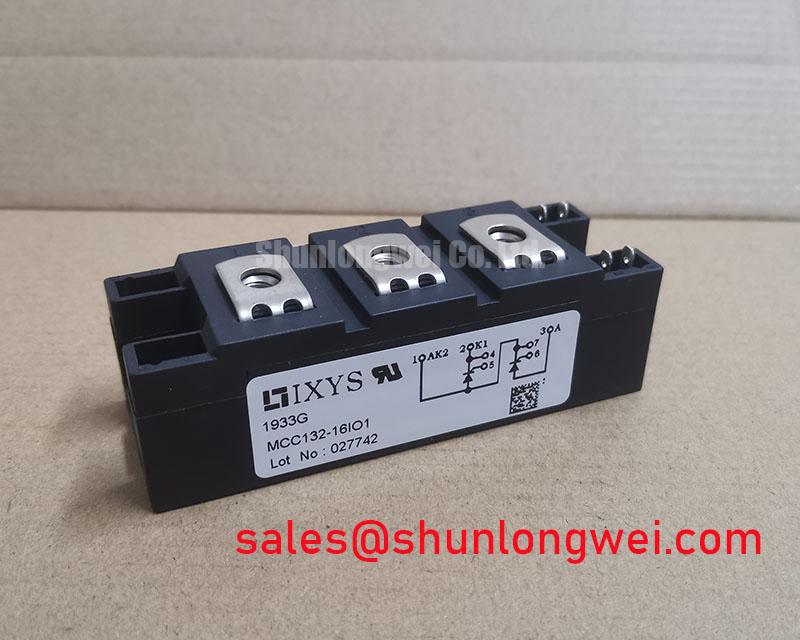
Are thermal bottlenecks limiting the operational lifespan of your heavy-duty AC drives? The Littelfuse (formerly IXYS) MCC132-08io1, a robust Thyristor Module engineered in a phase-leg configuration, directly addresses this challenge. Delivering an 800V repetitive peak reverse voltage and a continuous 130A average forward current, this component relies on a sophisticated Direct Copper Bonded (DCB) ceramic baseplate to maximize heat dissipation. What is the primary benefit of the DCB ceramic baseplate? It drastically lowers thermal resistance, preventing thermal runaway during continuous operation. With an exceptional Rth(j-c) of 0.23 K/W and a robust surge capability, it guarantees long-term stability in punishing environments. For AC line rectification systems requiring absolute thermal stability under high surge currents, this 800V phase-leg thyristor is the optimal choice.
Rapid Diagnostics & Engineering FAQ
Addressing Core Queries for the MCC Series
How does the I²t rating of 4750 A²s impact system protection?
This high energy rating provides a wide margin for error during fault conditions. How does a high I²t rating improve system reliability? It ensures the thyristor survives severe fault currents, simplifying overall fuse coordination. Engineers can seamlessly match this module with standard semiconductor fuses, preventing nuisance blowing while avoiding catastrophic module destruction during transient short circuits.
Why specify a planar passivated chip structure for a 50/60Hz line frequency application?
In environments subjected to continuous voltage stress and potential contamination, exposed silicon junctions degrade over time. Planar passivation chemically seals the active junction area. This architectural choice yields exceptional long-term voltage blocking stability, ensuring the 800V threshold remains impenetrable even after thousands of hours of field deployment.
Key Parameter Overview
Electrical and Thermal Specifications for System Sizing
Accurate system sizing relies on verified data. The following metrics are extracted directly from the official specifications to empower your thermal and electrical load calculations.
| Functional Group | Parameter | Value / Condition |
|---|---|---|
| Voltage & Current Ratings | Repetitive Peak Reverse Voltage (Vrrm) | 800V |
| Average Forward Current (Itav) | 130A (at Tc = 85°C) | |
| RMS Forward Current (Itrms) | 300A | |
| Surge Current Capability (I²t) | 4750 A²s (t = 10ms, 50Hz) | |
| Thermal & Mechanical Data | Thermal Resistance Junction to Case (Rth(j-c)) | 0.23 K/W |
| Isolation Voltage (Visol) | 3600 V~ (t=1s) | |
| Threshold Voltage (VTO) | 0.8V |
Download the MCC132-08io1 datasheet for detailed specifications and performance curves.
Technical Deep Dive
Decoding the Direct Copper Bonded (DCB) Ceramic Advantage
The operational ceiling of any high-power semiconductor is dictated by its ability to shed heat. The MCC132-08io1 abandons standard epoxy-based isolation in favor of an Al2O3 Direct Copper Bonded (DCB) ceramic substrate. This material science upgrade is paramount for achieving the module's 0.23 K/W thermal metric.
To conceptualize this, think of the DCB substrate as a multi-lane express highway for thermal resistance mitigation; it rapidly transports thermal energy away from the silicon junction directly to the heatsink, bypassing the thermal "traffic jams" typical of lesser insulating materials. This efficient heat transfer allows the device to handle a continuous 130A current without prematurely aging the silicon, a critical factor often analyzed in failure analysis and reliability studies.
Furthermore, the physical structure provides a secondary layer of industrial defense. The 3600V isolation rating acts like a massive firewall in a server room—it completely segregates the high-power AC line from the sensitive mounting chassis. This prevents catastrophic ground faults and allows multiple modules to be securely mounted onto a single grounded heatsink, vastly simplifying mechanical layout while preserving electrical safety.
Application Scenarios & Value
Engineering High-Fidelity Softstart Motor Controls
The rigorous demands of industrial automation require power components that do more than just switch currents; they must absorb immense kinetic energy transitions. The MCC132-08io1 demonstrates peak utility in softstart motor control systems. When initiating high-inertia loads like industrial conveyor belts or heavy-duty centrifugal pumps, the initial inrush current can easily exceed nominal operating parameters by a factor of six.
By leveraging its 4750 A²s I²t rating, this thyristor module effortlessly survives these punishing startup surges without degradation. In line frequency rectification stages, the module's 800V blocking capability provides a necessary buffer against grid fluctuations, ensuring stable DC bus generation. The predictable slope resistance (1.5 mΩ) guarantees that conduction losses remain manageable, directly aiding in precise fault current coordination protocols.
While the MCC132-08io1 is highly optimized for 400V–480V grid applications requiring 130A of steady-state throughput, systems demanding substantially higher voltage margins or current density might transition to the related MCC200-16IO1, which scales up to 1600V and 200A. Integrating these planar-passivated modules into your architecture not only ensures compliance with rigorous safety standards but fundamentally protects your capital equipment from thermal and electrical fatigue.