Content last revised on September 14, 2026
SKKT91/08D Circuit Protection & Reliability: Calibrating Non-Repetitive Surge On-State Current
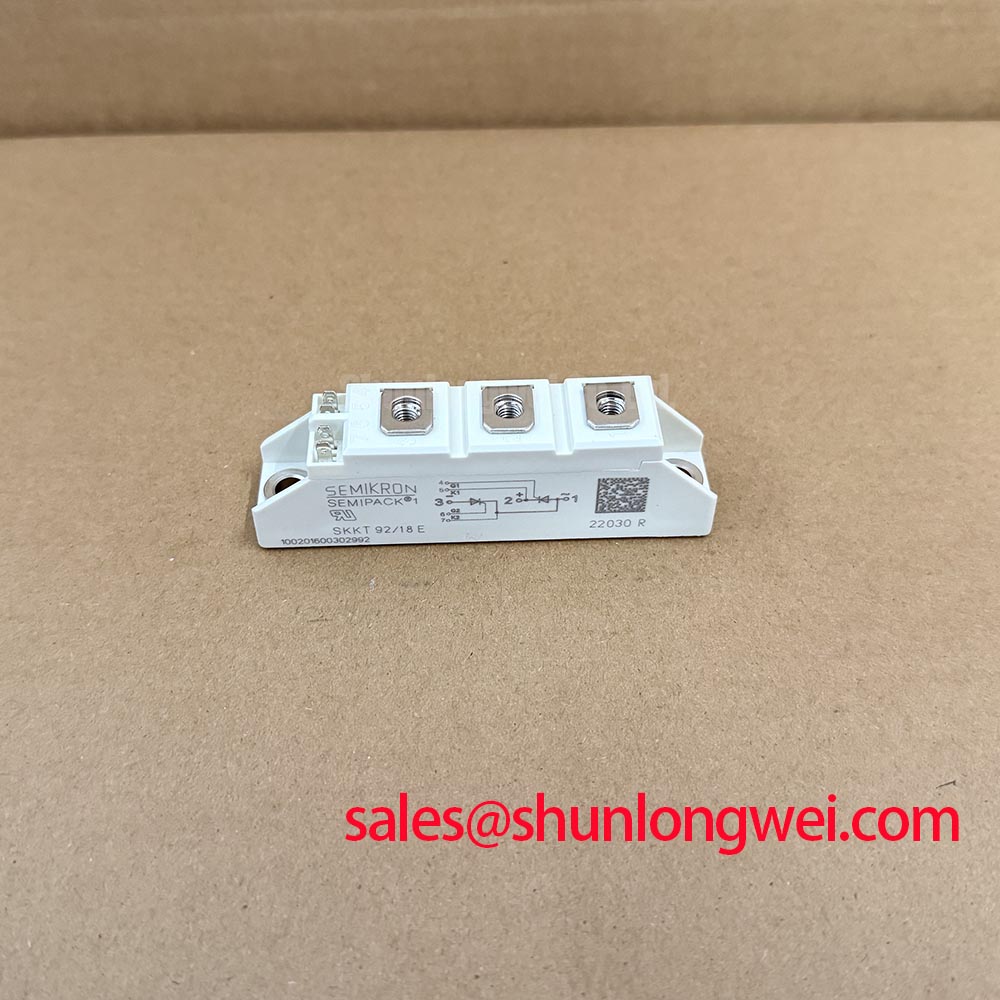
The Semikron SKKT91/08D is a dual-thyristor module specified for 800 V VDRM and VRRM. This repetitive peak off-state and reverse voltage rating is relevant when evaluating controlled rectifier assemblies connected to 400 V or 415 V AC systems, where line disturbances and commutation events must be assessed at system level.
Its official average on-state current rating is ITAV = 95 A, specified for a 180° sine wave at Tcase = 85°C. The official RMS on-state current rating is ITRMS = 150 A. These values should not be treated as interchangeable. The actual load waveform, conduction angle, cooling interface, ambient conditions, and parallel current paths determine whether the application remains within the permissible operating area.
The module’s official non-repetitive surge on-state current is ITSM = 2000 A for 10 ms at Tvj = 25°C. This is a short-duration surge capability, not a continuous overload rating. In a high-current green hydrogen electrolyzer DC power rectifier, engineers should coordinate the semiconductor with the upstream protection system by checking the applicable fuse clearing characteristic and the manufacturer’s fuse I²t coordination data. The selected protective device, prospective fault current, pulse duration, and reapplication of reverse voltage all require verification against the relevant datasheet tables.
After a fault interruption, inspect terminal connections, busbar contact surfaces, thermal compound condition, and signs of localized heating before restoring voltage. The module’s official on-state voltage is VT = 1.65 V at IT = 300 A and Tvj = 25°C. This test point supports conduction-loss estimation, but system loss calculations must use the operating current waveform and the permitted thermal conditions rather than treating 1.65 V as a fixed value at every load current.
Safety interlock note: Isolate and discharge the DC link before touching terminals, busbars, or control wiring.
SKKT91/08D Thermal-Electrical Optimization: Interphase Transformer Current Balancing Practical Tuning
Six-pulse and twelve-pulse rectifier bridges can be evaluated with the SKKT91/08D when the system architecture requires controlled high-current DC output. In a twelve-pulse arrangement, the interphase transformer helps coordinate current between bridge sections, but it does not remove the need to verify semiconductor current sharing, transformer leakage characteristics, commutation overlap, and thermal symmetry.
The 95 A average on-state rating is specified under a particular sinusoidal conduction condition and case temperature. In an electrolyzer rectifier, the load may be strongly continuous, ripple-producing, or dynamically regulated. Designers should therefore measure each bridge path under representative operating conditions and compare current distribution between phases. Unequal busbar impedance, transformer imbalance, firing-pulse timing, and cooling contact can all influence the measured result without one single cause being assumed in advance.
The Rth(j-c) = 0.28 K/W per thyristor official specification describes the thermal path from junction to case. The heat sink, thermal interface material, clamping method, and airflow or liquid cooling remain system responsibilities. A thin, uniform thermal interface layer is a general design consideration, while the correct compound, application method, and mounting procedure should follow the module and heatsink documentation.
For related bridge evaluations, engineers may compare the electrical and mechanical requirements of SKKH273/18E as a neutral same-family reference. It should not be treated as an automatic substitute. The original circuit topology, terminal arrangement, voltage class, current duty, gate requirements, and thermal assembly must be checked before any component change.
Assembly Integrity & Layout Architecture: Implementing Critical Rate of Rise of Off-State Voltage for SKKT91/08D
The official critical rate of rise of off-state voltage is (dv/dt)cr = 500 V/µs. This parameter is important when switching transients, commutation voltage, or long conductor paths create rapid voltage changes across the device. A value above the specified condition may increase the risk of unintended thyristor triggering, so the complete power loop should be evaluated with oscilloscope measurements at the module terminals.
RC snubber selection and any series saturable reactor arrangement are system-level engineering decisions. The resistor, capacitor, damping behavior, pulse energy, insulation requirements, and physical placement should be selected from measured transient behavior and verified during switching tests. Avoid placing the snubber across a long, inductive route that leaves the module terminals exposed to the very transient the network is intended to control.
Minimize parasitic loop inductance to reduce turn-off overshoot and localized current concentration, while keeping high-current paths physically balanced. Long motor or transformer cables can behave as transmission lines and may produce reflected voltage peaks at discontinuities. The appropriate filtering and termination strategy depends on cable construction, length, source impedance, switching behavior, and load characteristics; it should be validated by measurement rather than assigned from a generic cable rule.
Terminal creepage distance, electrical clearance, insulation barriers, and enclosure contamination level must be checked from the actual assembly drawing and applicable safety requirements. The supplied product data does not establish a universal creepage or clearance value for every installation. The same verification applies to cable lugs, busbar edges, fasteners, and any auxiliary control connection.
For gate circuit layout practice and commutation troubleshooting, the Precision Gate Drive Design reference provides a useful system-level engineering context. A gate pulse should be checked for amplitude, timing, return-path integrity, and noise coupling at the module terminals. The drive circuit must be evaluated together with the power layout, not in isolation.
Field Diagnostics & Commissioning: AC-to-DC Transfer Characteristics across V in SKKT91/08D Topologies
Commissioning should begin with phase sequence, terminal identification, gate pulse timing, insulation checks, and controlled low-energy measurements before full-current operation. The SKKT91/08D’s 800 V blocking rating, 95 A average on-state current, and 150 A RMS on-state current provide the principal datasheet boundaries for this review. Actual DC output depends on bridge topology, AC supply, firing angle, commutation overlap, load condition, transformer impedance, and control-loop behavior.
Across a firing-angle range from 0° to 150°, the rectifier’s average DC output generally changes with the control angle, while displacement power factor and reactive power demand also change. These relationships should be derived from the specific bridge configuration and confirmed with synchronized voltage and current measurements. Do not infer a fault from reduced DC output alone; inspect firing-pulse timing, phase voltage balance, transformer operation, commutation notches, load regulation, and thermal behavior as a group.
The official surge specification of 2000 A for 10 ms at 25°C junction temperature is relevant to short fault or inrush events, but repeated surges require a separate thermal and protection review. Record the current waveform, peak values, conduction intervals, and recovery behavior during commissioning. If a high-current electrolyzer rectifier uses a twelve-pulse transformer arrangement, compare both bridge sections under the same load condition and investigate any persistent imbalance through the transformer, busbar, firing control, and cooling paths.
When a related front-end or complementary rectifier stage is present, the SKKH330/08E may be reviewed as a separate system component. Compatibility remains dependent on the original schematic, electrical ratings, mechanical interface, and control method. The Semikron SEMIPACK® Thyristor / Diode Modules product information can also support comparison of module-family terminology and application context.
Before release to service, verify terminal torque from the applicable Semikron mechanical documentation, confirm the heatsink interface is uniform, and repeat voltage, current, and thermal measurements after the assembly reaches its intended operating condition.