Content last revised on September 10, 2026
High-Efficiency Power Control: The Engineering Value of the IXYS MCC255-12io1 Thyristor Module
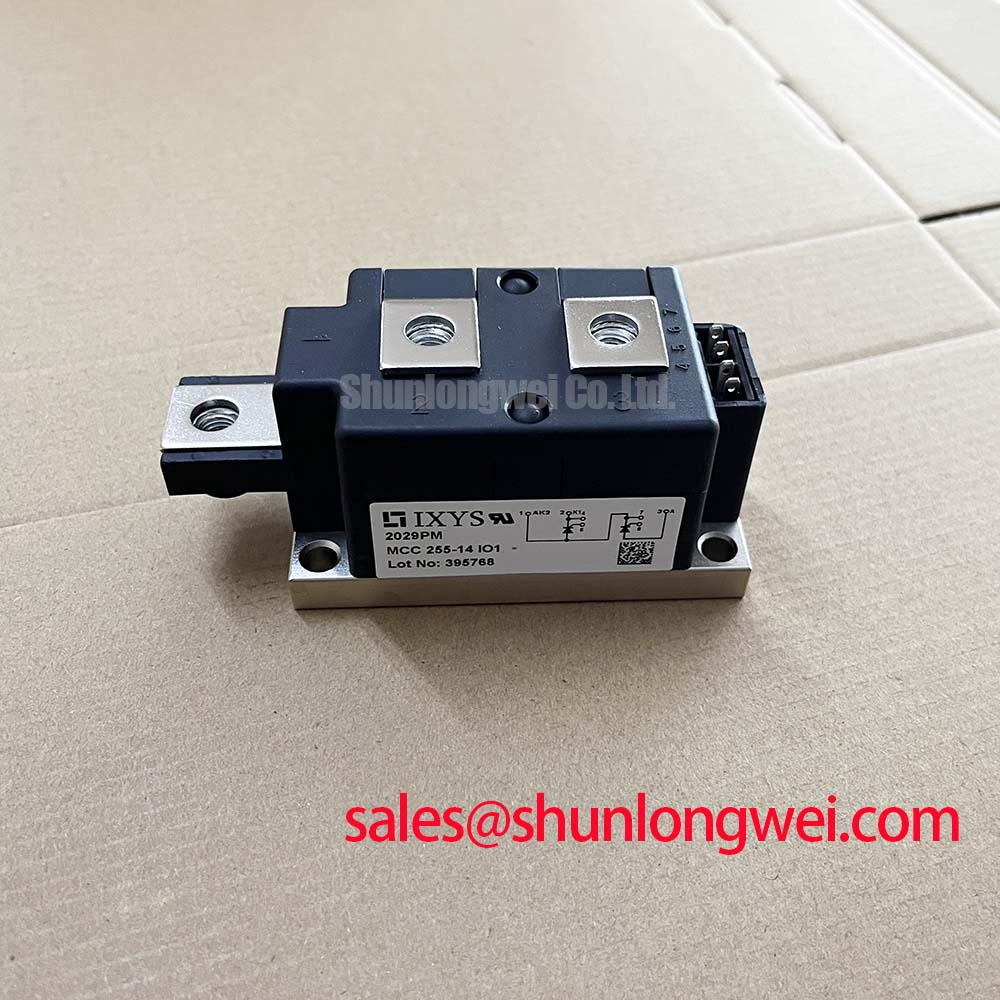
The IXYS MCC255-12io1 is a high-performance phase-control dual thyristor module optimized for demanding industrial power conversion and softstarter applications. Utilizing advanced packaging technologies, this module provides reliable switching control in a compact Y1-CU chassis footprint. The Direct Copper Bonded (DCB) ceramic isolation and copper base plate technology deliver optimized thermal dissipation and power cycling reliability in industrial motor control. Featuring top specifications of 1200V repetitive peak reverse voltage and 250A average on-state current per thyristor, it minimizes thermal fatigue and simplifies high-voltage chassis mounting. The integrated Direct Copper Bonded copper base plate reduces junction-to-case thermal resistance to just 0.14 K/W, preventing localized hotspotting and ensuring stable performance. For heavy-duty motor softstarters prioritizing thermal resilience and high surge capacity, this 1200V module is the optimal choice.
Key Parameter Overview
Decoding the Specs for Enhanced Thermal Reliability
The technical specifications of the MCC255-12io1 reflect its robust power handling capabilities under varied operating conditions. In the table below, the most critical electrical and thermal parameters are highlighted to assist design engineers in system-level integration.
| Parameter | Symbol | Standard Rating | Engineering Significance |
|---|---|---|---|
| Repetitive Peak Reverse Voltage | VRRM / VDRM | 1200 V | Maximum blocking voltage capability to protect against line transients. |
| Average On-State Current | ITAVM | 250 A | Continuous current capacity per thyristor branch at case temp TC = 85°C. |
| RMS On-State Current | ITRMS | 450 A | Maximum root-mean-square continuous load current. |
| Non-Repetitive Peak Surge Current | ITSM | 9000 A | Maximum allowable peak current for a 10 ms (50 Hz) transient pulse. |
| I2t Value for Fusing | I2t | 405,000 A2s | Thermal energy absorption capacity required for fuse coordination. |
| Thermal Resistance (Junction-to-Case) | RthJC | 0.14 K/W | Efficiency of heat transfer from silicon junction to the base plate. |
| Isolation Voltage | VISOL | 3000 V~ | Galvanic isolation rating (RMS, 50/60 Hz, 1 minute duration). |
| Package Style | - | Y1-CU | Standard dual-thyristor package footprint with screw terminals. |
Download the MCC255-12io1 datasheet for detailed specifications and performance curves.
Application Scenarios & Value
Achieving System-Level Benefits in High-Power Conversion
Designing power systems for industrial motor control requires components that can withstand intense electrical surges. Engineers often face severe thermal stress when developing AC motor softstarters, where transient starting currents regularly spike to several times the nominal load. The MCC255-12io1 addresses this directly with its surge current rating (ITSM) of 9000 A, providing a necessary buffer against electrical overload. This massive surge rating functions like a robust safety levee that protects a coastal town from high-tide surges, absorbing temporary energy spikes without compromising the semiconductor junction.
In addition to motor softstarters, this module serves as a reliable building block in solid-state switches and three-phase power converters. It is designed to work in conjunction with protective elements like an external EMC filter, and is suitable for systems compliant with safety guidelines such as IEC 61800-3. For designs operating in harsh grids with significant line voltage fluctuations, safety margins are critical. While this 1200V module fits standard 380V to 415V three-phase lines, systems demanding higher voltage headroom can evaluate the MCC200-16IO1, which provides a higher 1600V blocking voltage rating.
Technical & Design Deep Dive
A Closer Look at the DCB Al2O3 Insulation for High Reliability
At the core of the MCC255-12io1 is a pair of planar passivated chips mounted on a Direct Copper Bonded (DCB) ceramic substrate. By bonding copper directly to an alumina (Al2O3) ceramic layer, IXYS achieves a structure that exhibits low thermal expansion mismatches and high dielectric isolation. This mechanical integrity is vital in preventing delamination over millions of thermal cycles, which is the leading cause of power module wear-out in industrial heating controllers and industrial furnace applications.
The module’s low thermal resistance (RthJC) of 0.14 K/W acts like a wide, multi-lane highway for heat dissipation. It ensures that heat is rapidly conducted away from the active silicon junctions directly into the external heatsink. This efficient heat extraction path keeps the operating junction temperature well below the maximum limit of 130°C. Staying within this thermal window is essential for maintaining the device's Safe Operating Area (SOA). For further design context on thermal interfaces and power modules, refer to our technical article on power module thermal dynamics or review our framework for power semiconductor selection.
Frequently Asked Questions
Engineering Insights and Technical Queries Solved
How does the RthJC of 0.14 K/W directly impact heatsink selection and overall system power density?
A low thermal resistance of 0.14 K/W minimizes the temperature delta between the silicon junction and the heatsink surface. This enables engineers to specify smaller, passive heatsinks, reducing overall system weight and volume while keeping operating temperatures within safe limits.
What is the role of the 405,000 A2s I2t rating in coordination with circuit protection?
The I2t rating of 405,000 A2s specifies the maximum thermal energy the thyristor can absorb during a short-circuit fault. Designers use this value to select semiconductor fuses with a lower clearing rating, ensuring the fuse opens before the thyristor is damaged.
How does the planar chip design affect leakage current?
Planar passivation ensures extremely low off-state leakage currents and long-term voltage blocking stability.
What is the primary benefit of the DCB substrate?
It provides 3600V isolation while keeping thermal resistance low for optimized cooling.
Selecting the appropriate thyristor module requires a precise evaluation of electrical, thermal, and mechanical boundaries. Aligning your drive design's thermal footprint with the exact parameters of the power stage is essential to achieving decade-long field reliability in harsh industrial grids.