Content last revised on September 10, 2026
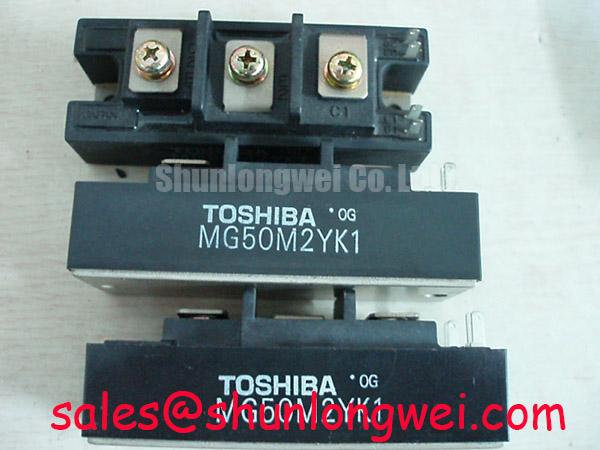
MG50G2YK1 Toshiba 600V 50A Dual Transistor Module
The Toshiba MG50G2YK1 delivers exceptional switching efficiency and layout simplicity for mid-power inverter designs. 600V | 50A | Dual N-Channel. This architecture ensures reduced parasitic inductance and guarantees streamlined system-level integration. By integrating two N-channel devices into a single isolated package, it drastically reduces parasitic inductance, thereby minimizing voltage overshoots during high-speed switching. For 200V-class industrial inverters prioritizing layout simplicity and dynamic switching efficiency, this 600V/50A dual module is the optimal choice.
Application Scenarios & Value
Deploying 600V/50A Half-Bridges in High-Frequency Motor Control
Engineers often face significant layout challenges when designing high-frequency AC motor drives and UPS systems. Coping with motor startup surge currents in industrial conveyor networks requires robust current handling. The 50A continuous current rating of the MG50G2YK1 provides the necessary thermal headroom to process these transient surges without catastrophic junction degradation. By eliminating discrete wiring between the high-side and low-side switches, this dual module shrinks the commutation loop area. When routing power for dynamic braking systems, this robust current-carrying capability prevents early degradation of the semiconductor junctions.
This compact integration directly aids compliance with strict IEC 61800-3 emission standards by suppressing high-frequency ringing. What is the primary advantage of the dual N-channel configuration? It minimizes parasitic loop inductance, optimizing dynamic response and reducing switching overshoots. While this model is ideal for 200V AC line systems, for 400V line applications requiring higher blocking capacity, the related 2MBI50N-120 offers a 1200V rating.
Technical Deep Dive
Evaluating the Switching Efficiency and Parasitic Inductance Reduction of the Dual N-Channel Design
The architecture of the Toshiba MG50G2YK1 shifts the paradigm from discrete component assembly to a unified half-bridge topology. Parasitic inductance in discrete setups is like fluid turbulence in a bent pipe; the dual package straightens the path, ensuring smooth current transitions and limiting voltage spikes. The silicon layout within the MG50G2YK1 balances gate charge and switching speeds. This equilibrium is crucial because an overly fast turn-on can exacerbate electromagnetic interference, while sluggish transitions generate excessive switching losses. Consequently, engineers can specify lower-rated snubber capacitors, decreasing overall system costs.
Thermal management is equally crucial in high-density power stages. The isolated baseplate acts like a multi-lane highway with a dedicated thermal express lane, keeping high-voltage electrical traffic safely separated from the cooling infrastructure. This structural isolation removes the need for external mica or silicone pads, directly lowering the junction-to-case thermal resistance. As a result, the thermal management of the power stage becomes highly predictable.
Key Parameter Overview
Critical 600V/50A Specifications for Thermal and Electrical Reliability
Understanding the exact specifications allows for precise Gate Drive tuning and robust system protection.
| Key Metric | Value | Engineering Implication |
|---|---|---|
| Collector-Emitter Voltage (Vces) | 600V | Provides sufficient overvoltage margin for 200-240V AC line operation. |
| Continuous Collector Current (Ic) | 50A | Supports continuous power delivery in mid-range industrial drives. |
| Topology | Dual N-Channel (Half-Bridge) | Minimizes internal stray inductance for optimized dynamic response. |
| Isolation Voltage (Visol) | 2500V AC (Typical) | Guarantees safe baseplate grounding without external insulators. |
Frequently Asked Questions
Resolving Engineering Queries on the MG50G2YK1 Transistor Module
- How does the 600V rating influence DC-link capacitor selection?
Operating at a 600V maximum blocking capacity dictates that the continuous DC-link voltage should generally not exceed 400V. This leaves a 200V buffer to safely absorb inductive switching spikes. - Can this 50A module handle a hard short-circuit fault?
While it processes 50A continuously, you must implement fast-acting desaturation detection in your module selection circuit to shut down the gate within microseconds to prevent thermal runaway. - Why is the dual half-bridge configuration better than two discrete packages?
It inherently reduces the physical distance between the high-side and low-side junctions. This minimizes the parasitic commutation loop, enabling cleaner switching waveforms. - What is the best way to mount the isolated baseplate?
Apply a uniformly thin layer of high-quality thermal grease and torque the mounting screws to the manufacturer's specified limits to ensure optimal heat transfer to the heatsink.
Looking ahead, the shift towards highly integrated topologies like this dual module represents a broader move toward power density optimization. Engineers utilizing these unified packages immediately gain ground in reliability, shrinking physical footprints while simultaneously reinforcing their systems against transient electrical stress.