
Content last revised on September 10, 2026
High-Speed Switching Reliability: Is the MG50J2YS40 the Right Choice for Modern Power Conversions?
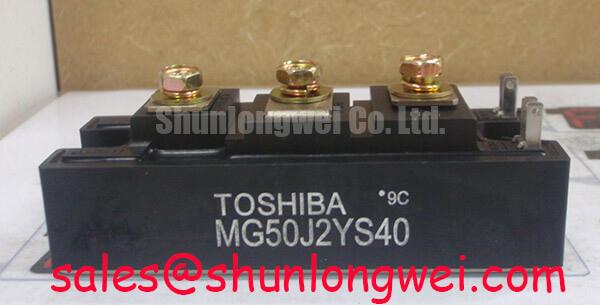
How can power engineers minimize switching losses in 600V industrial inverter designs without compromising thermal stability? This is a frequent challenge when sourcing mid-range power modules. The **Toshiba MG50J2YS40**, an established 2-pack IGBT module, addresses this specifically through its optimized internal structure designed for high-frequency PWM applications.
The **MG50J2YS40** by **Toshiba** is a high-power switching module featuring a dual-IGBT configuration in a single insulated package. With a maximum collector-emitter voltage of **600V** and a continuous collector current of **50A**, it delivers a robust solution for medium-power applications requiring rapid transition speeds. Engineers benefit from its low saturation voltage and integrated fast-recovery diodes, which collectively reduce the thermal overhead during high-duty cycle operations. For 400V DC bus motor drives prioritizing switching efficiency over raw current density, the **MG50J2YS40** is the optimal choice.
Frequently Asked Questions
Addressing Core Engineering Concerns for System Stability
How does the integrated fast-recovery diode in the MG50J2YS40 impact high-frequency PWM efficiency?
The integrated free-wheeling diode is specifically matched to the IGBT's switching characteristics to minimize reverse recovery time (**trr**). This is critical in inductive load switching, such as in a **Variable Frequency Drive (VFD)**, where it prevents excessive power dissipation during the turn-on phase, directly enhancing overall system efficiency.
Does the MG50J2YS40 offer sufficient isolation for direct heatsink mounting?
Yes, the module is designed with an internally insulated baseplate. This allows multiple **MG50J2YS40** units to be mounted on a single common heatsink, simplifying the mechanical layout and improving **Thermal Management** in compact enclosures. For designs requiring higher current handling, the MG150Q2YS50 offers a **Vces** of **600V** with a **150A** rating.
What is the primary benefit of the MG50J2YS40 in motor drive applications?
Reduced tail current and optimized switching speeds allow for higher carrier frequencies, which results in smoother torque output and reduced acoustic noise in motor systems.
Key Parameter Overview
Functional Specification Grouping for Performance Evaluation
| Absolute Maximum Ratings (Tc = 25°C) | |
|---|---|
| Collector-Emitter Voltage (Vces) | 600V |
| Gate-Emitter Voltage (Vges) | ±20V |
| Collector Current (Ic) | 50A |
| Collector Power Dissipation (Pc) | 250W |
| Electrical and Thermal Characteristics | |
|---|---|
| Collector-Emitter Saturation Voltage (Vce sat) | 2.7V (Max) |
| Collector Cut-off Current (Ices) | 1.0mA (Max) |
| Gate Threshold Voltage (Vge th) | 5.0V to 8.0V |
| Thermal Resistance (Rth j-c) | 0.5°C/W |
Download the MG50J2YS40 datasheet for detailed specifications and performance curves.
Technical Deep Dive
Architecting Efficiency through Optimized Switching Characteristics
The **MG50J2YS40** belongs to the high-speed generation of IGBTs that successfully bridge the gap between traditional power transistors and high-frequency MOSFETs. Its switching performance is characterized by a high-speed fall time, which minimizes the turn-off loss—a major contributor to heat generation in high-frequency converters. By reducing the "tail current" effect common in earlier IGBT generations, the **MG50J2YS40** allows designers to increase PWM frequencies without exceeding thermal limits.
A helpful analogy for this switching efficiency is a performance brake system on a car: just as high-end brakes allow a vehicle to stop precisely without overheating during repetitive use, the **MG50J2YS40** allows the current to "stop" (turn off) rapidly with minimal energy wasted as heat. This precision is essential when navigating the strict **IEC 61800-3** standards for electromagnetic compatibility and efficiency in industrial environments. Furthermore, its low **Vce(sat)** of **2.7V** ensures that conduction losses remain manageable, balancing the trade-off between switching speed and steady-state efficiency. For those evaluating different topologies, understanding IGBT vs MOSFET vs BJT is crucial for selecting the right semiconductor for the specific voltage-current profile.
Application Scenarios & Value
Achieving System-Level Benefits in Induction and Motion Control
The **MG50J2YS40** is frequently utilized in **Uninterruptible Power Supplies (UPS)** and AC motor control. Consider a high-fidelity engineering scenario involving an industrial conveyor system. During motor startup, the system experiences significant inrush currents. The **MG50J2YS40**, with its **50A** continuous rating and high peak current capability, handles these surges without entering desaturation, provided the gate drive is properly tuned.
In **Induction Heating** stages, the module's ability to maintain stable switching at high frequencies directly translates to better energy transfer to the workpiece. Because the module integrates two IGBTs in a half-bridge (2-pack) configuration, it significantly reduces the parasitic inductance that would otherwise be present if using discrete components. This lead-inductance reduction is vital for preventing voltage spikes that could potentially damage the gate oxide. For field technicians maintaining these systems, a practical field guide for testing IGBTs is an invaluable resource for diagnostic routines.
In the context of broader system integration, engineers might also consider the MIG50J7CSB1W, which provides similar current ratings within an Intelligent Power Module (IPM) framework for those seeking integrated protection features. However, for those who prefer the flexibility of external gate drive control to optimize for specific EMI or switching speed targets, the **MG50J2YS40** remains a preferred discrete-module choice.
To ensure long-term reliability in harsh industrial settings, designers should focus on the **0.5°C/W** thermal resistance rating. Proper application of thermal interface material (TIM) and adherence to torque specifications for the mounting screws are non-negotiable for maintaining the junction temperature within safe limits. As power electronics continue to evolve toward higher efficiency, modules like the **MG50J2YS40** provide a reliable, data-backed foundation for robust power conversion.