

Content last revised on September 10, 2026
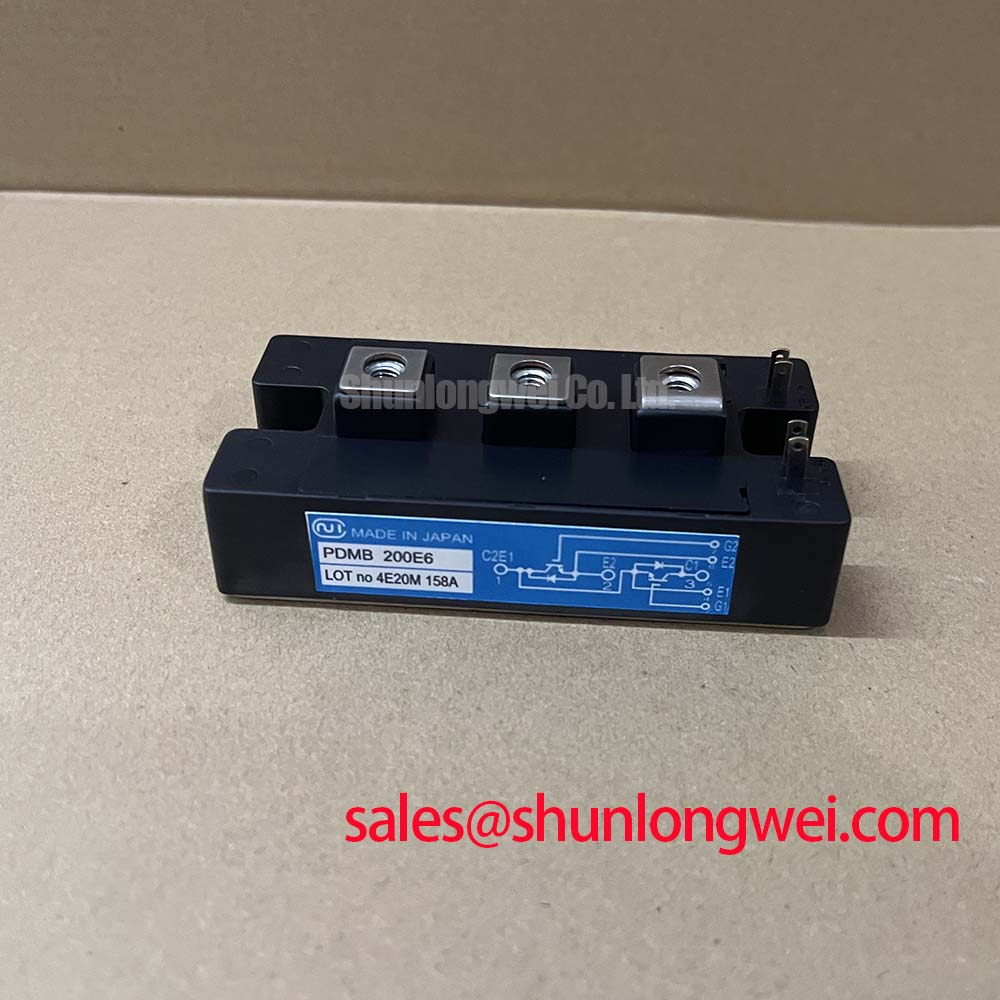
PDMB200E6 NIEC 600V 200A Dual IGBT Module
The PDMB200E6, manufactured by NIEC (Nihon Inter Electronics Corp), is a high-performance IGBT module engineered for high-power switching applications where efficiency and thermal reliability are non-negotiable. Featuring a dual (half-bridge) configuration, this module is optimized for high-current density within a 600V architecture, providing a robust solution for engineers designing industrial motor drives and power conversion systems. For 400V inverter designs requiring high-speed switching and short-circuit immunity, the PDMB200E6 delivers the necessary electrical ruggedness to ensure system longevity. For systems requiring higher voltage handling, related options like the 2MBI200NB-120 offer a Vces of 1200V.
Top Specifications: 600V | 200A | Vce(sat) 2.1V (typ)
Key Benefits: Enhanced switching speed for reduced power losses and high short-circuit withstand capability for improved system protection.
For high-frequency industrial drives prioritizing thermal margin and low conduction losses, the PDMB200E6 is the definitive 200A choice.
Key Parameter Overview
Decoding the Specs for Enhanced Switching Efficiency
The following table summarizes the critical electrical and thermal characteristics of the PDMB200E6. These values are essential for calculating power dissipation and selecting appropriate cooling solutions in Variable Frequency Drive (VFD) and UPS designs.
| Parameter | Symbol | Typical/Max Value | Engineering Significance |
|---|---|---|---|
| Collector-Emitter Voltage | Vces | 600V | Defines the maximum blocking voltage for 240V/480V systems. |
| Continuous Collector Current | Ic | 200A | Maximum steady-state current handling at Tc=25°C. |
| C-E Saturation Voltage | Vce(sat) | 2.1V | Determines conduction loss; lower values improve efficiency. |
| Thermal Resistance (j-c) | Rth(j-c) | 0.13 °C/W | Critical for heat sink sizing and junction temperature management. |
| Isolation Voltage | Viso | 2500V AC | Ensures safety and compliance with international standards. |
Download the PDMB200E6 datasheet for detailed specifications and performance curves.
Application Scenarios & Value
Maximizing System Reliability in High-Current Power Conversion
Engineers often face the challenge of managing transient surges and heat accumulation in high-density power modules. The PDMB200E6 addresses this through its 200A rating and low thermal resistance, making it a cornerstone for high-efficiency inverter ACs and industrial automation equipment.
- Uninterruptible Power Supplies (UPS): In UPS systems, the module provides seamless switching and high reliability during power transitions. The low Vce(sat) minimizes energy waste during battery-to-load operation.
- Motor Control (VFD): The module's soft-recovery diode characteristics significantly reduce electromagnetic interference (EMI), which is critical for meeting IEC 61800-3 standards in variable-speed drives.
- Welding Power Supplies: The high Ices margin allows for stable performance under the harsh, fluctuating loads typical of industrial welding environments.
When comparing performance within the 600V class, the 2MBI200VA-060 serves as a notable benchmark for high-reliability applications requiring similar current handling capacity.
Technical & Design Deep Dive
Optimizing Thermal Paths for Long-Term Reliability
A critical factor in the PDMB200E6's performance is its thermal management architecture. The Thermal Resistance of 0.13 °C/W is achieved through an advanced substrate design that facilitates rapid heat transfer from the IGBT chip to the baseplate. Think of Vce(sat) as "electrical friction"—the lower this value, the less heat is generated as current flows through the device. By maintaining a Vce(sat) of 2.1V, the PDMB200E6 ensures that more power reaches the load rather than being dissipated as waste heat.
Furthermore, the E6 series technology optimizes the trade-off between switching speed and softness. High-speed switching reduces turn-off losses (Eoff), but if the switch is too abrupt, it can cause voltage spikes that lead to failure. The PDMB200E6 is designed to provide a "soft" turn-off curve, which acts like a shock absorber for high-frequency circuits, protecting the module from overvoltage transients during high-current interruptions. This is particularly valuable in PFC stage designs where hard-switching is common. Engineers should also refer to IGBT failure analysis to ensure gate drive circuits are properly tuned to prevent desaturation events.
Frequently Asked Questions
How does the Rth(j-c) of 0.13 °C/W directly impact heatsink selection and overall system power density?
The low thermal resistance of 0.13 °C/W allows for higher power dissipation within the same physical footprint. This means engineers can either use a smaller, less expensive heatsink or push higher currents through the module while maintaining a safe junction temperature, directly increasing the power density of the inverter or VFD.
Is the PDMB200E6 suitable for hard-switching applications like high-frequency induction heating?
Yes, due to its high-speed switching characteristics and robust SOA (Safe Operating Area), it can be used in hard-switching topologies. However, proper snubber design is recommended to manage the dv/dt rates and prevent parasitic turn-on, ensuring the module operates within its specified thermal and electrical limits. For a deeper understanding of these principles, see our guide on IGBT switching principles.
The PDMB200E6 represents a proven, industry-standard choice for engineers who require a balance of power, thermal efficiency, and high-frequency capability in the 600V class. By providing consistent performance across a wide temperature range, it remains a reliable component for critical industrial infrastructure. For detailed pricing and availability, please consult with our technical sales team for your specific project needs.