Content last revised on September 10, 2026
PM25RL1C120 Mitsubishi Electric 1200V 25A Intelligent Power Module (IPM)
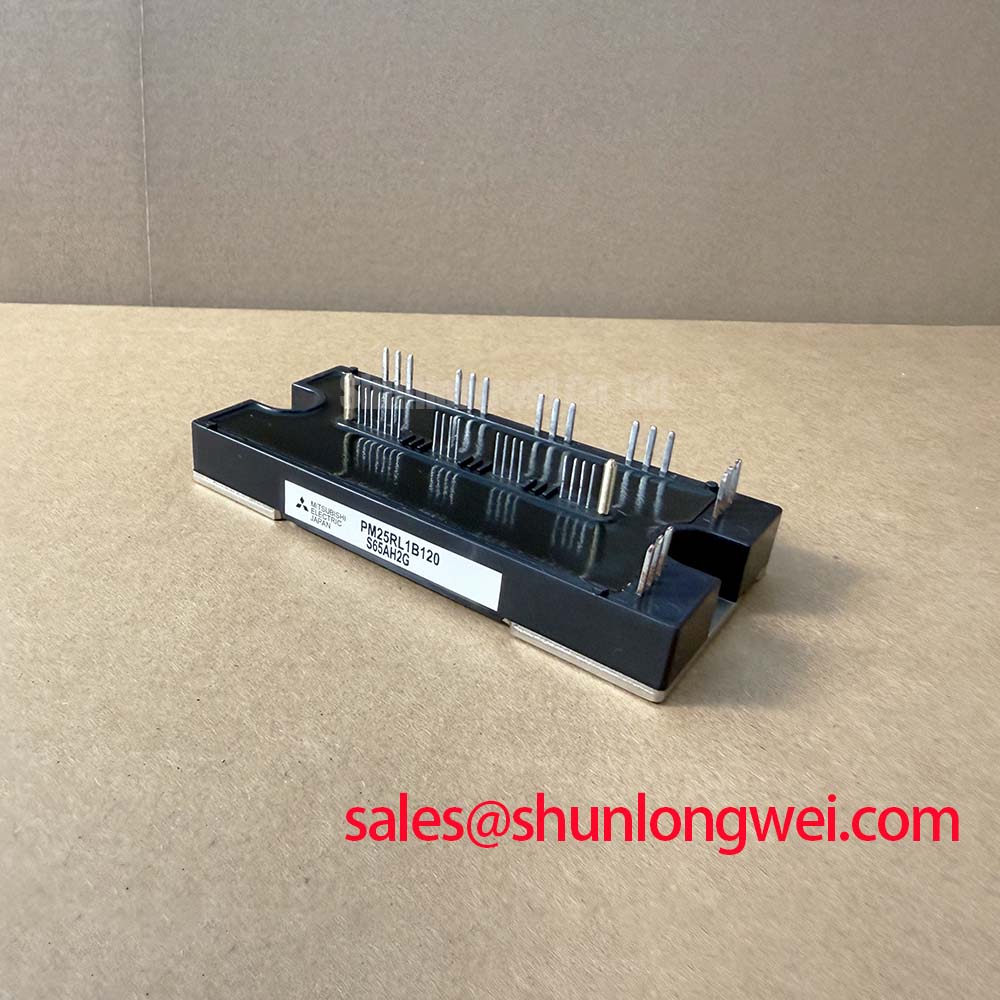
The PM25RL1C120, a flagship member of Mitsubishi’s L-Series, is an Intelligent Power Module (IPM) designed to bridge the gap between complex power stage design and high-reliability motor control. By integrating a 1200V 25A 3-phase inverter bridge, a dedicated brake circuit, and internal gate drive logic into a single flat-base type insulated package, this module serves as a robust solution for engineers seeking to minimize PCB footprint while maximizing system protection. This "all-in-one" approach eliminates the parasitic inductance issues often found in discrete layouts, providing a plug-and-play power stage for industrial automation.
Top Specs: 1200V | 25A | Rth(j-c) 1.25°C/W (IGBT)
Key Benefits:
- Simplifies design by integrating gate drive and protection circuits.
- Enhanced reliability via built-in over-temperature and short-circuit monitoring.
How does the PM25RL1C120 improve overall system uptime? It utilizes a dedicated Fo (Fault Output) signal that communicates directly with the system controller the moment an under-voltage or over-current condition occurs, preventing catastrophic failure. For industrial motor drives requiring high integration in a compact footprint, the PM25RL1C120 is the optimal choice.
Application Scenarios & Value
Optimizing Mid-Power Motor Control through System Integration
Engineers often face significant electromagnetic interference (EMI) and layout complexities when designing gate drive circuits for 1200V systems. The PM25RL1C120 addresses these challenges by housing the gate drivers within the module itself, physically close to the IGBT chips. This proximity minimizes the loop area, which is critical for maintaining signal integrity in high-speed switching environments like AC Servo Drives and Industrial CNC machinery.
In applications such as HVAC compressors or small-scale Variable Frequency Drives (VFD), the integrated brake IGBT is particularly valuable. When a motor decelerates, the generated back-EMF can spike the DC-bus voltage; the PM25RL1C120 manages this energy internally, ensuring the DC-link capacitors remain within their SOA (Safe Operating Area). This level of protection is essential for compliance with IEC 61800-3 EMC standards. While this module is ideal for compact 25A requirements, systems demanding similar current handling in different footprints might also consider the 6MBP25VAA120-50 for comparison.
Technical Deep Dive
The Engineering Behind the L-Series Intelligent Architecture
At the heart of the PM25RL1C120 is the 5th generation CSTBT™ (Carrier Stored Trench-Gate Bipolar Transistor) technology. This architecture significantly reduces the Vce(sat) to a typical 1.8V, which directly translates to lower conduction losses. Think of the IPM as having a "built-in brain" for each of its power switches; the internal circuitry doesn't just switch the IGBT on and off, it constantly monitors the collector current and junction temperature.
A critical engineering feature of this module is its Short-Circuit Protection. If the collector current exceeds the trip level, the gate drive logic executes a "Soft Shut-down," gradually decreasing the gate voltage to prevent a high di/dt voltage spike that could otherwise puncture the insulation. This is comparable to an emergency brake system that brings a vehicle to a controlled stop rather than a sudden, damaging halt. This integrated approach is a cornerstone of modern IPM vs discrete IGBT design strategies, where reliability and speed-to-market are prioritized.
Key Parameter Overview
Decoding the Specs for System-Level Efficiency
| Parameter | Official Value | Engineering Interpretation |
|---|---|---|
| Vces (Collector-Emitter Voltage) | 1200V | Provides ample headroom for 400V/480V AC line rectified DC buses. |
| Ic (Collector Current) | 25A (at Tc=25°C) | Rated for continuous duty in mid-sized industrial inverter stages. |
| Vce(sat) (Saturation Voltage) | 1.8V (Typical) | Low voltage drop minimizes thermal dissipation requirements. |
| Viso (Isolation Voltage) | 2500V (AC, 1 min) | Ensures safety and dielectric strength between power pins and heatsink. |
| OT Trip Level (Over-temperature) | 111°C (Min) | Automatic shut-off protects the silicon from thermal runaway. |
Download the PM25RL1C120 datasheet for detailed specifications and performance curves.
FAQ
How does the Fault Output (Fo) signal on the PM25RL1C120 simplify the controller's task?
The Fo pin pulls low whenever the internal protection logic detects a fault (Over-current, Short-circuit, or Under-voltage). This allows the MCU to monitor a single line rather than implementing complex external sensing for every IGBT in the 3-phase bridge.
Is an external negative power supply required for the gate drive?
No, the PM25RL1C120 is designed for single-supply operation. The internal gate drive logic handles the switching levels, which significantly simplifies the Gate Drive power supply architecture compared to high-power modules that require bipolar gate voltages.
How does the Rth(j-c) of 1.25°C/W impact heatsink selection?
With a thermal resistance of 1.25°C/W, the module can dissipate heat efficiently to the baseplate. Engineers must select a heatsink that, when combined with the interface thermal grease, keeps the junction temperature below the 150°C maximum limit during peak load conditions.
What is the primary benefit of the integrated Brake IGBT?
In motion control, the brake IGBT allows for the use of an external braking resistor to dissipate regenerative energy. Integration into the PM25RL1C120 ensures that the brake switch is thermally matched and protected by the same internal logic as the inverter stages.
Can this module operate safely on a 690V industrial line?
While the 1200V Vces rating is high, 690V AC lines typically rectify to nearly 1000V DC. For such high-voltage environments, a 1700V rated module is generally recommended to provide a sufficient safety margin against line transients. This module is best suited for 400-480V AC systems.
From a field engineering perspective, the PM25RL1C120 represents a shift toward "self-aware" power electronics. By moving the protection threshold into the silicon’s immediate environment, Mitsubishi has created a module that not only performs switching but actively guards against the most common failure modes in harsh industrial grids. For a broader understanding of how these specifications translate to long-term reliability, engineers may reference the Core Trio of IGBT Module Selection guide for deeper insights into thermal and voltage management. Furthermore, the use of Mitsubishi CSTBT™ technology ensures that these modules remain at the forefront of power density and efficiency.