
Content last revised on September 10, 2026
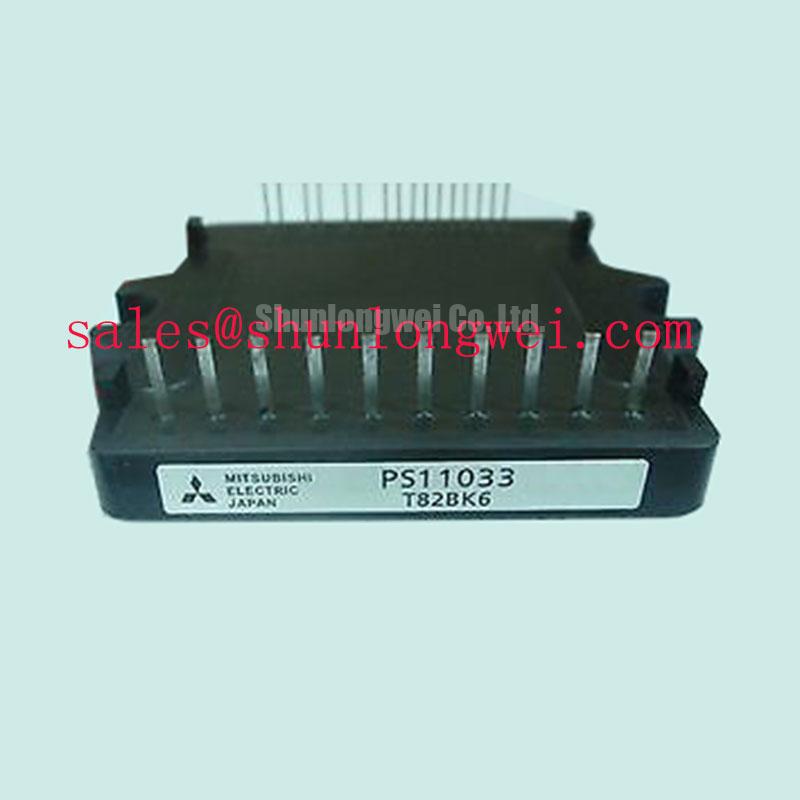
Mitsubishi PS11033: High-Performance 600V 30A ASIPM for Precision Motor Control
The PS11033 is a 3rd Generation C-series Application Specific Intelligent Power Module (ASIPM) developed by Mitsubishi Electric. Designed specifically for three-phase inverter applications, this module integrates high-speed, low-loss IGBTs with optimized gate drive circuitry and comprehensive protection logic. By consolidating power switching and control into a single flat-base package, the PS11033 empowers engineers to reduce system footprints while enhancing overall drive reliability. For three-phase motor drives requiring a balance of compact footprint and integrated protection, the PS11033 is the definitive ASIPM solution.
600V | 30A | Built-in Drive & Protection
- System Simplification: Integrated gate drive eliminates the need for complex external discrete drive stages.
- Enhanced Ruggedness: Real-time monitoring of over-current, under-voltage, and short-circuit conditions.
How does the PS11033 simplify high-frequency inverter design? It internalizes the timing and level-shifting required for high-side IGBTs, significantly reducing EMI and PCB layout complexity.
Application Scenarios & Value
Achieving System-Level Efficiency in Mid-Power Industrial Drives
In the realm of industrial automation, the PS11033 serves as the heartbeat of variable frequency drives (VFDs) and high-precision servo systems. Engineers often face the challenge of managing the inductive surges generated during rapid motor acceleration. The PS11033 addresses this through its integrated 600V 30A power stage, which is tuned for optimal switching transitions, effectively minimizing switching losses in 3-phase PWM inverter applications.
Consider a conveyor system in a smart factory: the PS11033 handles the startup current peaks with precision, while its built-in short-circuit protection acts as an immediate safety officer, preventing catastrophic failure during accidental motor stalls. For designs requiring even more robust thermal margins in smaller form factors, engineers often compare these metrics with specialized solutions like the PS11035. Furthermore, when evaluating the transition from discrete components to integrated power stages, the insights shared in our guide on IPM vs Discrete IGBT Design provide critical framework for total cost of ownership (TCO) assessments.
What is the primary benefit of the PS11033's integrated gate drive? It eliminates the need for external drive circuits, reducing PCB size and radiated EMI.
Key Parameter Overview
Decoding the Specs for Enhanced Industrial Reliability
Understanding the electrical boundaries of the PS11033 is essential for ensuring long-term stability in harsh environments. The following technical specifications represent the core operational parameters as defined in the official Mitsubishi ASIPM documentation.
| Category | Parameter | Value / Condition |
|---|---|---|
| Voltage/Current | Collector-Emitter Voltage (Vces) | 600V |
| Voltage/Current | Collector Current (Ic) | 30A (DC) |
| Integrated Logic | Control Voltage (Vcc) | 15V (Typ. ±1.5V) |
| Protection | Over-Current Trip (OC) | Detected via External Shunt |
| Protection | Short-Circuit Withstand | 10µs (at Vcc=15V) |
| Isolation | Isolation Voltage (Viso) | 2500V (60Hz, AC 1 min) |
Download the PS11033 datasheet for detailed specifications and performance curves.
FAQ
Technical Insights for Reliable System Integration
How does the flat-base package of the PS11033 impact thermal design compared to traditional DIP modules?
The flat-base design of the PS11033 ensures a more uniform contact area with the heatsink. This reduces the contact thermal resistance, allowing for higher power density without exceeding the junction temperature limits. Proper application of thermal grease is critical to maintaining this advantage. For more on this, refer to our guide on IGBT selection and thermal management.
Does the PS11033 require a negative gate voltage for reliable turn-off?
No. Thanks to the integrated level-shifting and gate drive logic optimized for Mitsubishi’s 3rd Gen IGBTs, the PS11033 achieves stable turn-off with a single-supply 15V control source. This simplifies the power supply design significantly compared to discrete high-power modules that often necessitate bipolar gate voltages to prevent parasitic turn-on.
Industry Insights & Strategic Advantage
The Evolution of IPMs in the Era of Industry 4.0
The strategic value of modules like the PS11033 extends beyond simple power switching. As global manufacturing shifts toward Industry 4.0, the demand for energy-efficient motor control has skyrocketed. The "Application Specific" nature of the PS11033 aligns perfectly with the need for high integration. By housing the gate drivers and protection circuits within the power module, manufacturers can reduce the number of components on a BOM (Bill of Materials), which in turn reduces the potential points of failure.
Current trends in factory automation emphasize Variable Frequency Drive (VFD) efficiency. The PS11033 contributes to this by reducing switching losses through its optimized IGBT chip set. This synergy between silicon technology and packaging is explored in detail at Mitsubishi CSTBT™ Technology. Utilizing integrated modules is no longer just a space-saving measure; it is a strategic decision to improve electromagnetic compatibility (EMC) and decrease time-to-market for complex industrial systems.
Technical & Design Deep Dive
A Closer Look at Integrated Protection Logic and Signal Integrity
The core intelligence of the PS11033 lies in its internal "Control Part." Unlike standard IGBT modules, the ASIPM includes an LVIC (Low Voltage Integrated Circuit) that manages the interface between the user's MCU/DSP and the power IGBTs. This internal circuitry provides an under-voltage lockout (UV) for both high-side and low-side power supplies. If the control voltage drops below a safe threshold, the module automatically inhibits switching to prevent the IGBTs from entering the linear region, which would lead to immediate destruction.
Think of the integrated gate driver as a specialized translator: it takes low-power 5V logic signals and converts them into the robust 15V drive pulses needed to charge the IGBT gates, while simultaneously acting as a watchdog. This "driver-watchdog" combination ensures that the signal path is incredibly short, which is a significant advantage for maintaining signal integrity in high-noise industrial environments. For engineers moving from older technologies, understanding the differences between IGBT, MOSFET, and BJT can clarify why the IGBT-based PS11033 remains the industry standard for 600V-class industrial applications.
As a leading distributor of specialized power electronics, we provide comprehensive technical data to support your engineering evaluations. For detailed lead times, availability, or technical clarifications regarding the PS11033 and its integration into your next-generation motor control platform, please contact our technical sales team for a formal quotation.


