

Content last revised on September 10, 2026
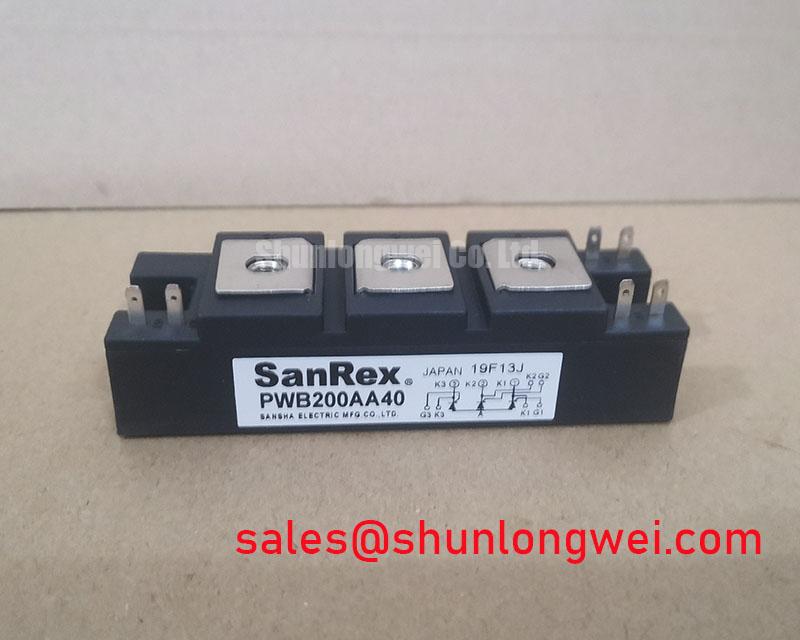
Sanrex PWB200AA40 400V 200A Three-Phase Bridge Rectifier Module
For 200V/230V three-phase input stages demanding rugged, high-current rectification, the Sanrex PWB200AA40 delivers a fully isolated 400V, 200A bridge in a single package. Its six-diode full-wave topology simplifies the front end of industrial power supplies. Best Fit: for 200–230V three-phase line rectification needing a compact, isolated 200A front end, this module is a direct fit.
- Core specs: 400V VRRM | 200A IO | three-phase full-bridge
- Isolated baseplate simplifies heatsink mounting and creepage design
- Integrated six-diode bridge reduces interconnects and assembly time
What is the main advantage of an integrated bridge module like this? It replaces six discrete diodes with one isolated package, cutting wiring, inductance, and assembly errors.
Application Scenarios & Value
System-Level Simplification for Three-Phase Front-End Rectification
Engineers building the input stage of a variable frequency drive (VFD) or industrial DC bus often wrestle with packaging six discrete rectifier diodes, each needing its own clamping, isolation, and thermal interface. The PWB200AA40 consolidates the full three-phase bridge into one isolated module rated at 400V and 200A, removing layout complexity at the AC input.
Consider a 200V-class three-phase drive feeding a DC link. During motor startup, the rectifier must absorb sustained inrush as the bus capacitors charge. A 200A continuous rating with the device's surge handling gives margin against these repetitive charging events, helping protect downstream electrolytics and the inverter stage.
Typical deployments include the rectifier front end of servo drives, DC bus power supplies, welding equipment, battery chargers, and uninterruptible power systems. In each case, the isolated baseplate lets multiple modules share a common heatsink without extra insulators.
This module suits 200–230V three-phase lines. For designs that must rectify higher 400V-class lines, a module with a greater reverse-voltage rating should be selected instead. When the downstream stage needs active switching rather than passive rectification, designers often pair such a bridge with a controlled stage built around devices like the DF200AA160 for higher-voltage rectification needs.
Key Parameter Overview
Decoding the Specs for Robust Three-Phase Rectification
| Parameter | Value |
|---|---|
| Manufacturer | Sanrex (Sansha Electric) |
| Type | Three-Phase Bridge Diode Rectifier Module |
| Repetitive Peak Reverse Voltage (VRRM) | 400V |
| Average Forward Output Current (IO) | 200A |
| Configuration | Six-diode full-wave bridge |
| Baseplate | Electrically isolated |
Download the PWB200AA40 datasheet for detailed specifications and performance curves: PWB200AA40 datasheet.
Technical Deep Dive
How the Isolated Bridge Architecture Shapes Thermal and Mechanical Design
The defining trait of the PWB200AA40 is its integration of a complete three-phase rectifier behind a single isolated baseplate. Think of it like a six-lane bridge built on one foundation: instead of pouring six separate footings, you mount one structure and route all traffic across it.
This integration carries direct engineering consequences. The isolated baseplate means the module case can be bolted straight to a grounded heatsink without separate mica or polymer insulators, removing a thermal interface that would otherwise add resistance. Fewer interfaces means a shorter, more predictable heat path from junction to sink.
Current rating interacts closely with thermal design. The 200A average output figure is a steady-state value tied to a defined case temperature; real-world headroom depends on how effectively the heatsink holds that case temperature under load. Treat the 200A as a thermal contract, not a guarantee, the cooler you keep the baseplate, the closer you operate to the rated figure.
What is the primary benefit of the integrated bridge configuration? It minimizes interconnect inductance and assembly points, improving reliability over discrete-diode front ends. For deeper background on choosing rectifier and power modules, see this guide to voltage, current, and thermal management.
Frequently Asked Questions
What does the PWB200AA40 actually contain inside the package?
It contains a six-diode full-wave bridge that rectifies a three-phase AC input into DC, integrated on a single isolated baseplate.
How does the 400V VRRM rating define which line voltages it suits?
The 400V repetitive reverse rating makes it appropriate for 200–230V three-phase lines, where peak reverse stress stays within a safe margin. Higher 400V-class lines require a device with a higher reverse-voltage rating.
Why does the isolated baseplate matter for system assembly?
It lets the module mount directly to a grounded heatsink without separate insulating washers, lowering thermal resistance and simplifying mechanical layout. Multiple modules can share one heatsink.
From a strategic standpoint, integrated bridge modules like the PWB200AA40 remain a cost-effective backbone for three-phase front-end rectification, where reliability and assembly simplicity outweigh the flexibility of discrete designs.