Content last revised on September 10, 2026
QM150DY-HK Datasheet, Specs & Engineering Analysis: A 600V 150A Transistor Module
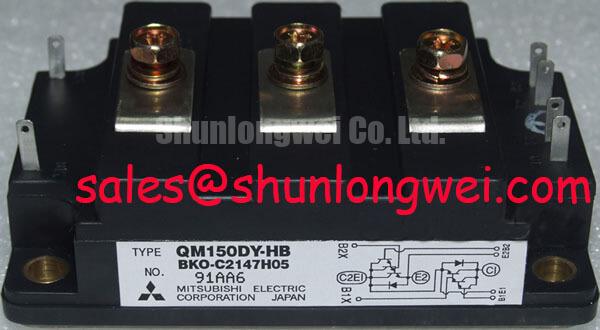
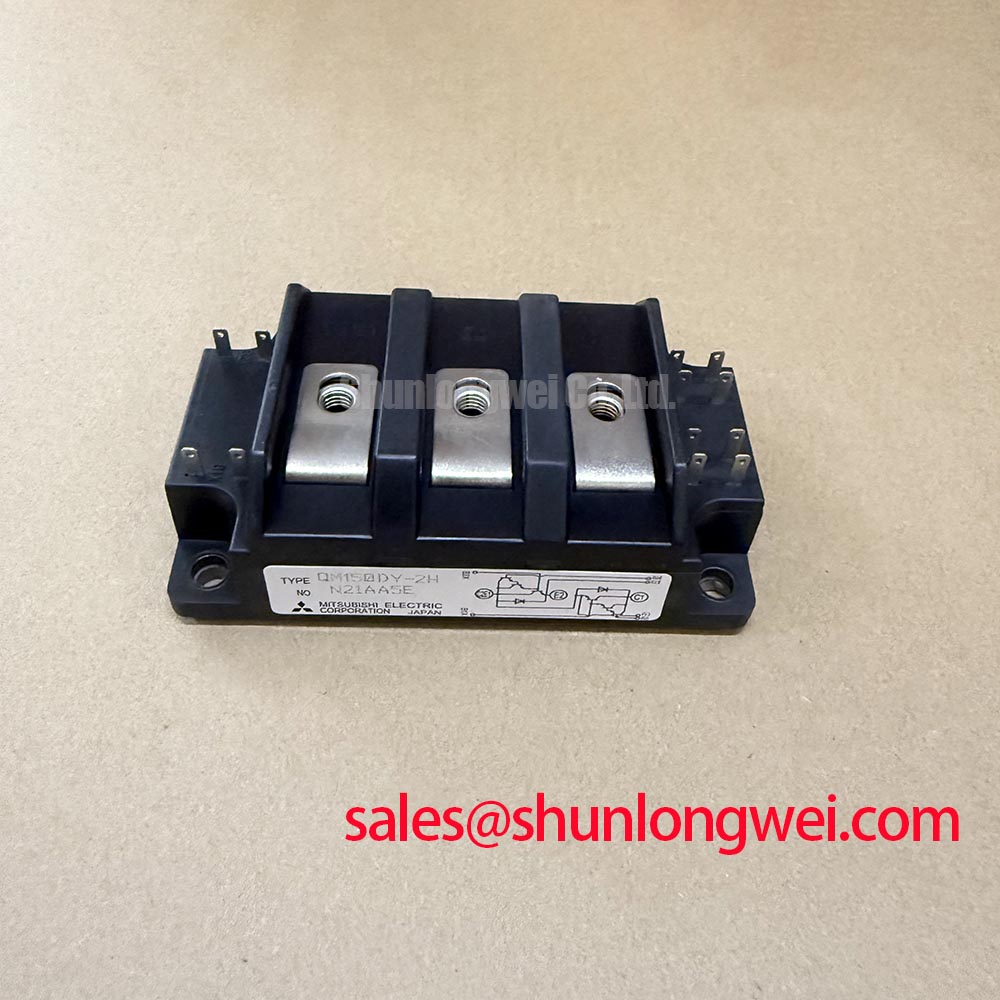
The Mitsubishi QM150DY-HK is a rugged, UL-recognized dual Darlington transistor module engineered for reliable power control in demanding industrial environments. With core specifications of 600V, 150A, and a transistor thermal resistance (Rth(j-c)Q) of 0.18 °C/W, this device offers a robust foundation for power conversion systems. Its key benefits include simplified thermal design due to integrated isolation and proven field reliability for industrial power systems. The module's insulated baseplate simplifies mounting directly to a heatsink without requiring extra insulating layers, directly addressing a common and critical assembly challenge. For legacy motor drives and welders requiring a robust 600V/150A switch, the QM150DY-HK offers a field-proven and cost-effective solution.
Key Parameter Overview
Decoding the Specs for Thermal Stability and Safe Operation
The technical specifications of the QM150DY-HK are grounded in providing a reliable and thermally stable switching solution. Its ratings are tailored for low-to-medium frequency industrial applications where durability is paramount. The parameters detailed below are based on the official manufacturer's datasheet.
| Parameter | Symbol | Value | Conditions |
| Collector-Emitter Voltage | VCEX | 600V | VEB = 2V |
| Collector Current (DC) | IC | 150A | - |
| Collector Power Dissipation | PC | 690W | TC = 25°C |
| DC Current Gain | hFE | 75 min. | IC = 150A, VCE = 2V |
| Thermal Resistance (Junction-to-Case, Transistor) | Rth(j-c)Q | 0.18 °C/W (Max) | Transistor Part |
| Isolation Voltage | Viso | 2500V | AC for 1 minute |
Download the QM150DY-HK datasheet for detailed specifications and performance curves.
Application Scenarios & Value
Achieving System-Level Reliability in Industrial Motion Control and Welding
The QM150DY-HK is optimized for applications where robust performance and long-term durability are more critical than cutting-edge switching speed. Its architecture makes it a prime candidate for the maintenance and repair of existing industrial systems as well as for new designs in specific cost-sensitive segments. For systems that demand higher voltage and current capabilities, the QM300HA-2H offers ratings of 1000V and 300A, providing a clear upgrade path within a similar technology family.
A primary application is in DC motor controllers used for material handling equipment like conveyor belts or hoists. In these scenarios, frequent start/stop cycles induce significant thermal stress. The QM150DY-HK's high collector dissipation of 690W and a competent thermal resistance of 0.18 °C/W enable it to efficiently channel heat to the heatsink. This effective Thermal Management prevents the transistor junction from overheating, directly contributing to system reliability and minimizing costly downtime in production environments. The dual-transistor configuration is also ideal for implementing a compact half-bridge topology within a single module, simplifying the layout of Variable Frequency Drive (VFD) and Servo Drive systems.
- Welding Power Supply: The module's ability to handle high currents makes it suitable for the power output stage of industrial welders.
- NC Equipment: Its proven reliability is valued in numerical control machines where predictable performance is essential.
- Legacy Inverters: Serves as a reliable component for the repair and maintenance of older inverter systems that were originally designed with Darlington technology.
Technical Deep Dive
A Closer Look at the Darlington Configuration and Insulated Module Construction
The QM150DY-HK is not an IGBT, but a dual Darlington transistor module. This distinction is crucial for understanding its performance characteristics. Each of the two switching elements within the module consists of a Darlington pair—two bipolar junction transistors (BJTs) connected in a way that the current amplified by the first transistor drives the base of the second, larger transistor. What is the primary benefit of its insulated design? It simplifies assembly and enhances safety by providing 2500V of isolation.
Think of the Darlington pair as a two-stage amplifier for current. A small input current at the base acts like a whisper, which is first amplified by the driver transistor. This larger current then controls the main power transistor, enabling a massive flow of current through the collector-emitter path. The result is a very high DC current gain (hFE), specified with a minimum of 75 at a full 150A load, allowing the module to be controlled by a lower-power drive circuit. While this configuration typically has a higher saturation voltage (VCE(sat)) than modern IGBTs, its ruggedness and simplicity are advantageous in less frequency-sensitive applications.
The module's "Insulated Type" construction provides an intrinsic dielectric layer rated for 2500V between the active semiconductor components and the metal baseplate. This feature is a significant engineering advantage, as it eliminates the need for separate, often fragile, insulating thermal pads (like mica or silicone sheets) during assembly. This directly reduces BOM complexity, lowers labor costs, and creates a more reliable and consistent thermal path to the heatsink.
Frequently Asked Questions
Engineering Questions on the QM150DY-HK
What is the engineering significance of the QM150DY-HK being UL Recognized?
The UL Recognition (File No. E80271) signifies that the component has been evaluated by Underwriters Laboratories and meets established safety standards for use within larger systems. For engineers designing industrial equipment for the North American market, using UL Recognized components like the QM150DY-HK can dramatically streamline the final product's certification process, reducing compliance risks and accelerating time-to-market.
How does the 2500V isolation voltage (Viso) benefit the system design process?
The 2500V isolation rating allows designers to mount the module directly onto a grounded chassis or heatsink without any additional insulating hardware. This simplifies mechanical assembly, reduces the number of parts in the bill of materials (BOM), and enhances thermal performance by removing an extra interface layer (the external insulator) that would otherwise impede heat flow.
Given its Rth(j-c) of 0.18 °C/W, what does this imply for heatsink selection?
A thermal resistance from junction to case (Rth(j-c)) of 0.18 °C/W indicates the temperature rise in Celsius for every watt of power dissipated by the transistor. This relatively low value for its technology class signifies efficient heat transfer from the semiconductor die to the module's baseplate. When selecting a heatsink, this allows an engineer to use a smaller or less complex cooling solution compared to a device with higher thermal resistance, helping to manage system size and cost while maintaining a safe junction temperature.
The strategic value of the QM150DY-HK lies in its position as a durable and certified component for established industrial systems. While newer technologies push the boundaries of efficiency and speed, this module offers a dependable, cost-effective solution for applications where proven reliability, simplified assembly, and safety compliance are the primary engineering drivers. Its availability and well-documented performance make it an essential part for the maintenance, repair, and operation (MRO) of a vast installed base of industrial machinery, ensuring continuity and performance without the need for extensive redesigns.