
Content last revised on September 10, 2026
Maximizing Thermal Stability in High-Current Power Systems with the Mitsubishi QM500HA-H Darlington Transistor Module
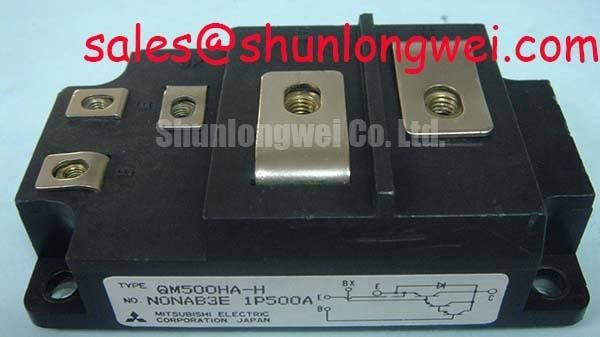
The Mitsubishi QM500HA-H is a high-power Darlington transistor module designed to meet the rigorous thermal demands of heavy industrial switching. Key specifications include 600V | 500A | Rth(j-c) 0.07°C/W. The module provides two primary engineering advantages: exceptional thermal dissipation and robust electrical isolation. It effectively resolves the challenge of high-current power switching in industrial inverters by keeping junction temperatures well within safe limits. For 600V class high-current motor control systems requiring 500A continuous current and low thermal resistance, the QM500HA-H is the optimal choice.
Key Parameter Overview
Decoding the Specs for Enhanced Thermal Reliability
| Category | Parameter | Symbol | Rated Value / Conditions | Unit |
|---|---|---|---|---|
| Absolute Maximum Ratings | Collector-Emitter Voltage (VEB = 2V) | VCEX | 600 | V |
| Collector Current (DC) | IC | 500 | A | |
| Collector Dissipation (Tc = 25°C) | PC | 1780 | W | |
| Base Current (DC) | IB | 10 | A | |
| Isolation Voltage (AC, 1 minute) | Viso | 2500 | V | |
| Electrical Characteristics | Collector-Emitter Saturation Voltage | VCE(sat) | 2.5 (Max at IC = 500A, IB = 0.67A) | V |
| Base-Emitter Saturation Voltage | VBE(sat) | 3.5 (Max at IC = 500A, IB = 0.67A) | V | |
| DC Current Gain | hFE | 750 (Min at IC = 500A, VCE = 2.5V) | - | |
| Diode Forward Voltage | VEC | 1.8 (Typical at -IC = 500A) | V | |
| Typical Switching Times | ton / ts / tf | 3.0 / 10.0 / 3.5 (at IC = 500A) | µs | |
| Thermal Resistance | Thermal Resistance (Junction to Case, Transistor) | Rth(j-c)Q | 0.07 (Max) | °C/W |
| Thermal Resistance (Junction to Case, Diode) | Rth(j-c)R | 0.25 (Max) | °C/W | |
| Contact Thermal Resistance (Case to Fin) | Rth(c-f) | 0.04 (Max, grease applied) | °C/W |
Download the QM500HA-H datasheet for detailed specifications and performance curves.
Application Scenarios & Value
Ensuring Heavy-Duty Performance in AC Motor Control and UPS Systems
Engineers designing high-power industrial equipment frequently encounter thermal bottlenecks. In applications like large-scale AC motor controllers and high-capacity UPS systems, transient surge currents during startup or load shedding generate rapid thermal spikes. In a typical heavy machinery startup, a motor may draw a massive inrush current, causing the junction temperature of switching elements to soar. If the module cannot dissipate this heat quickly, thermal fatigue sets in, leading to catastrophic failure. The QM500HA-H addresses this problem directly with its exceptionally low junction-to-case thermal resistance of 0.07°C/W, which guarantees that heat is rapidly conducted away from the silicon die to the heatsink. This low thermal impedance is key to preventing thermal runaway during prolonged high-load operation.
For systems that utilize high-current power stages, proper layout and protection are vital. Integrating this module alongside a well-calculated snubber circuit minimizes voltage spikes caused by stray circuit inductance, keeping the operating trajectory well within the module's defined Safe Operating Area. Furthermore, when selecting components for diverse power platforms, matching the exact current rating is critical. While the QM500HA-H is optimized for systems requiring up to 500A of continuous current, for applications with lower power requirements, the related QM300HA-H offers a collector current rating of 300A. For engineers seeking to compare Darlington switching architectures with modern topologies, our engineer's guide to power modules provides an in-depth transition roadmap.
Technical Deep Dive
Understanding the Darlington Configuration and Thermal Resistance Paths
The internal architecture of the QM500HA-H consists of a multi-stage NPN Darlington configuration with an integrated free-wheel diode. This integration provides a unique set of electrical characteristics that dictate system-level efficiency and driver requirements. To successfully implement this module, design engineers must focus on two critical parameters: the DC current gain (hFE) and the junction-to-case thermal resistance (Rth(j-c)).
First, the DC current gain (hFE) is rated at a minimum of 750 under a full load of 500A. In engineering terms, hFE acts like a force multiplier or a mechanical lever. Just as a long lever allows a technician to lift a heavy weight with minimal physical effort, the gain of 750 allows a small drive current of just 0.67A at the base to control a massive 500A flow through the collector. This high gain simplifies the base drive design, reducing the power rating and physical size of the control circuitry compared to discrete transistors.
Second, managing the thermal energy generated during high-current conduction is the chief constraint of any power system. The QM500HA-H features a maximum Rth(j-c)Q of 0.07°C/W for the transistor section. Think of thermal resistance as a thermal bottleneck or traffic congestion. A high thermal resistance acts like a narrow, congested single-lane bridge, backing up heat inside the silicon die. Conversely, a low thermal resistance of 0.07°C/W functions like a wide, multi-lane superhighway, allowing heat to flow out of the silicon junction almost instantaneously. When combined with proper thermal management and heatsink design, this low resistance ensures that the junction temperature remains far below the absolute limit of 150°C, preventing premature semiconductor degradation.
FAQ
Addressing Core Engineering Queries on Darlington Module Integration
What is the primary benefit of the low thermal resistance of the QM500HA-H?
It minimizes junction-to-case temperature rise under heavy loads.
What is the isolation rating of the QM500HA-H base plate?
It provides 2500V AC isolation for safe chassis mounting.
For technical inquiries regarding bulk procurement, heatsink compatibility, or to request a quote, please contact our technical sales team directly.