




Content last revised on September 10, 2026
RM50TC-2H | 1000V 50A Darlington Module for Reliable Power Control
An Engineering-Focused Analysis of the Mitsubishi RM50TC-2H Transistor Module
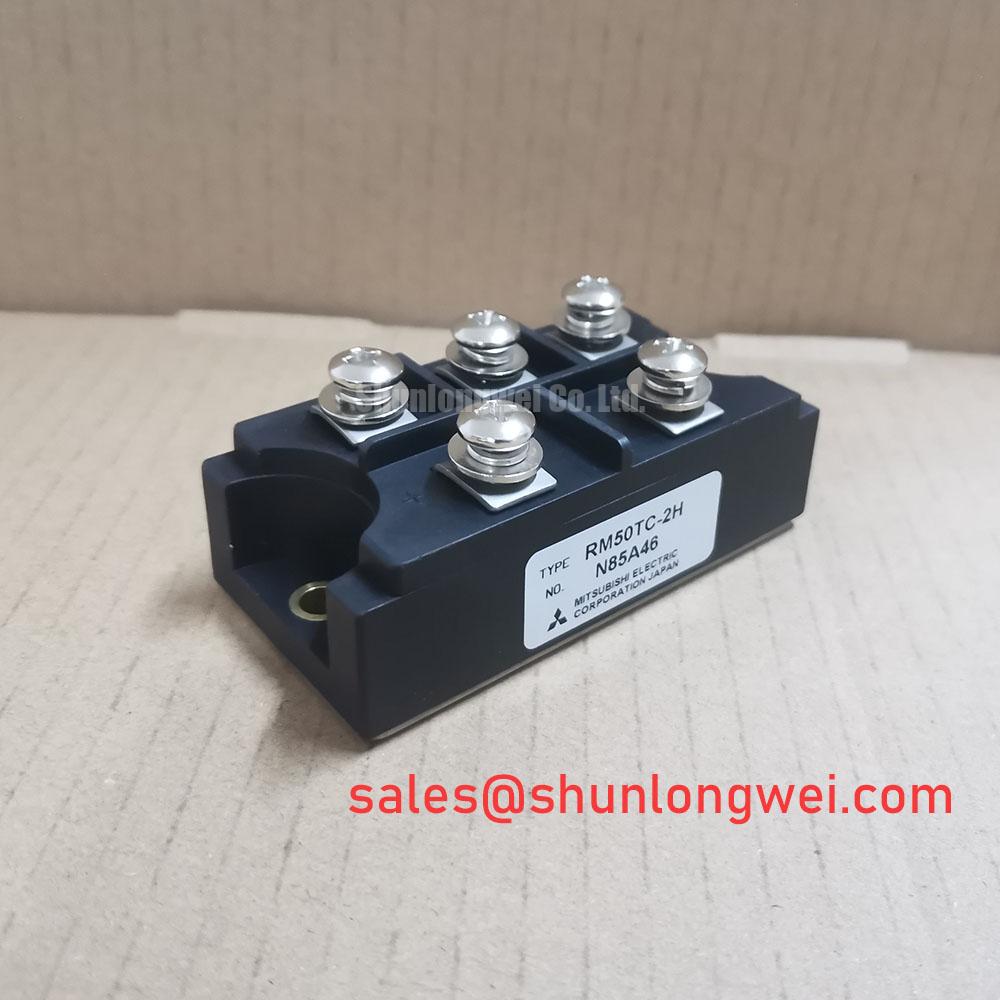
Engineered for durability in demanding industrial environments, the Mitsubishi RM50TC-2H is a half-bridge Darlington transistor module that delivers robust power switching performance. It integrates key protective features and a high-isolation design to simplify system assembly and enhance long-term operational reliability. With core specifications of 1000V | 50A | hFE of 75 (typ), this module provides significant advantages, including simplified thermal management and inherent protection against inductive loads. It directly addresses the need for a cost-effective and dependable switching solution in high-voltage DC applications. For industrial motor controls where straightforward design and operational stability are paramount, the RM50TC-2H's high-isolation and integrated component topology offer a distinct engineering advantage.
Key Parameter Overview
Decoding Electrical and Thermal Specs for Robust Design
The technical specifications of the RM50TC-2H are foundational to its performance in industrial power systems. The parameters below have been selected to provide engineers with the critical data needed for thermal modeling, drive circuit design, and reliability assessment.
| Parameter | Symbol | Conditions | Rating | Unit | Engineering Value |
|---|---|---|---|---|---|
| Collector-Emitter Voltage | V_CEO | - | 1000 | V | Provides a substantial safety margin for high voltage DC bus applications, protecting against transient overvoltage events common in industrial settings. |
| Collector Current (DC) | I_C | - | 50 | A | Enables control of medium-power loads, suitable for a wide range of motor drives and power converters. |
| DC Current Gain | hFE | I_C=50A, V_CE=5V | 75 (Typ) | - | The high gain of the Darlington pair significantly reduces the base current required for switching, simplifying the gate drive circuit design and lowering its power consumption. |
| Collector-Emitter Saturation Voltage | V_CE(sat) | I_C=50A, I_B=0.5A | 2.5 | V | A key factor in calculating conduction losses. This value is critical for accurate thermal design and heatsink selection. |
| Diode Forward Voltage | V_EC | -I_C=50A | 2.5 | V | Defines the voltage drop and subsequent power loss across the integrated freewheeling diodes during operation. |
| Thermal Resistance (Junction to Case, Transistor) | Rth(j-c)Q | Per 1/2 Module | 0.28 | °C/W | Represents the efficiency of heat transfer from the active transistor to the module base. A lower value indicates superior thermal performance, allowing for smaller heatsinks or higher power density. |
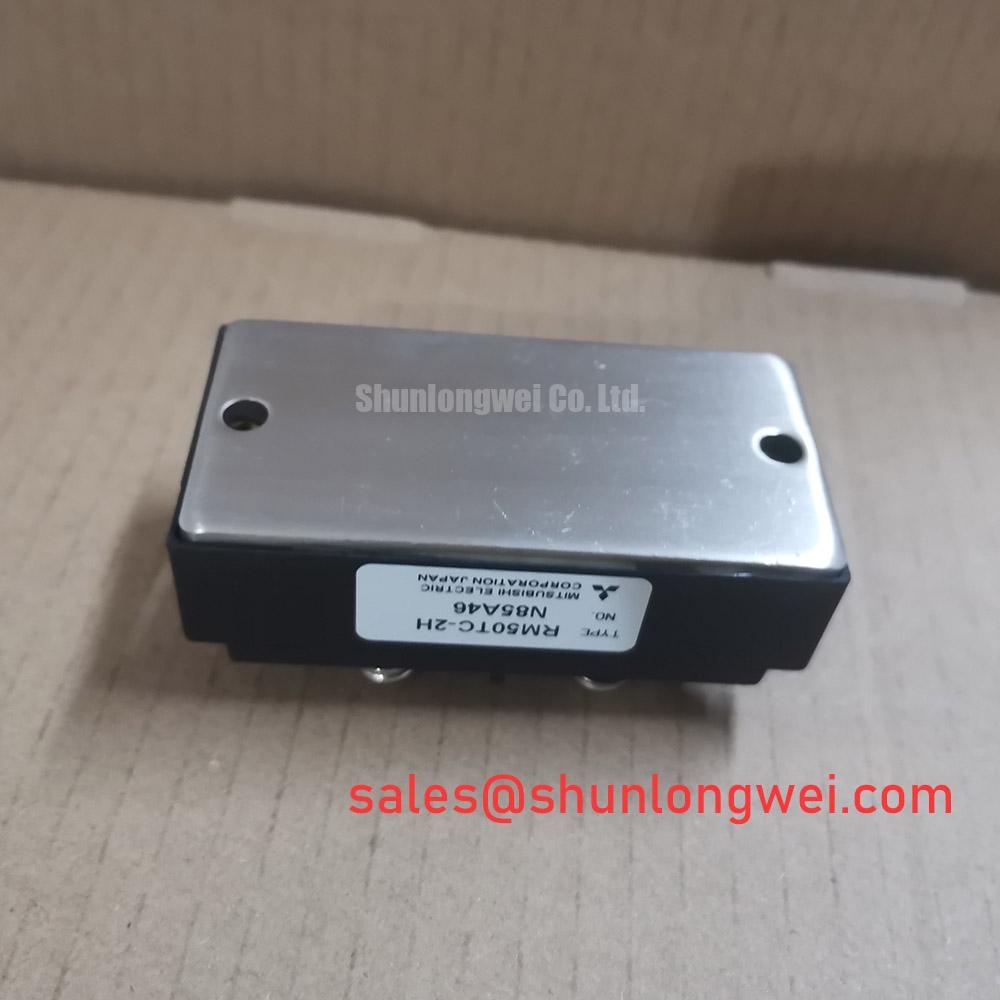
| Isolation Voltage | Viso | AC, 1 minute | 2500 | V | What is the primary benefit of its high isolation voltage? It allows direct mounting to a grounded heatsink without extra insulating layers, improving thermal transfer and simplifying mechanical assembly. |
Download the RM50TC-2H datasheet for detailed specifications and performance curves.
Application Scenarios & Value
System-Level Benefits in Industrial Motor Drives and Power Supplies
The RM50TC-2H is best suited for applications where reliability and design simplicity are primary engineering goals. Its integrated nature provides tangible benefits in systems that manage inductive loads, such as DC motor controllers and specific topologies of Switch-Mode Power Supplies (SMPS).
Consider the challenge of designing a controller for a medium-sized DC motor. When the motor's power is cut, the collapsing magnetic field generates a significant voltage spike (inductive kickback), which can destroy the switching transistor. The RM50TC-2H mitigates this risk directly by incorporating anti-parallel freewheeling diodes. These diodes provide a safe path for the inductive current to circulate, protecting the Darlington transistors. This built-in protection eliminates the need for external high-power diodes, reducing component count, simplifying the PCB layout, and removing a potential point of failure. The module’s architecture is fundamentally aligned with the demands of Variable Frequency Drive (VFD) and other inductive load switching systems.
Furthermore, the 2500V isolated base is a critical feature for system integrators. It allows multiple modules to be mounted on a single, common heatsink without the need for fragile and thermally inefficient mica or silicone insulators. This approach not only improves the overall thermal efficiency of the system but also streamlines the manufacturing process, contributing to a lower total cost of ownership. While the RM50TC-2H is rated for 50A, for systems requiring higher current handling, the related QM100DY-2H offers a collector current of 100A within a similar functional package.
Frequently Asked Questions (FAQ)
What is the main advantage of using a Darlington transistor module like the RM50TC-2H over a standard BJT?
The primary advantage is its high DC current gain (hFE). The Darlington configuration, which uses two transistors cascaded together, allows a very small base current to control a much larger collector current. This simplifies the driver circuitry, making it less complex and lower power than what would be required for a single BJT of similar power rating.
How does the 2500V isolation voltage (Viso) impact the mechanical and thermal design of a power system?
The high isolation voltage allows the module's metallic baseplate to be mounted directly onto a grounded chassis or heatsink. This eliminates the need for separate, thermally resistive insulating pads and complex mounting hardware. The direct contact enhances heat transfer, leading to better thermal performance and improved long-term reliability.
Are the integrated diodes in the RM50TC-2H suitable for all inductive load applications?
The built-in freewheeling diodes are designed to handle the reverse recovery characteristics typical of medium-frequency motor drive and SMPS applications. For systems with extremely high switching frequencies or specialized requirements, engineers should consult the datasheet's reverse recovery time (trr) curves to ensure compatibility and prevent excessive switching losses.
Can the RM50TC-2H be used in a three-phase inverter?
Yes, three RM50TC-2H modules can be configured to create a standard three-phase inverter bridge. Each module provides one leg (a high-side and low-side switch) of the inverter. This modular approach is common in the construction of three-phase servo drives and general-purpose motor controllers.
What does the 'UL Recognized' status indicated in the datasheet mean for my design?
UL Recognition (under file E80276) signifies that the component has been evaluated by Underwriters Laboratories and meets their standards for safety when used within a larger piece of equipment. Using UL Recognized components like the RM50TC-2H can streamline the process of obtaining final UL certification for the end product, which is often a requirement for industrial equipment sold in North America.
Industry Insights & Strategic Advantage
Strategic Value in Proven, Cost-Effective Power Topologies
In an era dominated by advancements in high-frequency IGBT and SiC technologies, the continued relevance of the Darlington transistor module lies in its targeted application value. The RM50TC-2H from Mitsubishi represents a design philosophy centered on ruggedness, simplicity, and cost-effectiveness. For a significant segment of the industrial market—including applications like conveyor systems, pumps, and basic power converters—the switching speeds offered by the latest technologies are unnecessary and can introduce complexity in EMI management and gate drive design.
What is the strategic value of this proven technology? It offers a reliable, no-frills solution that minimizes design risk and development time. The 1000V collector-emitter rating provides a robust safety buffer, acting as a crucial defense against the unpredictable voltage spikes often present on industrial power lines. This high voltage headroom is not merely a specification; it is an investment in the equipment's operational longevity. For engineers developing systems where uptime and service life are more critical than achieving the highest possible efficiency or switching frequency, the RM50TC-2H provides a proven and economically sound building block.
An Engineer-to-Engineer Perspective
For power electronics systems where operational robustness and straightforward implementation outweigh the need for ultra-high switching frequencies, the RM50TC-2H remains a highly practical choice. Its integrated, high-isolation design addresses core challenges in thermal management and assembly, while its electrical characteristics are well-matched for the rigors of industrial motor control and power conversion. This module is a testament to the principle that the optimal component is not always the newest, but the one that most effectively and reliably meets the specific demands of the application.

