

Content last revised on September 10, 2026
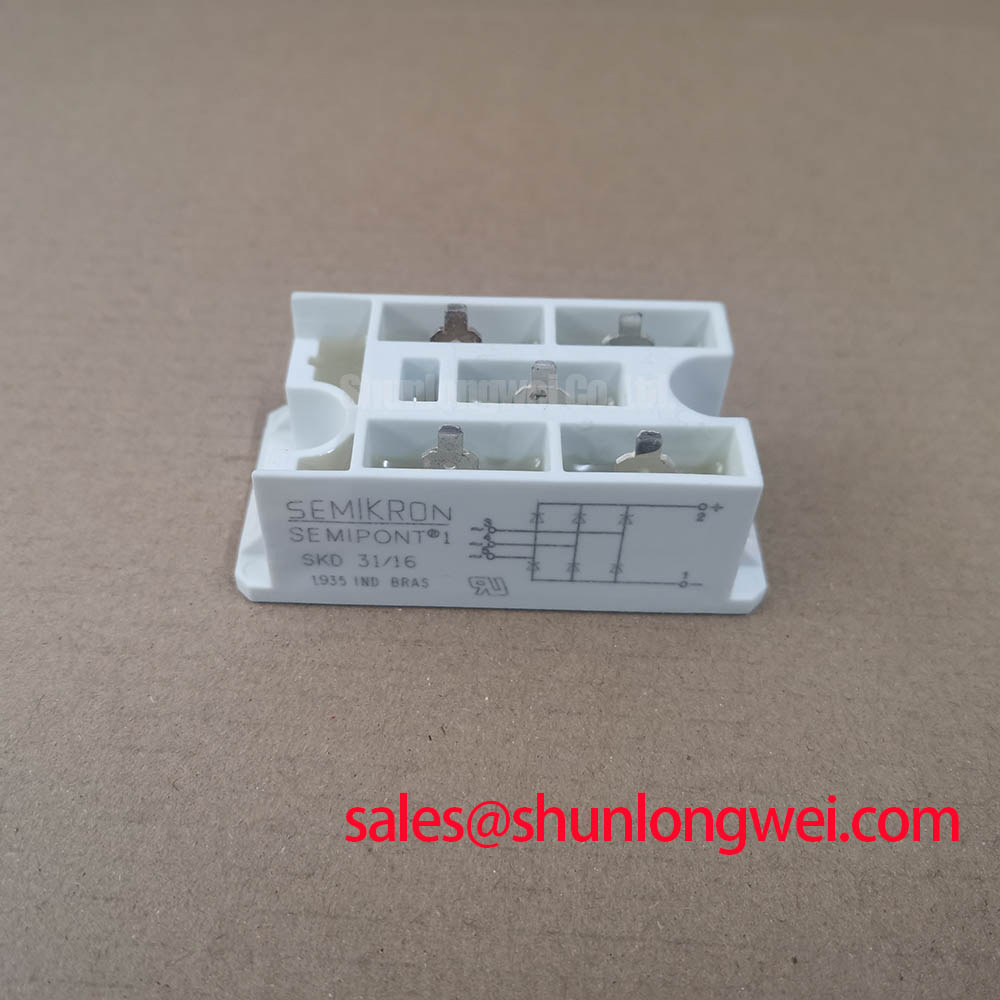
SKD31/16 | Semikron 1600V, 35A Three-Phase Rectifier Bridge Module for Industrial Drives
An Engineering-Focused Overview of the SEMIPONT® 2 Rectifier Module
The Semikron SKD31/16 offers exceptional thermal reliability and simplified assembly for industrial power supplies and motor drives. This three-phase uncontrolled bridge rectifier is engineered to provide a robust front-end solution, featuring specifications of 1600V | 35A (Tc=100°C) | Rth(j-c) 1.3 K/W. Key engineering benefits include streamlined heatsink mounting due to its isolated baseplate and resilient operation in high-voltage industrial environments. The module's design directly addresses the need for efficient thermal management by eliminating the requirement for separate insulating materials, simplifying the bill of materials and assembly process. What is the key advantage of its integrated isolation? It enables direct mounting to a common heatsink, improving thermal transfer and reducing assembly complexity. For cost-sensitive 480V AC motor drives requiring reliable DC bus generation, the SKD31/16's integrated isolation provides a distinct design advantage.
Application Scenarios & Value
System-Level Benefits in Industrial Motor Drive Front-Ends
The Semikron SKD31/16 is fundamentally designed for the input stage of power conversion systems, particularly in demanding industrial settings. Its primary application is as the main rectifier in the front-end of Variable Frequency Drives (VFDs), soft starters, and regulated DC power supplies. In a typical VFD operating on a 480V (+10%) industrial line, engineers face the challenge of designing for voltage transients while ensuring efficient thermal dissipation to maximize uptime. The SKD31/16's 1600V repetitive peak reverse voltage (VRRM) provides a substantial safety margin against such line disturbances, enhancing the overall resilience of the drive. The module's most significant value lies in its physical design. The integrated isolated metal baseplate allows engineers to mount the rectifier directly onto a chassis or a shared heatsink with other power components without needing additional, thermally-inefficient insulating pads. This not only simplifies the mechanical design but also creates a more effective and predictable thermal path, contributing to a stable DC bus voltage under various load conditions.
While the SKD31/16 is well-suited for applications up to 35A, systems demanding higher current capacity can utilize the SKD62/16, which is housed in the same SEMIPONT® package. For systems based on 200/240V lines, the SKB60/12 offers a similar architecture with a 1200V rating.
Key Parameter Overview
Decoding the Specs for Thermal Reliability and Electrical Robustness
The performance of the SKD31/16 is defined by key electrical and thermal parameters that directly influence its suitability and reliability in a given design. The following specifications are critical for engineering evaluation.
| Parameter | Value | Engineering Implication |
|---|---|---|
| Repetitive Peak Reverse Voltage (V_RRM) | 1600 V | Provides essential safety margin for operation on 400V, 480V, and even some 600V AC lines, protecting against common industrial voltage spikes. |
| DC Output Current (I_d) | 35 A (at T_c = 100 °C) | Defines the continuous current handling capability under specific thermal conditions, critical for right-sizing the device for the target load. |
| Forward Voltage (V_F) | max. 1.25 V (at T_j = 25 °C, I_F = 35 A) | A low forward voltage drop directly translates to lower conduction losses, which means less heat is generated during operation. |
| Thermal Resistance, Junction to Case (R_th(j-c)) | 1.3 K/W (per diode) | Indicates highly efficient heat transfer from the silicon die to the module case, enabling cooler operation and enhanced long-term reliability. |
| Isolation Voltage (V_isol) | 3000 V~ | Guarantees high electrical isolation between the active terminals and the mounting baseplate, ensuring system safety. |
The 1600V V_RRM rating acts as a crucial safety buffer. For an engineer, this is analogous to having tires rated for high speeds on a standard passenger vehicle; it provides robust protection against unpredictable real-world conditions. Secondly, the thermal resistance (Rth) of 1.3 K/W is a direct measure of how effectively heat can escape the active semiconductor. A low value like this is like a wide, unobstructed pipeline for heat, ensuring the device operates at a lower, safer temperature, which is the cornerstone of long-term component life.
Download the SKD31/16 datasheet for detailed specifications and performance curves.
Frequently Asked Questions
Engineering Inquiries on the SKD31/16 Module
How does the isolated baseplate on the SKD31/16 benefit the manufacturing process?
The isolated baseplate simplifies the assembly process significantly. It eliminates the need for separate thermal interface materials like silicone pads or mica sheets, along with their associated mounting hardware. This reduces the bill of materials (BOM), shortens assembly time, and removes a potential point of failure, leading to a more streamlined and cost-effective manufacturing flow.
What is the significance of the 1600V V_RRM rating for a rectifier intended for 480V AC systems?
A standard 480V AC line has a peak voltage of approximately 679V. However, industrial power lines are prone to transient overvoltages from motor switching and other inductive loads. The 1600V rating provides more than double the nominal peak voltage as a safety margin. This design choice by Semikron ensures high reliability and prevents rectifier failure due to common voltage surge events, making it a robust choice for industrial environments.
Does the single-screw mounting system of the SEMIPONT® 2 package provide sufficient pressure for optimal thermal contact?
Yes, the SEMIPONT® 2 housing is specifically engineered for this purpose. The single-screw fixing mechanism is designed to apply uniform pressure across the module's baseplate when tightened to the specified torque. This ensures a low-void connection to the heatsink, which is critical for achieving the low thermal resistance specified in the datasheet and ensuring efficient, long-term heat dissipation.
Application Vignette
Designing a Resilient Power Front-End for a Conveyor System Soft Starter
Consider the challenge of designing a power stage for a soft starter controlling a 20 HP conveyor system motor. The operating environment is a busy manufacturing facility with a 480V AC supply, which is subject to voltage fluctuations from other heavy machinery. The primary design goals are high reliability to prevent costly downtime and a compact, cost-effective build.
The SKD31/16 module is an ideal solution for this scenario. The high 1600V breakdown voltage provides the necessary resilience against line transients, a frequent occurrence in this type of setting. However, the key design advantage is realized in the thermal and mechanical integration. The engineer can mount the SKD31/16 directly onto the soft starter's aluminum enclosure chassis, using the chassis itself as a heatsink. This design choice, enabled by the module's 3000V isolation, completely eliminates the cost and space of a separate, insulated heatsink assembly. During motor inrush current events, the module's low thermal resistance (Rth(j-c)) ensures the heat generated is efficiently transferred to the chassis, keeping the diode junction temperatures well within their safe operating area. This strategy results in a smaller final product, a reduced bill of materials, and a simplified manufacturing process, directly contributing to a lower total cost of ownership while enhancing the robustness of the power electronics at the heart of the plant's motor control systems.
The design choices embodied in the SKD31/16—high voltage headroom, integrated electrical isolation, and simplified mounting—represent a strategic approach to power system design. By focusing on features that reduce system-level complexity and enhance thermal reliability, this module enables engineers to build more robust and economically efficient industrial power solutions that deliver value over the entire operational lifespan of the equipment.