Content last revised on September 16, 2026
Field Diagnostics & Commissioning: Saturable Reactor and Snubber Sizing to Protect SKKH 57/12E Topologies
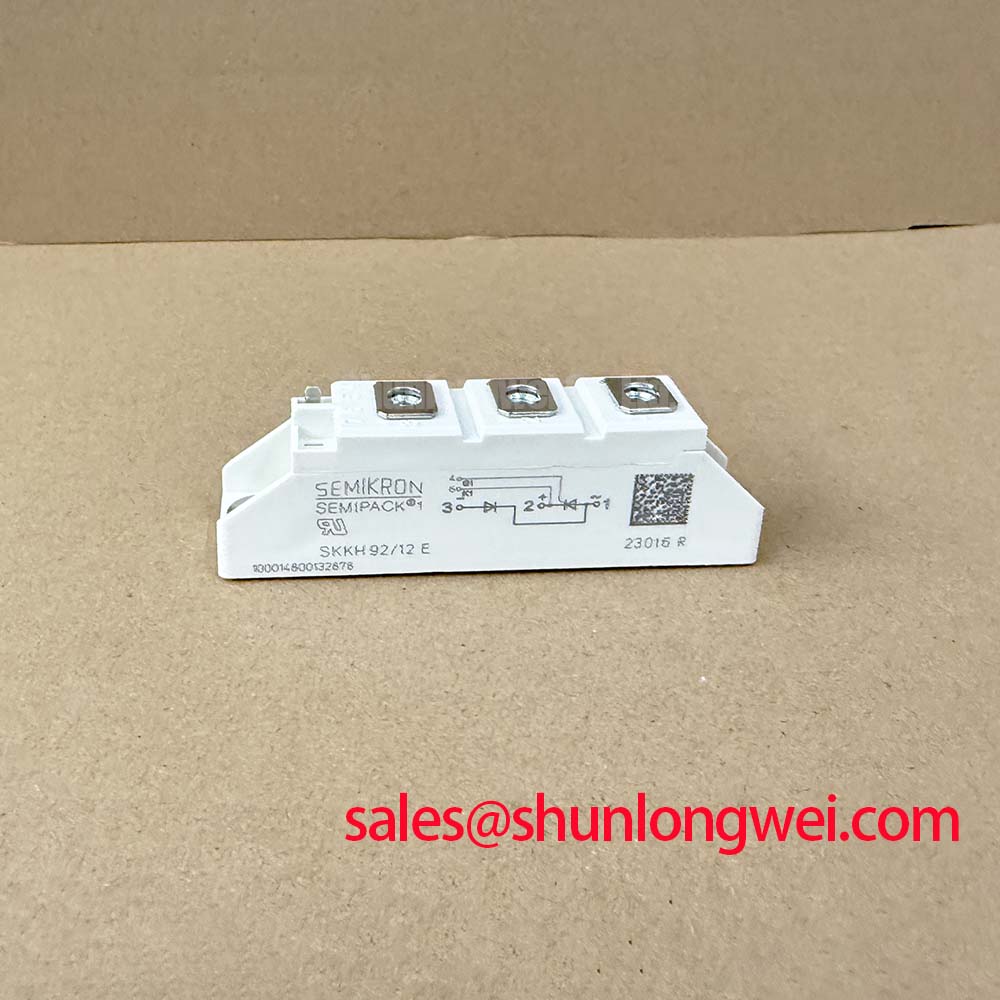
With the soft starter isolated and discharged, verify the nameplate boundary of SKKH 57/12E before reconnecting phase conductors, snubber parts, or gate wiring. This Semikron thyristor module is officially rated at VRRM 1200V, IT(AV) 57A at TC 85°C, and ITSM 1150A for 10ms at 25°C. These ratings provide the electrical reference points for evaluating a repair in 480V class industrial motor control equipment, subject to the complete system voltage, cooling, and protection design.
| Official specification | Value | Engineering relevance |
|---|---|---|
| Repetitive peak reverse voltage, VRRM | 1200V | Defines the repetitive blocking-voltage rating. |
| Mean on-state current, IT(AV) | 57A at TC 85°C | Reference for continuous current capability with controlled case temperature. |
| Surge on-state current, ITSM | 1150A, 10ms, 25°C | Reference for non-repetitive half-cycle current stress. |
| Junction-to-case thermal resistance | 0.35 K/W | Official thyristor thermal path rating. |
| Isolation voltage, Visol | 3000V AC | Module isolation rating to be assessed within the finished assembly. |
Before commissioning, inspect the power path from the incoming phases through the line protection, reactor, thyristor positions, and motor terminals. Check that every cable lug is fully seated, that no conductor strand bridges adjacent terminals, and that the installed circuit follows the equipment schematic. Cold resistance checks can help identify an obvious line-to-line short, but they do not establish thyristor triggering behavior or dynamic blocking performance.
For a three-phase motor solid-state soft starter, RC snubbers and series saturable reactors are Design Considerations, not factory-specified accessories of the SKKH 57/12E. Their function is to manage transient voltage rate and current rise where cable inductance, transformer impedance, contactor switching, and motor conditions can stress the thyristor path. The snubber resistor and capacitor must be selected from measured waveform behavior and the original controller design. A reactor should likewise be evaluated against the actual fault energy, phase current, and firing sequence rather than chosen from a generic parts list.
Coordinate semiconductor fuse selection using the fuse manufacturer’s time-current and I²t documentation together with the protected assembly’s available fault current. The 1150A 10ms surge rating is an official non-repetitive capability reference; it is not a substitute for correctly coordinated fault protection. For physical installation, follow the equipment manufacturer’s terminal and heatsink hardware instructions, because bolt size, washer stack, conductor geometry, and specified torque cannot be inferred solely from this module number.
⚡ Safety Interlock Note: De-energize, lock out, and verify the DC and AC energy stores are discharged before loosening any power terminal or control connection.
SKKH 57/12E Circuit Protection & Reliability: Calibrating Mechanical Torque Shock Elimination in Soft Starter Control
Phase-angle control can reduce the abrupt torque transfer associated with direct-on-line motor starting, but the resulting current profile depends on motor characteristics, load inertia, supply strength, and the controller’s firing strategy. Designers should validate the start ramp with current and voltage measurements at the actual equipment terminals. A target such as limiting locked-rotor current is system-determined; it cannot be assigned from the SKKH 57/12E current rating alone.
The official 57A mean on-state rating at a case temperature of 85°C must be read alongside the installed heatsink and airflow condition. The module’s 0.35 K/W junction-to-case thermal resistance describes the thyristor thermal route to the case, while the thermal interface material, heatsink flatness, clamping method, and enclosure temperature remain assembly-level variables. Apply thermal interface material as a controlled, uniform film according to the thermal material supplier’s guidance, then verify temperature behavior under the actual duty cycle.
Where multiple controlled current paths are used in parallel, equal static resistance alone does not prove equal dynamic current sharing. Symmetrical conductor routing, similar thermal conditions, matched trigger timing, and oscilloscope verification are Design Considerations. If the existing starter architecture requires a different current class or topology, SKKT273/12E can be reviewed as a separate Semikron module option against the original circuit requirements, thermal design, and protection coordination.
Benchtop Waveform Tuning: Mitigating Stress via Coordination of Primary Spark Gaps, MOVs, and SKKH 57/12E
Connect differential voltage probes and current measurement equipment at defined test points before altering MOV, spark-gap, or snubber components. A visible surge event or repeated unexplained fuse operation can arise from several interacting causes, including supply disturbances, wiring inductance, switching sequence, or degraded protection parts. Compare measured waveforms with the known-good circuit behavior and the controller documentation rather than attributing a fault to one component without evidence.
MOV and primary surge-arresting stages are Design Considerations for limiting externally introduced transient energy before it reaches the thyristor junctions. Their clamping behavior, energy capability, location, and coordination with RC networks must be validated at the equipment level. IEC 61000-4-5 is commonly used as a system surge-immunity test reference; a power module alone should not be represented as independently compliant with the complete equipment standard.
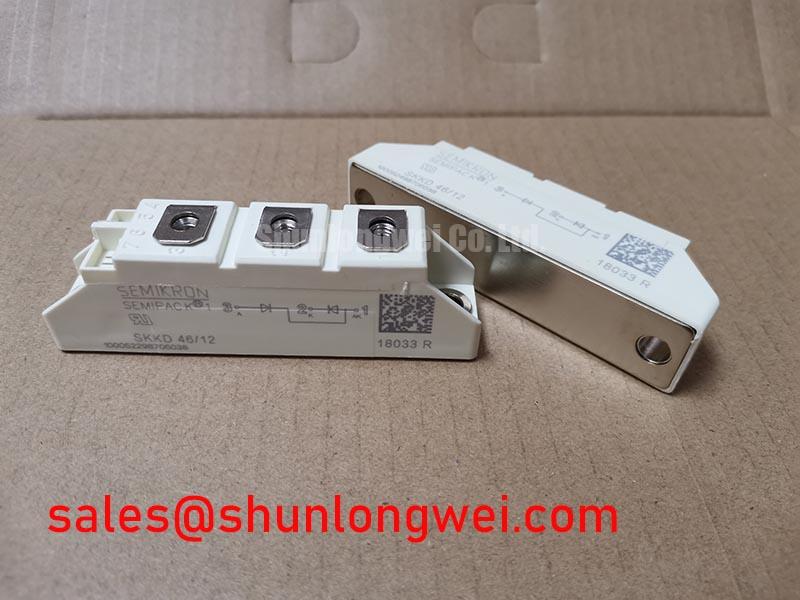
For rectifier or complementary power-stage review, the SKKD162/12 is a related diode module that should be assessed by its own official ratings and circuit role. Background on module product families can be checked through Semikron SEMIPACK® Thyristor / Diode Modules and Semikron CAL Diode Technology when reviewing semiconductor technology context.
Preventing Spurious Faults: Evaluating Post-Surge Reverse Voltage Blocking Guidelines for SKKH 57/12E
After a surge, abnormal start attempt, or line-side fault, inspect the protection network before applying reverse voltage again. Confirm that MOVs have no visible cracking or displacement, that snubber connections remain secure, and that phase conductors preserve the required clearance and creepage distances established by the equipment design. The module’s official 3000V AC isolation voltage is a component rating; final insulation safety depends on the enclosure, busbar arrangement, contamination level, mounting surfaces, and assembled spacing.
The 1150A, 10ms ITSM specification should be treated as a controlled reference for one sinusoidal half-cycle event at 25°C. Before restarting, technicians should examine the fault record, assess whether upstream protection cleared correctly, inspect heatsink contact, and verify that no repeated transient condition remains. Repetitive surge exposure, prior junction temperature, and current sharing conditions are not defined by this single rating.
Maintain short, symmetrical high-current paths where the circuit layout permits, because reduced parasitic inductance can help suppress switching-related overshoot. 💡 Pro Tip: Validate peak voltage and current margins with instrumented tests after any change to busbar routing, surge protection, or snubber components. For broader industrial-drive stress evaluation practices, see Unlocking Efficiency in Industrial Drives.