
Content last revised on October 13, 2026
Preventing Spurious Faults: Critical Rate of Rise of Off-State Voltage Guidelines for SKKH57-16E
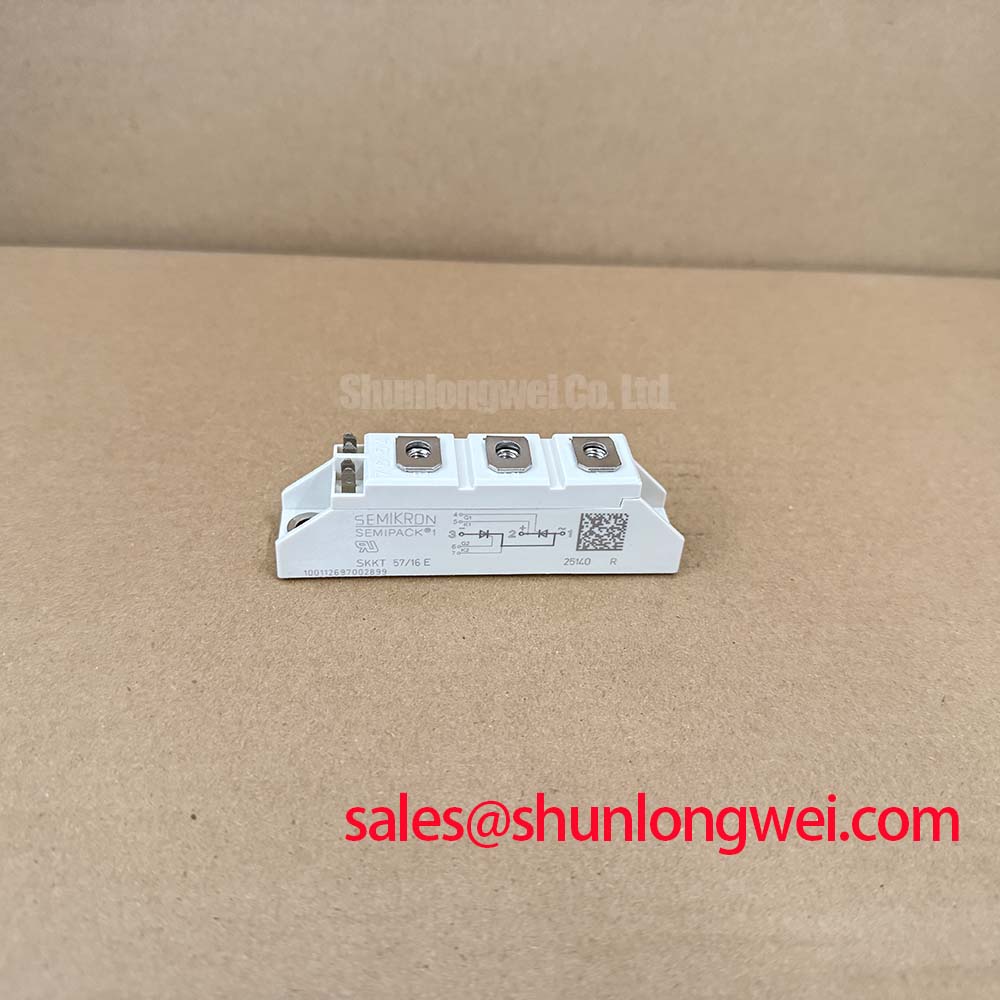
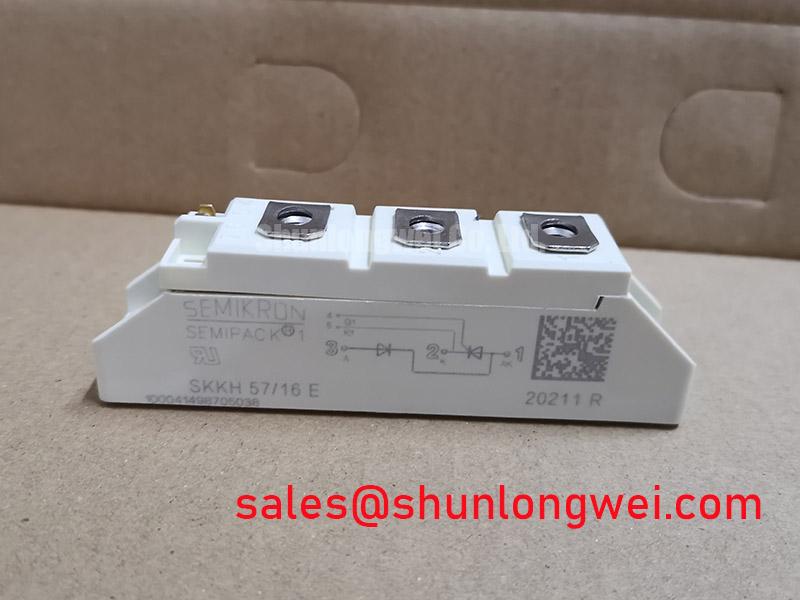
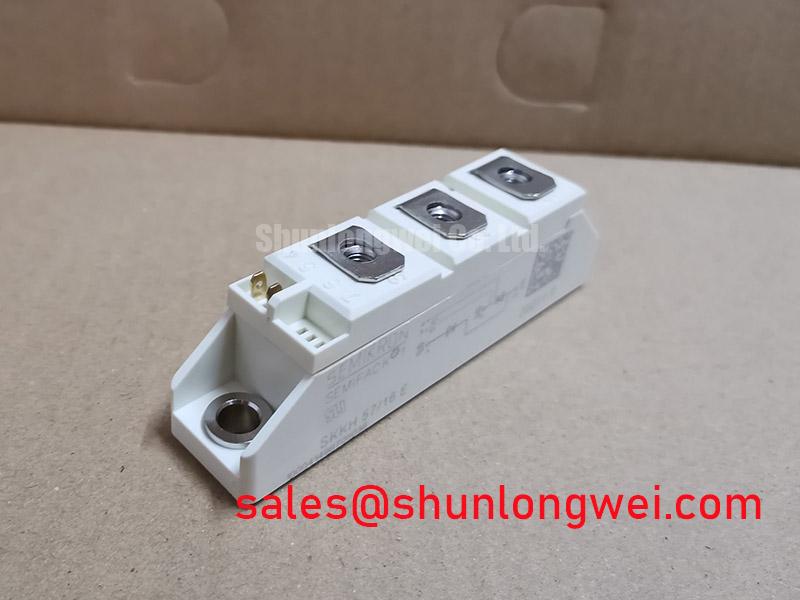
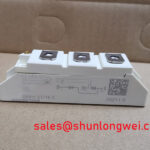
With the power circuit isolated and stored energy discharged, trace the SKKH57-16E power terminals and gate return against the equipment schematic before investigating intermittent firing. A displaced gate return, deteriorated terminal joint, or damaged snubber can produce similar symptoms, so retain the original wiring references before removing the module. This Semikron thyristor/diode module requires thyristor-specific triggering and protection analysis, rather than an IGBT gate-drive checklist.
For maintenance planning, establish a baseline of terminal temperature, heatsink cleanliness, and firing-waveform behavior under documented operating conditions. Subsequent inspections are more useful when compared with that baseline than when judged from cabinet temperature alone.
Capture the voltage across the blocking thyristor and the gate-to-cathode waveform during the operating transition associated with the fault. As a Design Consideration, excessive off-state voltage rise can initiate unwanted conduction without an intended gate command. Correlating both waveforms helps distinguish a blocking-voltage disturbance from interference entering the firing circuit; neither observation alone identifies the defective part.
Inspect the existing RC snubber for damaged connections, resistor deterioration, and capacitor condition before changing its values. Snubber resistance and capacitance should be evaluated against the actual commutation waveform, repetitive dissipation, and the thyristor’s specified critical voltage-rise limit. If the original circuit includes a series saturable reactor, inspect its connections and evaluate its current-limiting behavior during turn-on. Adding or resizing one requires system-level verification rather than a generic component prescription.
The manufacturer’s SEMIPACK thyristor and diode module information provides the relevant product-family context. Use the exact device datasheet for terminal identification, mounting torque, and electrical limits; family-level information does not establish those values for every module.
As an Engineering Recommendation, coordinate the semiconductor fuse using its total clearing I²t and the module’s permissible I²t under compatible waveform and temperature conditions. An ampere-rating match alone does not establish protection coordination. Record the installed fuse reference and terminal-tightening requirements alongside the equipment schematic so maintenance substitutions remain traceable.
Transient Dynamics & Electrical Design: High-di/dt Gate Firing: Pulse-Train Timing on SKKH57-16E
Measure firing current at the module’s gate circuit rather than judging pulse quality solely at the controller output. As a Design Consideration, gate-loop inductance and return-path coupling can alter pulse rise, introduce ringing, or reduce the effective trigger delivered to the thyristor. Keep the outgoing and return paths closely associated, and evaluate damping against measured waveforms and driver capability.
Gate-pulse amplitude, rise time, duration, and repetition should follow the device’s trigger requirements and the load’s current buildup. A pulse train can support triggering across a changing conduction opportunity, but it does not remove the need to reach latching current. Holding current describes continued conduction after triggering; it is not a substitute specification for the gate pulse’s back porch. Thyristor turn-off also differs fundamentally from IGBT desaturation detection and commanded soft shutdown.
When assessing a high-voltage three-phase motor solid-state soft starter, designers should verify the complete phase-leg arrangement, blocking requirements, firing isolation, and thermal duty. The comparison below separates product categories from values that require manufacturer-document confirmation before electrical acceptance.
| Selection item | SKKH57-16E | SKKD101-16 |
|---|---|---|
| Device category | Thyristor/diode module | Diode module; not a gate-controlled equivalent |
| Voltage | Consult exact datasheet | Consult datasheet |
| Current | Consult exact datasheet | Consult datasheet |
| Package | SEMIPACK; verify mechanical drawing | Verify mechanical drawing |
| Acceptance checks | Trigger requirements, circuit configuration, thermal conditions | Rectifier configuration, terminal arrangement, thermal conditions |
The SKKD101-16 is therefore a comparison reference, not a drop-in replacement recommendation. For a separate rectifier stage sharing the supply architecture, the SKKD380 discussion addresses a different circuit role; its ratings cannot be transferred to the controlled module.
SKKH57-16E Circuit Protection & Reliability: Minimizing Commutation Turn-Off Voltage Stress
Examine reverse-recovery current and the accompanying voltage overshoot at the actual commutation transition. As a Design Consideration, recovery behavior depends on operating current, temperature, and the external circuit. Evaluate reverse-recovery peak current and recovery time under comparable test conditions rather than treating either as an unconditional switching-loss indicator.
Semikron’s CAL diode technology information offers diode-technology context, but does not establish that technology inside this particular module. Likewise, Wide Bandgap Revolution provides broader switching context, not replacement approval or SKKH57-16E-specific recovery data.
Maintenance Note: Trend terminal temperature and check airflow regularly, with the equipment safely isolated before cleaning or tightening connections.
Set thermal-interface inspection intervals from operating history and the equipment maintenance plan, checking disturbed assemblies for uneven seating or degraded interface material. Where temperature cycling creates condensation risk, inspect terminal surfaces and insulating barriers for moisture and contamination before restarting. Preserve the original creepage and clearance geometry, and investigate changes in waveform or temperature against the recorded baseline before returning the assembly to service.