Content last revised on August 28, 2026
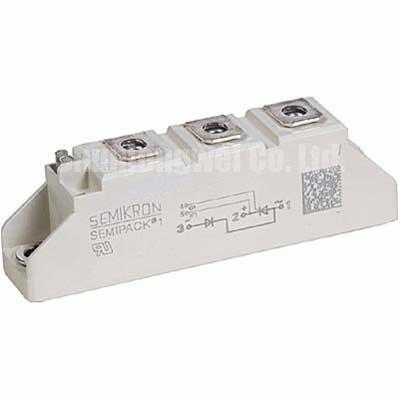
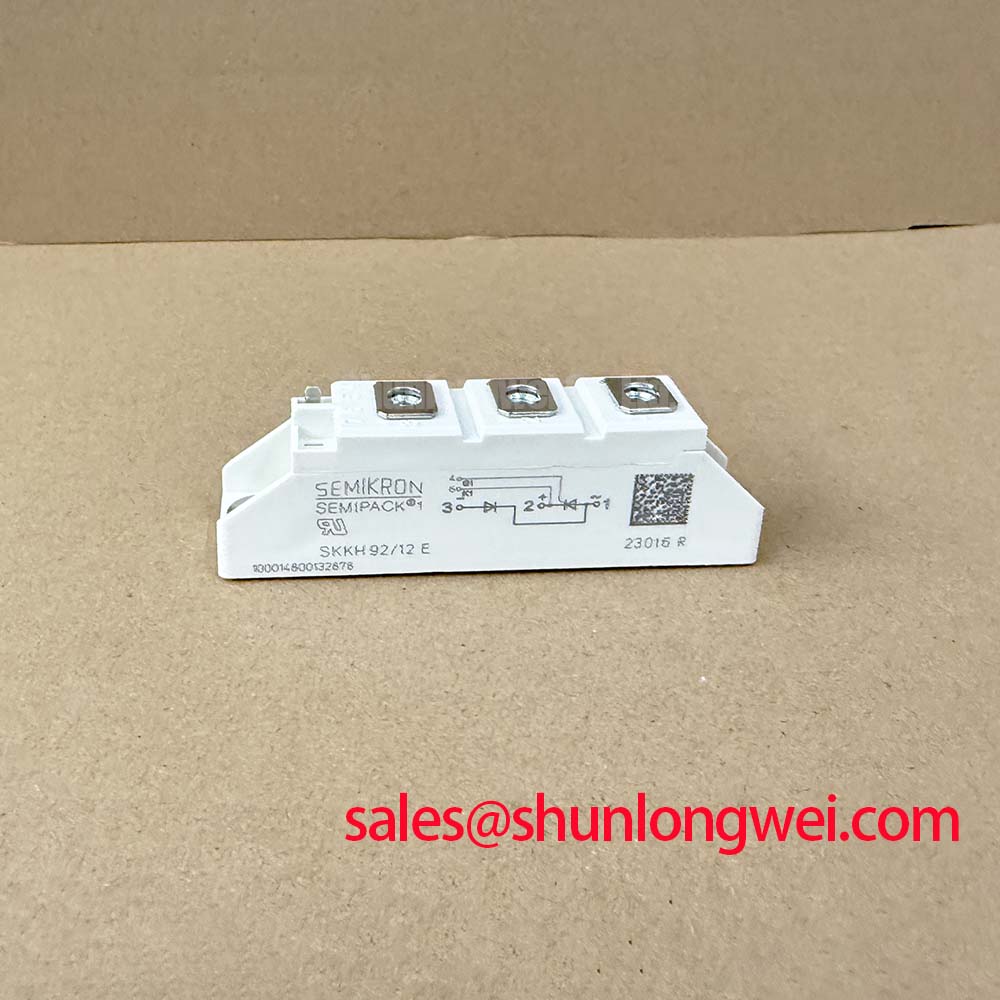
Semikron SKKT92/12E SEMIPACK 1 Thyristor Module
How does the mechanical design of a phase-control SCR module prevent catastrophic failure under continuous thermal cycling? By employing hard-soldered joints and an alumina ceramic isolated metal baseplate, the Semikron SKKT92/12E dual-SCR module mitigates internal mechanical stress. This package architecture ensures outstanding durability in phase-controlled configurations.
What is the primary benefit of the hard-soldered design? It prevents micro-cracking and contact degradation under high thermal stress. How does the ceramic metal baseplate improve operation? It delivers 3000V electrical isolation and accelerates heat dissipation to the heatsink. The SKKT92/12E features a 1200V rating, a 95A average on-state current, and a low junction-to-case thermal resistance of 0.28 °C/W. For phase-controlled industrial drives prioritizing thermal margins, the 1200V SKKT92/12E is the optimal thyristor module choice.
Frequently Asked Questions
Solving Core Engineering Challenges of Semipack Thyristor Modules
How do hard-soldered joints in the SKKT92/12E improve reliability compared to standard solder processes?
Hard soldering uses high-temperature bonding that resists delamination. This structure prevents void formation and interface degradation, ensuring stable performance during repetitive temperature fluctuations.
Why is the 0.28 °C/W thermal resistance rating critical for enclosed industrial drives?
The low thermal resistance minimizes the temperature delta between the silicon junction and the heatsink. This efficiency keeps junction temperatures well below the 125°C threshold in high-ambient enclosures.
What is the engineering impact of the 15,000 A2s surge current rating on circuit protection?
The high I2t rating ensures the module can absorb short-duration fault currents. This allows safety engineers to coordinate semiconductor fuses without risking destructive failure of the SCR during overload events.
Key Parameter Overview
Decoding the Specs for Enhanced Thermal Reliability
| Specification Parameter | Value / Condition |
|---|---|
| Repetitive Peak Off-State / Reverse Voltage (VDRM / VRRM) | 1200 V |
| Average On-State Current (IT(AV)) | 95 A (at Tcase = 85 °C) |
| RMS On-State Current (ITRMS) | 150 A |
| Surge On-State Current (ITSM) | 1750 A (at Tvj = 125 °C, 10 ms) |
| Max. Surge Integration Capacity (I2t) | 15,000 A2s (at Tvj = 125 °C, 10 ms) |
| Thermal Resistance, Junction to Case (Rth(j-c)) | 0.28 °C/W (per thyristor, continuous) |
| Isolation Voltage (Visol) | 3000 V AC (1 min) / 3600 V AC (1 s) |
Download the SKKT92/12E datasheet for detailed specifications and performance curves.
Technical & Design Deep Dive
A Closer Look at the Hard-Soldered Joints and Ceramic Baseplate Isolation
At the center of the SKKT92/12E performance is the integration of an alumina oxide (Al2O3) ceramic isolated metal baseplate. This structure serves a vital role by separating high-voltage electrical paths from the external thermal management system. While the module conducts high currents, the ceramic substrate provides 3000V AC of isolation safety. The hard-soldered joints form a mechanically stable bond that prevents the silicon die from shearing or forming thermal voids when subjected to cyclic loading.
To understand the utility of the parameters, two engineering concepts must be considered. First, think of the thermal resistance Rth(j-c) as the electrical resistance in a circuit; a lower resistance allows current to flow freely. Similarly, a low thermal resistance of 0.28 °C/W acts like a wide thermal highway, allowing heat to escape from the silicon junction to the heatsink with minimal bottleneck. This prevents hotspot accumulation.
Second, the I2t rating of 15,000 A2s is the module's thermal shield. Just as a crumple zone in a vehicle absorbs crash energy to protect occupants, this rating represents the silicon's capacity to absorb electrical energy spikes during short circuits without fracturing. This gives the protection fuses enough time to isolate the circuit safely.
Application Scenarios & Value
Achieving System-Level Benefits in Industrial Power Control
Engineers designing AC motor soft starters often face intense starting currents that strain power semiconductors. During a typical motor startup, the inrush current can spike up to six times the nominal rating. The SKKT92/12E manages these transients via its robust surge current capability of 1750A, protecting the system without oversized components. It excels in applications demanding precise phase control, including heating control for industrial ovens and speed regulation for industrial drives. The hard-soldered joints ensure the module maintains its integrity despite continuous temperature cycling.
While the 95A capacity of this module fits medium-power configurations, designers requiring lower current levels can evaluate the SKKT57B12E, while high-demand applications may necessitate the SKKT162/12E. Designing stable converters requires careful attention to thermal management and gate drive topologies. Optimizing the thermal envelope is heavily dependent on understanding thermal resistance and Rth(j-c) values. Using high-quality components from reputable manufacturers like Semikron ensures that thermal calculations align with real-world behavior.
Integrating modules with robust thermal cycling capabilities is a strategic decision that pays off in reduced field maintenance and longer machine lifespans. As industrial automation demands higher reliability under severe duty cycles, specifying components with high isolation ratings and low thermal drift becomes central to future-proofing infrastructure investments.