Content last revised on September 15, 2026
SKKT92/16E Electrical Verification Before Installation
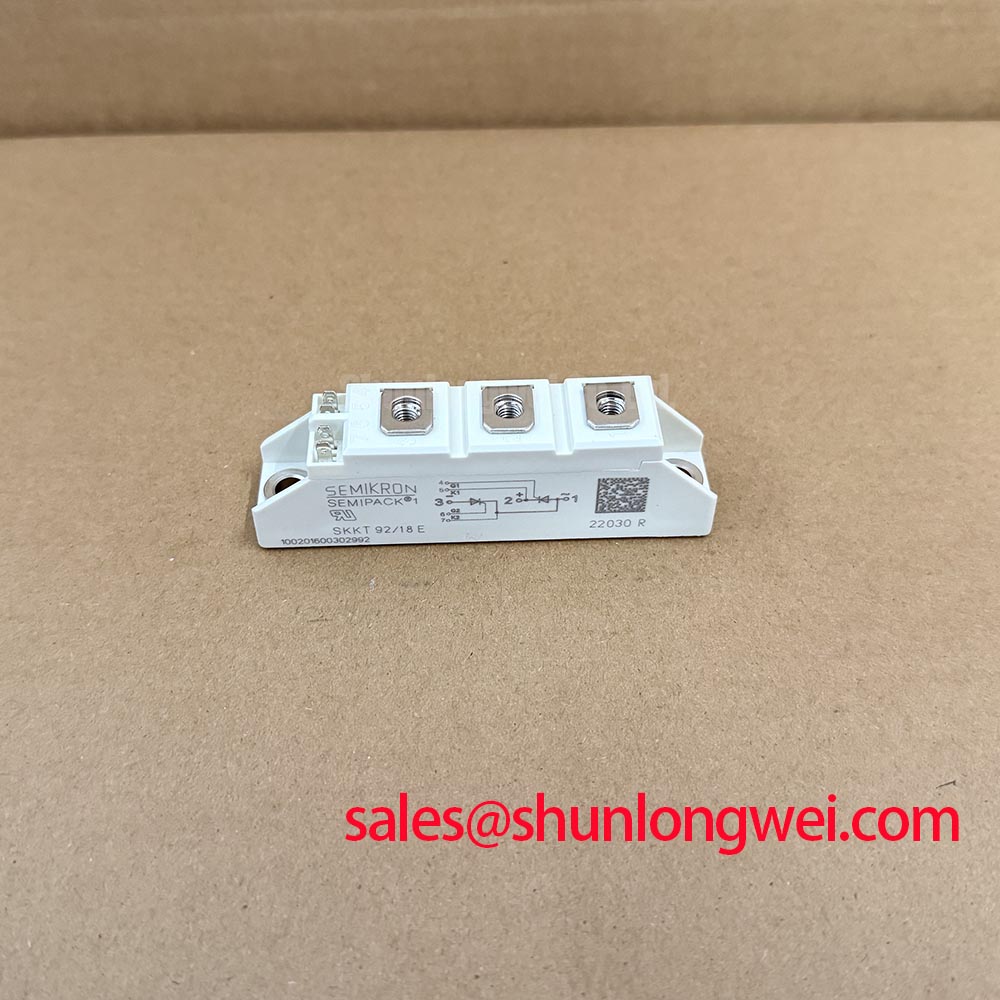
Begin the service check by isolating the power stage, inspecting the module body and terminals, and comparing the marked electrical boundaries with the original furnace schematic before reconnecting any conductor. The Semikron SKKT92/16E is a dual-thyristor module specified for high voltage AC power conversion and controlled rectifier applications.
| Parameter | Official Specification |
|---|---|
| Repetitive peak reverse and off state voltage | VRRM / VDRM: 1600 V |
| Average on state current | IT(AV): 95 A at Tcase = 85°C |
| On state RMS current | ITRMS: 150 A |
| Surge on state current | ITSM: 1750 A at Tvj = 125°C |
| Maximum I2t value | 15,000 A²s at Tvj = 125°C |
| Critical off state voltage rise | dv/dt: 1000 V/µs |
| Thermal resistance | Rth(j-c): 0.28°C/W per thyristor and 0.14°C/W per module |
| Isolation voltage | Visol: 3000 V AC at 50 Hz for 1 minute |
These are official specification values supplied for this product page. They do not establish complete system compliance, surge immunity, or a permissible operating point for every induction heating design. When evaluating a medium frequency induction melting or metal hardening power supply, the system engineer should verify the actual current waveform, case temperature, commutation conditions, and terminal arrangement against the equipment documentation.
Transient Dynamics and Electrical Design for Industrial Surge Conditions
For an AC input stage exposed to industrial switching disturbances, treat IEC 61000-4-5 as a system level test reference rather than as a certification claim for the module. A design consideration is to place the surge protection, input fusing, and any RC suppression network according to the converter topology and measured transient path. The SKKT92/16E provides a stated 1600 V VRRM and VDRM rating, while the permitted repetitive voltage in the complete assembly remains dependent on overshoot, source impedance, commutation, and thermal conditions.
The module’s 1000 V/µs dv/dt specification is relevant when checking unwanted thyristor triggering during fast voltage transitions. Designers should measure the voltage directly at the power terminals during switching tests and verify that the observed waveform remains within the applicable device and system limits. MOV selection, if used, should account for continuous line voltage, temporary overvoltage, clamping behavior, and pulse energy. The supplied product data does not define a specific MOV part number or RC snubber value.
Terminal connections should follow the original equipment drawing and the markings on the replacement device. Keep high current paths short and mechanically supported, while maintaining the required insulation spacing for the working voltage and contamination environment. The Semikron SEMIPACK® Thyristor / Diode Modules reference provides useful manufacturer family context, but the SKKT92/16E application must still be checked against its own documented ratings.
SKKT92/16E Circuit Protection and Snubber Coordination
The stated I2t value of 15,000 A²s at Tvj = 125°C is a device withstand reference for coordination work; it is not a replacement for a complete fuse selection table. A semiconductor fuse must be evaluated by comparing its clearing I2t, prospective fault current, let through energy, and interruption behavior with the protected circuit. The installer should obtain the original protection schedule or calculate the coordination using the fuse manufacturer’s data before energizing the assembly.
Series impedance, including a saturable reactor where the equipment topology requires one, should be evaluated with the measured current rise and the module’s terminal waveform. The engineering objective is to limit excessive current concentration and suppress unwanted triggering without preventing the thyristor from reaching the intended conduction state. RC snubber values are system determined because stray inductance, transformer leakage, line impedance, firing control, and operating frequency all affect the required damping. Verify the result with differential voltage probes and current measurement rather than assuming a generic network is suitable.
The module’s isolation specification is 3000 V AC at 50 Hz for 1 minute. This value should not be treated as a complete clearance, creepage, enclosure, or pollution degree design rule. After service work, inspect the insulation barriers, terminal hardware, and heat sink interface for contamination and moisture before applying the rated supply.
Benchtop Waveform Tuning with the Non Repetitive Surge Rating
The 1750 A ITSM rating is specified for the stated junction temperature condition and should be interpreted as a non repetitive surge characteristic, not as an allowable repeating operating current. During a bench test, capture the first half cycle of a controlled current event and compare it with the protection response, case temperature trend, and the timing of reverse voltage reapplication. The 95 A average current rating is specified at Tcase = 85°C, so cooling performance must be verified under the actual duty cycle rather than inferred from ambient temperature alone.
For a furnace power controller, waveform review should include firing symmetry, current sharing between phases, commutation disturbance, and voltage overshoot at the module terminals. Any unexpected ringing may indicate an interaction between wiring inductance, snubber impedance, transformer characteristics, or the firing circuit. Confirm the known good signal path with an oscilloscope and use isolated measurement equipment suitable for the test voltage.
⚠️ Maintenance Note: Clean the heat sink and air path during scheduled service, then check for aged thermal interface material and monitor contact temperature under the normal furnace load.
For a related current path or equipment comparison, engineers may also review SKKT273/12E as a separate Semikron module reference; compatibility must be established from voltage, current, mechanical, and circuit requirements rather than model numbering alone.
Operational Boundaries for Reverse Recovery and EMI Evaluation
The supplied SKKT92/16E data identifies the product as a dual-thyristor module but does not provide numerical thyristor recovery parameters such as circuit-commutated turn-off time or reverse recovery characteristics. Those values should be obtained from the applicable manufacturer documentation or measured under representative current, junction temperature, and commutation conditions. Do not infer recovery parameters from the 1600 V blocking rating or the 150 A RMS current rating.
When the module is used in an induction heating converter, designers should inspect recovery current, voltage rebound, gate timing, and common mode noise as one switching event. Minimize parasitic commutation loops and verify peak voltage margins at the actual DC link and operating frequency. The manufacturer’s Semikron CAL Diode Technology information can provide broader power semiconductor technology context, but it does not substitute for the SKKT92/16E device data.
For service teams reviewing semiconductor switching behavior and practical test methods, The Ultimate IGBT Knowledge Base offers additional general reference material. In a final equipment check, confirm terminal identity, fuse coordination, isolation condition, cooling contact, and measured transient behavior before returning the furnace power stage to production service.