
Content last revised on March 9, 2026
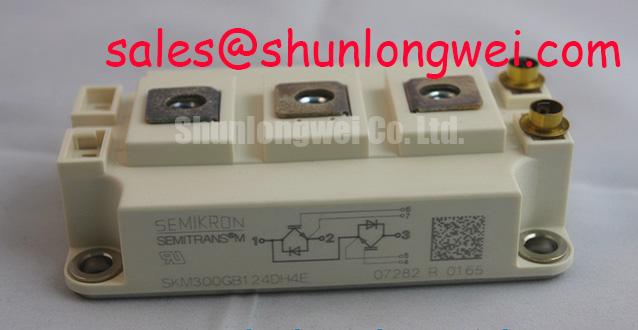
SKM300GB124D Semikron 1200V 300A SEMITRANS 3 IGBT Module
Designing high-frequency industrial motor drives often forces engineers into a technical corner: sacrificing thermal margins to achieve necessary switching speeds. The SKM300GB124D addresses this fundamental conflict by utilizing advanced Trench 4 technology within the proven SEMITRANS 3 package. This module provides a 1200V collector-emitter voltage and a 300A continuous collector current rating (at Tc=80°C), optimized specifically to minimize switching losses without the typical penalty of high conduction voltage. For high-performance motor drives prioritizing thermal stability at frequencies up to 20kHz, the 1200V SKM300GB124D is the optimal choice.
What is the primary benefit of the Trench 4 architecture in this module? It significantly lowers switching losses while maintaining a low Vce(sat) of typical 1.85V. How does the DBC isolation contribute to system reliability? The Direct Bonded Copper technology provides superior heat spreading and a high isolation voltage of 2500V AC, essential for harsh industrial environments.
Frequently Asked Questions
Addressing Design Constraints and Implementation Realities
How does the Trench 4 technology in the SKM300GB124D compare to older NPT structures regarding thermal management?
Unlike traditional Non-Puntch-Through (NPT) designs, the Trench 4 structure used here significantly reduces the cell pitch and increases current density. This results in a lower Vce(sat) and reduced switching energy (Eon/Eoff). In practical engineering terms, this allows for a more compact heatsink design or a higher output current within the same thermal envelope compared to older generations. Understanding why Rth matters is critical when transitioning to these high-density modules.
Is the SKM300GB124D suitable for systems requiring high short-circuit ruggedness?
Yes. This module features a guaranteed short-circuit withstand time (tpsc) of 10 microseconds at Vge=15V and Vcc=800V. This provides a vital safety margin for gate driver protection circuits to detect and shut down the system during a fault, preventing catastrophic failure in Variable Frequency Drive (VFD) applications.
What is the significance of the CAL (Controlled Axial Lifetime) diode integrated into this module?
The CAL diode is a soft-switching freewheeling diode specifically matched to the 4th generation IGBT chip. It minimizes peak reverse recovery current and dv/dt noise. This is particularly important for electromagnetic compatibility (EMC) and reducing stress on motor insulation during rapid switching transitions.
Key Parameter Overview
Decoding the Specs for Enhanced Thermal Reliability
| Technical Specification | Value / Rating | Engineering Significance |
|---|---|---|
| Collector-Emitter Voltage (Vces) | 1200 V | Standard for 400V/480V AC line systems. |
| Continuous DC Collector Current (Ic) | 300 A (@ Tc=80°C) | High power density for SEMITRANS 3 package. |
| Saturation Voltage (Vce(sat)) | 1.85 V (Typical) | Minimizes conduction losses in heavy-duty cycles. |
| Gate-Emitter Threshold Voltage (Vge(th)) | 5.8 V (Typical) | Ensures robust noise immunity against parasitic turn-on. |
| Thermal Resistance Junction-to-Case (Rth(j-c)) | 0.11 K/W (IGBT) | High-efficiency heat transfer via DBC plate. |
Download the SKM300GB124D datasheet for detailed specifications and performance curves.
Technical Deep Dive
A Closer Look at the Trench 4 Architecture and DBC Packaging
The SKM300GB124D represents a strategic shift in power semiconductor design, moving away from the limitations of planar structures. Imagine the IGBT chip as a multi-lane highway; traditional designs required wider lanes that increased the overall footprint and resistance. The Trench 4 architecture effectively stacks these lanes vertically, allowing more current to flow through a smaller surface area. This "verticalization" reduces the VCE(sat) significantly, much like how a modern high-rise building accommodates more residents on the same city block than a single-story warehouse.
Furthermore, the internal construction utilizes Direct Bonded Copper (DBC) isolation on an aluminum oxide ceramic substrate. This serves as the bridge between the high-voltage silicon and the grounded heatsink. The DBC layer acts as a massive thermal reservoir, smoothing out transient temperature spikes during rapid load changes. This is particularly effective for achieving balanced current sharing and long-term reliability in high-cycle applications. For engineers requiring even higher power handling in the same footprint, the SKM400GB124D provides an alternative current rating while maintaining the same mechanical compatibility.
Application Scenarios & Value
Achieving System-Level Benefits in High-Frequency Power Conversion
In a high-fidelity engineering scenario, consider a 55kW industrial air compressor driven by a variable-speed motor. The SKM300GB124D is often the preferred choice here due to the variable nature of the load. During peak compression, the IGBT must handle sustained high currents; during standby or low-demand periods, switching losses at the carrier frequency become the dominant source of heat. The balanced loss profile of this module ensures that the cooling system doesn't need to be over-engineered for the worst-case scenario.
The SKM300GB124D is widely utilized across several key sectors:
- Industrial Motor Drives: Providing the switching backbone for mid-to-high power VFDs where thermal cycling is frequent.
- Uninterruptible Power Supplies (UPS): Ensuring high-efficiency energy conversion in the inverter stage to prolong battery life.
- Renewable Energy Inverters: Managing DC-to-AC conversion in solar string inverters with high reliability.
- Electronic Welding: Handling high-frequency pulse widths required for precision arc control.
For designs that are more space-constrained or require lower current, the SKM200GB124D offers a smaller power profile within the same SEMITRANS family. The integration of UL-recognized (File No. E63532) isolated housing simplifies safety certifications for OEM manufacturers, making it a "plug-and-play" solution for global industrial markets.
As the industry moves toward Industry 4.0 and higher energy efficiency standards, the SKM300GB124D provides a stable, long-lifecycle platform for power electronic designs. By leveraging the soft-switching characteristics of the 4th generation chips, designers can achieve higher system reliability and lower total cost of ownership through reduced thermal stress and simpler EMI filtering requirements.
The strategic value of the SKM300GB124D lies in its ability to deliver high power density without the engineering compromises associated with earlier IGBT generations. Its alignment with modern Gate Drive requirements and Thermal Management standards makes it a cornerstone for resilient industrial power architectures.