

Content last revised on September 10, 2026
SKM200GB124DE SEMITRANS 2 IGBT Module: Engineering for High-Efficiency Power Conversion
An In-Depth Technical Review of the 1200V, 200A Half-Bridge Module
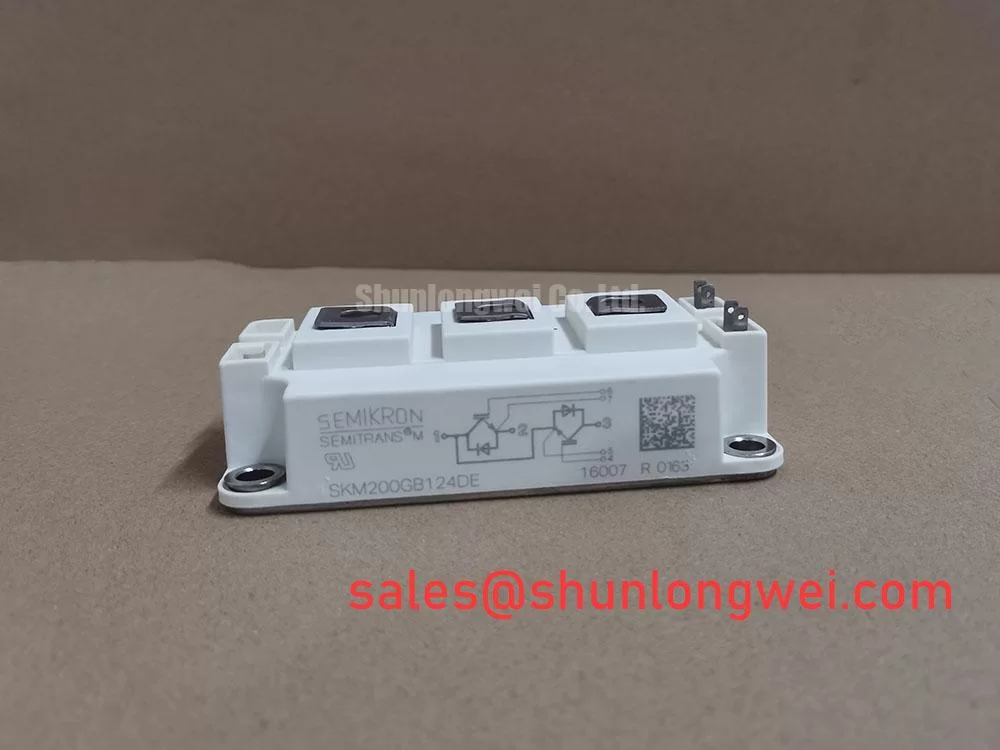
The SKM200GB124DE from Semikron-Danfoss is a high-performance SEMITRANS 2 half-bridge IGBT module engineered to minimize total power losses in demanding, high-frequency switching applications. It integrates advanced Trench Gate IGBTs with fast and soft-recovery CAL (Controlled Axial Lifetime) freewheeling diodes to deliver superior efficiency and reliability. The module's core value lies in its ability to reduce both conduction and switching losses, a critical factor for designers of modern power conversion systems. What defines the SKM200GB124DE's performance? Its Trench IGBTs and fast, soft-recovery CAL freewheeling diodes. For mid-power motor drives and solar inverters targeting high efficiency and power density, the SKM200GB124DE's low total losses make it an optimal design choice.
Application Scenarios & Value
System-Level Benefits in Industrial Drives and Renewable Energy Systems
The SKM200GB124DE is engineered for applications where efficiency, thermal performance, and reliability are paramount. It is a primary choice for the DC/AC inverter stage of systems such as industrial Variable Frequency Drives (VFDs), solar inverters, and Uninterruptible Power Supplies (UPS).
Consider the engineering challenge in a 75 kW industrial motor drive: achieving high efficiency to meet stringent energy standards (e.g., IEC 61800) while managing heat in a compact, cost-sensitive enclosure. The SKM200GB124DE directly addresses this. Its low typical VCE(sat) of 1.95 V (at 200A, 125°C) significantly cuts down on conduction losses during operation. This reduction in waste heat translates directly to smaller, lower-cost heatsinks and improved system power density. Furthermore, its optimized switching characteristics, enabled by the integrated CAL diode, allow for higher Pulse Width Modulation (PWM) frequencies without incurring excessive switching losses, enabling smoother motor control and reduced audible noise. How does the CAL diode improve system design? It reduces switching losses and minimizes electromagnetic interference (EMI).
While this module is well-suited for a broad range of mid-power applications, systems requiring higher current output can consider the related SKM400GB124D, which offers increased current handling within the same SEMITRANS 2 package family.
Key Parameter Overview
A Functionally Grouped Specification Table for Design Engineers
The following parameters are critical for system design and simulation. The data is based on the official manufacturer's documentation, providing a reliable foundation for your engineering evaluation.
| SKM200GB124DE Key Specifications (Tcase = 25 °C unless otherwise noted) | |
|---|---|
| Parameter Group | Value |
| Absolute Maximum Ratings | |
| Collector-Emitter Voltage (VCES) | 1200 V |
| Continuous DC Collector Current (IC) @ TC = 80 °C | 200 A |
| Repetitive Peak Collector Current (ICRM) | 400 A |
| Total Power Dissipation per IGBT (Ptot) | 1250 W |
| Operating Junction Temperature (Tj) | -40 to +150 °C |
| IGBT Characteristics (Tj = 125 °C) | |
| Collector-Emitter Saturation Voltage (VCE(sat)) @ IC = 200 A, VGE = 15 V | 1.95 V (typ.), 2.40 V (max.) |
| Turn-on Energy (Eon) | 22.0 mJ (typ.) |
| Turn-off Energy (Eoff) | 26.0 mJ (typ.) |
| FWD Characteristics (Tj = 125 °C) | |
| Diode Forward Voltage (VF) @ IF = 200 A | 1.90 V (typ.), 2.30 V (max.) |
| Reverse Recovery Energy (Err) | 15.0 mJ (typ.) |
| Thermal and Mechanical Characteristics | |
| Thermal Resistance, Junction-to-Case (Rth(j-c)) per IGBT | 0.12 K/W |
| Thermal Resistance, Junction-to-Case (Rth(j-c)) per Diode | 0.21 K/W |
Technical Deep Dive
The Synergy of Trench IGBTs and CAL Diodes for Loss Reduction
The performance of the SKM200GB124DE is not just a result of individual component quality, but the synergy between its Trench Gate IGBT and the CAL freewheeling diode. The Trench Gate structure creates a vertical current path in the silicon, reducing the on-state resistance and leading to a lower VCE(sat) compared to older planar technologies. Think of VCE(sat) as the "friction" the current encounters; lower friction means less energy wasted as heat.
However, the CAL diode is the key to minimizing switching losses. A standard diode turning off can abruptly stop conducting, causing a large voltage spike and ringing (EMI). The CAL diode is engineered for "soft" recovery. This is analogous to a vehicle with advanced shock absorbers hitting a bump; instead of a harsh, damaging jolt (voltage spike), it provides a firm but controlled response. This soft recovery significantly reduces the turn-on losses in the opposing IGBT and dampens oscillations, which simplifies the design of external snubber circuits and improves the system's overall electromagnetic compatibility (EMC) performance.
Frequently Asked Questions
What is the key benefit of the CAL (Controlled Axial Lifetime) freewheeling diode in the SKM200GB124DE?
The primary benefit of the CAL diode is its fast yet soft reverse recovery characteristic. This reduces diode switching losses (Err) and significantly lowers voltage overshoot during turn-off. For the design engineer, this means lower EMI, reduced stress on the IGBTs, and potentially a simplified snubber circuit design, leading to a more robust and efficient inverter.
How does the positive temperature coefficient of VCE(sat) in the SKM200GB124DE benefit high-power system design?
The positive temperature coefficient means that as the IGBT heats up, its on-state voltage (VCE(sat)) slightly increases. This characteristic is crucial for paralleling multiple modules to achieve higher current output. It ensures automatic current balancing among the modules; if one module starts to carry more current and gets hotter, its increased VCE(sat) naturally diverts current to the cooler modules. This prevents thermal runaway and is a key feature for building reliable, high-power systems, a topic further explored in resources like this guide to achieving balanced current sharing.
Evaluating the SKM200GB124DE for Your Design
To assess the suitability of the SKM200GB124DE for your specific power conversion requirements, or to inquire about its integration into your system, please contact our technical support team. We can provide additional resources and information to support your design and procurement process.