Content last revised on September 10, 2026
SKM40GD125D: A High-Reliability IGBT Module for Industrial Power Systems
Engineering-Grade Insights into the SKM40GD125D
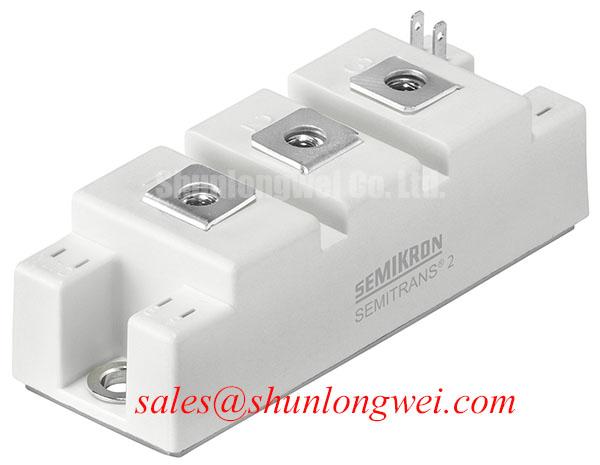
The SKM40GD125D by Semikron is a robust 1200V IGBT module designed to deliver exceptional thermal performance and efficiency in demanding industrial power conversion systems. It integrates two IGBTs in a half-bridge configuration, offering a balanced solution for motor drives, switch-mode power supplies, and uninterruptible power systems. Key specifications include: 1200V | 55A | VCE(sat) of 2.15V. This module provides significant advantages through its low conduction losses and proven thermal stability. It directly addresses the engineering challenge of designing compact, reliable inverters by ensuring efficient heat dissipation and maintaining performance under heavy loads. Best fit for cost-sensitive industrial drives up to 15 kW requiring robust thermal performance and proven reliability.
Key Parameter Overview
Decoding the Specs for Thermal Stability and Efficiency
The technical specifications of the SKM40GD125D are foundational to its performance in high-stress applications. The parameters listed below have been selected to provide engineers with the critical data needed for thermal modeling, efficiency calculations, and gate drive design. The emphasis on low saturation voltage and defined thermal resistance underscores its suitability for systems where reliability and energy efficiency are paramount.
| Parameter | Symbol | Value | Conditions |
|---|---|---|---|
| Collector-Emitter Voltage | Vces | 1200 V | Tj = 25 °C |
| Continuous Collector Current | Ic | 55 A | Tcase = 25 °C |
| Collector Current Pulsed | Icp | 80 A | tp = 1 ms |
| Collector-Emitter Saturation Voltage | VCE(sat) | 2.15 V (typ.) | Ic = 40 A, Tj = 25 °C |
| Gate-Emitter Voltage | Vges | +/- 20 V | |
| Thermal Resistance, Junction-to-Case | Rth(j-c) | 0.5 °C/W | per IGBT |
| Maximum Junction Temperature | Tjmax | 150 °C |
Application Scenarios & Value
Enhancing Power Density in Motor Drives and UPS Systems
The SKM40GD125D is engineered for power conversion topologies where thermal management and operational reliability are critical design drivers. Its primary value is demonstrated in applications such as Variable Frequency Drives (VFDs), Uninterruptible Power Supplies (UPS), and industrial welding equipment. In these systems, engineers constantly face the challenge of dissipating heat effectively to maximize power output without compromising the unit's lifespan.
Consider a 15 kW VFD application. The module's low VCE(sat) of 2.15V directly translates to lower conduction losses during operation. This reduction in wasted energy as heat is crucial; it means a smaller, more cost-effective heatsink can be used, which in turn allows for a more compact overall drive design. This is akin to choosing a more efficient engine for a car—not only does it use less fuel (energy), but it also requires a smaller radiator (heatsink), saving space and weight. The module's robust thermal cycling capability ensures it can withstand the repetitive power fluctuations inherent in motor control without degradation. For systems requiring higher current handling, the related SKM75GD123D offers a similar voltage class with increased amperage.
Frequently Asked Questions
Engineering Considerations for the SKM40GD125D
What is the internal configuration of the SKM40GD125D?
The module features a half-bridge topology, containing two IGBTs connected in series with an antiparallel freewheeling diode for each switch. This configuration is standard for building two-level inverters used in three-phase motor drives and single-phase UPS systems.
How does the Rth(j-c) of 0.5 °C/W impact thermal design?
This thermal resistance value is a direct measure of how efficiently heat can be transferred from the IGBT junction to the module's case. A lower value is better. For designers, this specific value allows for precise calculation of the required heatsink performance to keep the junction temperature below the 150 °C maximum, even under full load conditions. For more information on thermal design, see our guide on mastering IGBT thermal management.
What is the primary benefit of its isolated baseplate?
It simplifies thermal design and enhances electrical safety. The integrated electrical isolation allows the module to be mounted directly onto a grounded heatsink without the need for additional, thermally-inefficient insulating layers. This reduces assembly complexity and improves the overall thermal transfer efficiency of the system.
Technical Deep Dive
Analyzing the Role of the Isolated Baseplate in System Reliability
A key, yet often understated, feature of the SEMITRANS 2 package used for the SKM40GD125D is its isolated copper baseplate. While seemingly a simple mechanical component, it is central to the module's long-term reliability and ease of integration. The baseplate serves as the primary thermal interface between the semiconductor chips and the external heatsink. By using an Al2O3 (Aluminium Oxide) ceramic substrate, the module achieves high dielectric strength, providing robust electrical isolation (typically rated at 2500V or higher).
From an engineering perspective, this integration is critical. It eliminates the need for external insulating pads (like mica or silicone films), which can introduce additional thermal resistance and are prone to damage during assembly. Think of it as having built-in insulation in a house wall versus attaching insulation panels to the outside. The integrated solution is more efficient and less susceptible to installation errors. This design choice by Semikron directly contributes to a more predictable and reliable thermal management system, a cornerstone for any power electronics application designed for a long operational life.
This approach to thermal management is a strategic element in achieving higher power density and system-level cost savings. By ensuring a consistent and efficient thermal path, the SKM40GD125D allows designers to push operational limits with confidence, knowing the foundational thermal design is inherently robust and reliable.