
Content last revised on September 10, 2026
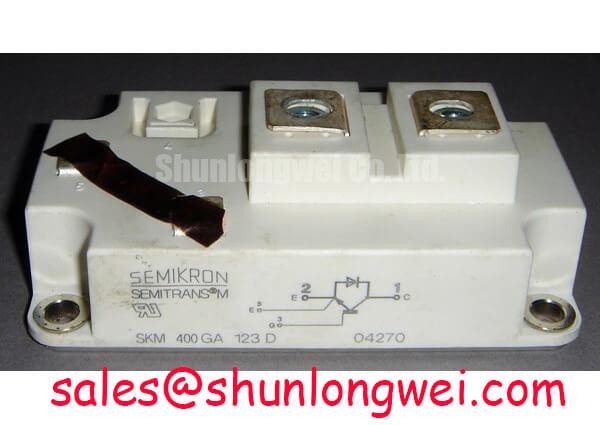
SKM400GA123D Semikron 1200V 400A IGBT Module
Designing high-frequency power converters above 20 kHz often introduces severe thermal management bottlenecks and parasitic turn-on risks. The Semikron SKM400GA123D solves this by providing a low-inductance, temperature-independent single-switch switching path.
- UVP: High-frequency switching ruggedness backed by homogeneous silicon, offering exceptionally stable thermal performance in heavy-duty resonant systems.
- Top Specs: 1200V | 400A | Rth(j-c) 0.045 K/W
- Key Benefits: Low inductance casing; zero latch-up risk.
- Core Question: How does the module control thermal runaways? The homogeneous silicon structure stabilizes tail currents across the operating range, preventing thermal degradation.
- Best Fit: For 600V bus systems requiring high-frequency switching above 20 kHz, this 1200V module is the optimal choice.
Frequently Asked Questions
Addressing Core Design Concerns and Thermal Realities
How does the junction-to-case thermal resistance (Rth(j-c)) of 0.045 K/W impact heatsink design and power density?
This low thermal resistance enables rapid heat extraction from the silicon die. Think of thermal resistance as a highway's traffic throughput: a high thermal resistance is a single-lane bottleneck, whereas this module's 0.045 K/W acts like a wide, multi-lane superhighway, allowing heat to flow out of the silicon chip into the heatsink with minimal congestion. This allows engineers to reduce the heatsink footprint while keeping junction temperatures safely below the 150°C limit.
What is the significance of the homogeneous silicon structure for tail currents in resonant applications?
Unlike standard chips where tail current duration increases at high temperatures, this module's homogeneous structure keeps the tail current extremely short and stable. This prevents cumulative turn-off switching losses from causing thermal runaway at higher switching frequencies.
How does the 10 µs short-circuit withstand time affect gate drive protection layouts?
The high short-circuit capability (self-limiting to 6 times the nominal current) provides a generous 10 µs safety margin. This allows gate drivers to initiate desaturation protection safely without resorting to ultra-fast, noise-sensitive shutdown thresholds.
Why is the CAL diode technology critical for high-frequency welding applications?
The Controlled Axial Lifetime (CAL) inverse diode exhibits soft-recovery characteristics and low peak reverse recovery current. This minimizes electromagnetic interference (EMI) and voltage spikes during rapid current commutation in electronic welding power stages.
Key Parameter Overview
Decoding the Specs for Enhanced Thermal Reliability
| Parameter | Specification Value | Engineering Significance |
|---|---|---|
| Collector-Emitter Voltage (VCES) | 1200V | Ensures robust safety margin in 600V DC bus applications, protecting against transient overvoltage spikes. |
| Continuous Collector Current (IC) | 400A (Tc = 25°C) / 360A (Tc = 80°C) | Defines the continuous current-carrying capacity under typical operating and maximum thermal loads. |
| Thermal Resistance Junction-to-Case (Rth(j-c)) | 0.045 K/W (per IGBT) | Ultra-low barrier allows high power dissipation without exceeding the maximum junction temperature. |
| Isolation Voltage (Visol) | 2500 V AC (RMS, 1 min) | Guarantees electrical isolation between the power circuit and the heatsink baseplate. |
| Gate-Emitter Voltage (VGES) | ±20V | Maximum gate voltage range, offering design flexibility for standard drive levels. |
| Package Style | SEMITRANS 4 | Standardized package with large creepage and clearance distances for heavy-duty industrial integration. |
Download the SKM400GA123D datasheet for detailed specifications and performance curves.
Technical & Design Deep Dive
Optimizing High-Frequency Switching Paths via Low-Inductance Engineering
The internal architecture of the SKM400GA123D, manufactured by Semikron, utilizes a homogeneous silicon N-channel structure. In typical high-power modules, high-frequency switching speeds are limited by the tail current duration. This module solves that limitation by stabilizing the carriers in the drift region, leading to a very low tail current that is virtually independent of operating temperature. This ensures that high-temperature operations do not compromise the turn-off timing, preserving duty-cycle integrity in resonant inverter topologies.
From a layout perspective, parasitic gate trigger events represent a major failure mode in high-current switches. Think of the gate threshold voltage as a physical door spring. If the spring is too weak (a low threshold voltage), a sudden gust of wind—represented by induced Miller currents from high dV/dt transients—can accidentally blow the door open (parasitic turn-on). The SKM400GA123D incorporates a stable threshold voltage of 5.5V typical, acting like a stiff door spring that prevents unintended activation. Engineers designing the gate drive should still implement robust gate drive layout strategies to minimize stray loop inductance and clamp transient spikes.
Additionally, the integration of Controlled Axial Lifetime (CAL) fast-recovery freewheeling diodes addresses the recovery issues common to hard-switching configurations. By controlling carrier lifetimes locally, the diode exhibits a soft reverse-recovery waveform. This reduces electromagnetic emission at its source, making compliance with EMC directives more manageable for system designers.
For quick reference: What is the benefit of the homogeneous silicon structure? It stabilizes tail currents across operating temperatures, reducing high-frequency losses. What is the function of the CAL diode? It provides soft recovery to minimize EMI during fast commutation.
Industry Insights & Strategic Advantage
Addressing the Carbon-Neutral Transition with Rugged Industrial Power Stages
As industries accelerate toward electrification and energy optimization, the reliance on highly efficient switching modules is paramount. The shift toward higher operating frequencies in power electronics is driven by the desire to reduce the physical size of passive components like inductors and transformers. The SKM400GA123D aligns with these global power electronics market trends by providing a medium-voltage, high-current switch that operates reliably up to the high-frequency boundaries without thermal deterioration.
Furthermore, standardizing on a robust platform like the SEMITRANS 4 package reduces total cost of ownership (TCO) by enabling modular retrofits. By ensuring mechanical compatibility and high thermal margin, plant managers can extend the service life of existing equipment, contributing directly to sustainable industrial operations. Choosing components with high short-circuit limits protects capital-intensive equipment from catastrophic failures, reinforcing grid stability and system-level uptime.
Application Scenarios & Value
Field Performance in Resonant Converters and Heavy-Duty Welders
In high-fidelity engineering scenarios, such as designing a high-power induction heating system operating at 30 kHz, thermal dissipation is the chief bottleneck. High-frequency operations compound switching losses, which quickly exceed the thermal capacity of standard modules. Under these demanding conditions, the SKM400GA123D’s low switching energy ratings (Eon and Eoff) and its low thermal resistance of 0.045 K/W keep the silicon temperatures within safe operating limits. This enables designers to use smaller heat exchangers, saving weight and space.
Beyond induction heating, this single-switch configuration is a core building block in high-power UPS (Uninterruptible Power Supply) systems, heavy-duty electronic welders, and large-scale power factor correction (PFC) stages. Its capability to handle continuous collector currents up to 400A makes it highly suitable for multi-kilowatt designs that require high reliability over years of continuous load cycling. For designs with lower current margins, the related SKM300GA123D offers a 300A alternative, while applications demanding higher current scaling can utilize the SKM500GA124D to expand current margins without redesigning the physical layout footprint. This modular compatibility streamlines the engineering evaluation process for diverse system capacities.
Deploying this module in Variable Frequency Drive (VFD) systems or resonant converters guarantees long-term durability, minimizing costly downtime. Procurement managers and hardware engineers can confidently evaluate the module's detailed technical characteristics to meet their design targets.